
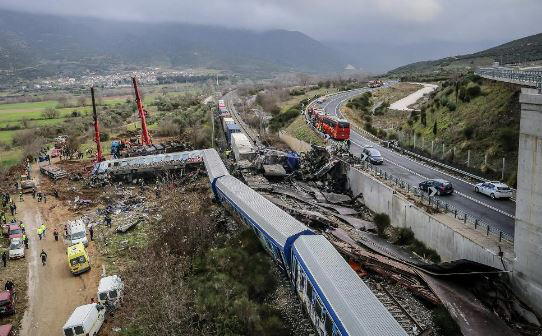
THE death toll from Tuesday’s train crash in Greece has increased to 57, a coroner has told the BBC.
Eleni Zaggelidou, one of the ten coroners working on the investigation, said DNA had been taken from 57 intact bodies.
Meanwhile, a government minister said austerity during Greece’s economic crisis in the 2000s contributed to a lack of investment in the railways.
Rail workers held a one-day strike on Thursday following the disaster, blaming government neglect.
The walkout followed protests in Athens, Thessaloniki and the city of Larissa, near the site of the disaster.
Rescue workers are still going through burned and buckled carriages there, searching for victims.
This was the “most difficult moment”, rescuer Konstantinos Imanimidis told Reuters news agency, because “instead of saving lives, we have to recover bodies”.
The incident happened just before midnight on Tuesday. A passenger train carrying 350 people collided with a freight train after both ended up on the same track – causing the front carriages to burst into flames.
The railway workers’ strike began at 0600 local time (0400 GMT), affecting national rail services and the subway in Athens.
Many in Greece see the crash as an accident waiting to happen, and the union blamed successive governments’ “disrespect” towards Greek railways for leading to this “tragic result”.
During a visit to a hospital where relatives of the missing had gathered, Zoe Rapti, Greece’s Deputy Minister of Health, told the BBC that investing in the rail network had been made more difficult by the Greek debt crisis around 2010, which led to drastic austerity measures in exchange for a financial rescue by the European Union and the International Monetary Fund.
“Of course, things should have been done during these years but, as you remember, Greece faced a big economic crisis for more than 10 years, which means that many things went back,” she said.
Disclaimer
Comments expressed here do not reflect the opinions of Vanguard newspapers or any employee thereof.