
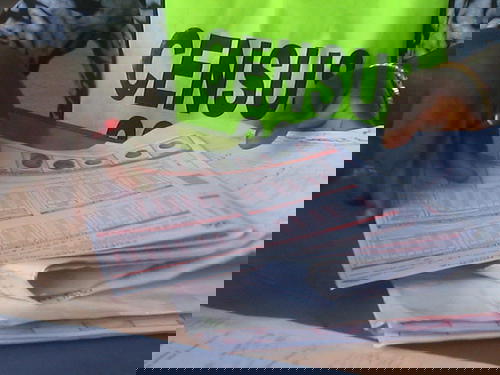
…how we will deal with fictitious enumeration in 2023
By Nnamdi Ojiego
Following the outcome of the National Council of State’s meeting that slated
April 2023 for the conduct of a national census, the Chairman of the National Population Commission, NPC, Alhaji Nasir Isa Kwarra, in this interview, says the commission is well prepared and committed to giving Nigeria an unbiased, technologically driven exercise that will provide timely, accurate and reliable data. He also speaks on the importance of census data and the implications of its absence on the economy; the cause of Nigeria’s high fertility rate and how the country can control population explosion, among other issues. Excerpts:
Why is there no census in Nigeria in the last 16 years?
It is a fact that we have not had a census since 2006, that’s about 16 years since we had the last one. The United Nations recommend that we hold a census every decade, that is, after every ten years. So we have been delayed for about six years now. The reasons for the delay are not far-fetched. You know, what happens in the country also affects the conduct of censuses. The exercise would have been conducted earlier but there was a transition in the leadership of the country in 2015. We had President Muhammadu Buhari come in as our new President after the tenure of Dr. Goodluck Jonathan, and, as a new President, he would have to study the environment before he can commit to conducting a census. So, I cannot speak exactly for President Buhari but I think he needed that time and, owing to the prevailing situation such as the issue of insecurity, the issue of the economy, and the advent of COVID-19 in 2020/2021, which also put a serious strain on the resources of the Federal Government, contributed in the delay in conducting the census until now. That’s my thinking of why the exercise was delayed.
Presidential Nod
However, the President started giving us attention in 2019 when he asked us to continue the enumeration area demarcation. Census is a very long process involving a lot of resources, both men and materials, so we have to do the foundation work of conducting enumeration area demarcation, which will provide the mappings that would be required to conduct the census. Now, the President has given his nod, so, we are going to conduct a census by the grace of God in 2023.
Your predecessor, Chief Eze Duruiheoma, said he could not conduct the census because former President Jonathan did not make a presidential proclamation to signal that the country was ready for the exercise. Has President Buhari made this all-important proclamation?
So far, he has not made a formal proclamation but his body language and the recent decision at the National Council of State meeting have clearly shown that he wants us to conduct the census. As the President, he makes all necessary consultations with all stakeholders to be convinced that it’s actually the best time to conduct a census.
You made mention of Mr. President’s body language. From all indications, do you see him committed to conducting this national exercise next year?
I can tell you 100 per cent that I see President Buhari committed to conducting a census next year. There is no better assurance than what came out of the Council of State meeting where the census was fixed for April next year.
What are the political and socio-economic implications of the absence of a census? What does the country stand to lose as a result of the delay in conducting a census?
One of the things we stand to lose or we are losing is not having accurate data that will profile the population of the country and all the other characteristics for economic development. It actually makes whatever data we are using very suspect because it’s not the actual census data but just a projection based on what was taken from the 2006 census. Naturally, the projected figure can never be as accurate as the census data. So, that’s why we are craving for the census to be organized so that we can have an up to date and evidence-based data to work with.
How ready is your commission to conduct a national census next year?
We are very much on course. With the support of government, both the Executive and the National Assembly, we have been able to conduct enumeration area demarcations in 772 of the 774 local government areas and, even as I speak, there are pockets of other areas in the local governments we have actually demarcated that we couldn’t demarcate then because of security challenges. Now, we are partnering security agencies to complete the demarcation. The local governments that have not been completely demarcated are Birnin Gwari in Kaduna and Abadam in Borno State. We didn’t enter Abadam local government at all but we demarcated two of eleven electoral wards in Birnin Gwari before insecurity prevented us from going further. Now, we have arranged with the two states and security agencies and our staff are back in the field to complete those local governments that we have not demarcated. I can assure you that before the end of this year, we would have demarcated the entire landscape of this country.
Has the Commission fixed any date for the exercise?
As you are aware, the National Council of State just met and decided that the census will hold in April next year. This was the result of extensive consultations by Mr. President to get the buy-in of the critical cross-section of Nigerians for the conduct of the census. Even though the commission is ready for the census this year, as a constitutional requirement, we will abide by the decision and continue to fine-tune our preparation to give Nigerians an accurate, reliable and acceptable census in 2023.
Talking about insecurity, do you think it is feasible to conduct this exercise now in the face of the security challenges in the country?
Absolutely so. I believe the exercise is feasible because it was still in face of the security challenges that we also conducted the demarcation exercise. The demarcation exercise is even more time consuming than enumeration because you will go from house to house and we are not just going there, we are deploying satellite imageries and geocoding for each of the buildings. We are listing households, and separate buildings, to be able to get the data. The data on the image itself is a huge asset that we have in this country. You can relate a person or family to a particular building in a ward, local government and state. So we did that with the security challenges and I believe that we will be able to conduct the census with this security challenge. Don’t forget that normally, during a census, we have our people (enumerators) that go from house to house, collecting data, using handheld devices for the electronic census that will eventually be uploaded to our server. Furthermore, the commission has undertaken a risk assessment of the whole census process and adopted risk mitigation plans.
What are the obstacles the commission is likely to face in conducting this exercise?
No doubt, we will encounter challenges in the area of funding, safety, etc. However, I’m sure government will be able to provide the funding and security operatives will provide our staff security cover. You know, I was taking you through our progress in the recent area demarcation where we were able to do the maps collected from the exercise to conduct two census pretests. We conducted the first one in May last year (2021) and the second census pretest in December. Those successful exercises did not cover all the enumeration areas but just a sample of those enumeration areas that were utilized for the conduct of census pretext.
Dress Rehearsal
So we did it successfully and we were able to test the methodology, test the instruments, and the workload on the teams of enumerators and so on. The map itself was also tested and we found out that all were okay. We did the second pretest by increasing the number of enumerated areas. With more enumeration areas, we should be able to have decent results. As we speak now, we are working on the third pretest, which is the pilot census hopefully by June 2022. A pilot or trial census is like a dress rehearsal, it’s a mini census and we selected difficult terrain like mountainous areas, riverine areas, creeks, etc., to test our methodology and instruments there. We also selected six LGAs in the six geo-political zones to test a complete LGA to see the outcome
Your predecessor said it would cost about N280b to conduct a qualitative census but your budget said N400b which has been described as humongous. How did you arrive at the figure and how will it be expended?
I’m not sure about your figure. What we took to the National Assembly that was eventually passed as law was N200billion plus and they cut it down to about N187billion. Yes, I can assure you that this figure is not adequate because the exchange rate has gone up and it has affected the prices of everything. Certainly, we will go back to government with a request for augmentation because the amount approved by the NASS won’t be enough. However, you have to start with what you have in your hand and, if you eventually need more, you will have to go back to government and ask for more funding. This census is one Nigeria cannot afford to miss because it will be digital and accurate and we believe Nigerians will accept it because we, as a commission, have resolved that we are going to give Nigeria an unbiased exercise.
Talking about unbiased exercise, there have been reports that previous exercises were marred by irregularities such as ghost Nigerians, double counting, fictitious enumeration, etc. Do you think NPC under your leadership can conduct a transparent, credible and acceptable exercise?
I say yes because the methodology we are using is digital. Again, the country is demarcated into smaller units and when an enumerator is handling an Enumeration Area, that is, EA, he cannot delve into another EA.
The setting will not even allow it. On the issue of double counting, there’s no way it will be possible because the headcount is done from one household to another. You can’t come to another household and say you are not counted, it’s not possible. In the past, it was marred by a lot of things but in this time of the computer age and digitalization, we cannot have that kind of thing happening in Nigeria. And we have been to other countries that are also doing electronic censuses and we have seen how effective it is. We have learnt some lessons from those exercises and we want to try and make sure that those irregularities do not happen in Nigeria.
In what way is the commission deploying technology for the exercise?
The Commission plans to deploy technology in every phase of the Census exercise. Being the first digital census in Nigeria, the Commission shall deploy digital technology in data capturing, processing and storage as well as dissemination of results. The e-Recruitment portal will be used for the recruitment of census functionaries. Census Integrated Enumeration dashboard to monitor the quality of data and other check parameters shall be used.
Technological Driven
The Commission has earlier deployed geographical information system technology with geospatial resources for the Enumeration Area Demarcation exercise for the 18 phases which produced a robust census geographic frame for the whole country. This frame is referenced as a base map in all socioeconomic surveys in the country. The commission is committed to a technologically driven census that will provide timely, accurate and reliable census data.
Your predecessor said that the commission is acutely lacking technical manpower. Has this particular problem been fixed?
Well, we are fixing it because we are continually training and retraining our staff. We have the backing of the government and the development partners. I think the development partners have seen the body language of the government, and when government supports an agency like ours, development partners also come with their support. So we have been improving the technical depth and knowledge of our staff and their capacity is being enhanced through capacity building. So I can assure you it’s changing but we can improve it more.
Are you going to use ad-hoc staff to conduct the census as the INEC does during elections?
Yes. If I tell you that the permanent staff of the commission will be enough to conduct the exercise, I will be lying to you. We are going to recruit about 1.5 million youths that will support us in conducting this census in an ad-hoc capacity.
Are you also going to use NYSC Corps members or is it strictly for locals?
We will use both. We will recruit from within the community because it is cheaper if you operate from within your environment. The stress and pressure will be less on you. We will also use the corpers who are out on national service, as much as possible. We are talking with the Director-General of NYSC and he has given full support in that regard.
There’s this impression that a census exercise is all about revenue allocation and political representation. This was given as part of the reasons why census figures were manipulated in the past to get more monetary allocation, etc. Is there more to a census?
I think there is much more to a census. I can’t take those concerns away as a factor, however, census figure is meant for planning not just distribution across geographical zones. It helps you to know the population to work on, what ratio is dependent, what is the young population that cannot work or the old population that is also dependent. All these are meant for planning. As far as I’m concerned, policy-making and planning drive towards sustainable development of the country.
Allocation Purposes
Yes, you can use population figures for allocation purposes, what we do is to present the data to the policymakers of the government and private sector. Yes, the private sector uses our data also because when you are planning for production, you also think of marketing. It helps you to know the population of an area and the type of products that needs to be produced for the area. Where there’s a high concentration of children, you produce things the children will use like diapers, etc. It is actually the mother of all data that census exercises create for the use of the country not just for revenue allocation or political representation.
You just came back from South Africa where you monitored their census. Can you share your experience and lessons learnt?
It’s quite an experience. You know, we have some similarities in the way we conduct our censuses. They used three methodologies in conducting census – the CAPPI computer-aided system, that is, you go out, collect data and fill it to a computer. That’s exactly what we use. They also use what we called CAWI, that is, using a web-based system, as well as CATI, that is, a telephone system for collecting data. You dial a code on your number, and it enables you to get back to the commission with certain information. To me, that takes a very long time. We normally take one week to conduct our census but this process South Africa deployed takes a longer time.
Call Center
The third method is the telephone. We have a data/call centre where you can phone in and give all the characteristics of your family, your location, and so on. I think for us in Nigeria, with our peculiar nature; we are larger, we are more populous, so the direct data collection, going from house to house to collect data, is actually what we use now. The technology that they are using is exactly what we are using. They developed their software in-house, we also developed ours in-house and then, CSpro, that’s a kind of census package that the US census and many other countries use. We have a better way of collecting complete data than South Africa. I think those are the experiences that we leant.
Any concerted efforts by the Commission to check population explosion?
It is part of our mandate to advise the government on population issues. Nigeria’s fertility rate is high. So, for us to bring it down, and achieve the demographic transition, we are advising the government continually on what to do. There are government ministries that work on that, ours is to give advice based on research outcomes. The Ministry of Health is working on improving the health condition of Nigerians while the Ministry of Education is also working on improving access to quality education. We are advocating that educating adolescent girls is very instrumental to the demographic transition. When a girl goes through secondary school, she would have attained 18 years by the time she completes secondary school and we will avoid the incidences of early marriages.
Fertility Rate
So if a girl marries early or starts sexual activities early to get pregnant, the fertility rate will continue to rise but if we educate them to a certain level, minimum of secondary education, and if they continue from secondary to higher institution, it will even give us a better outlook. So this is our advice and advocacy that we carry out with people like you, the press. We also have other stakeholders that we engage like state governors, local government chairmen, Houses of Assembly members, traditional rulers and community leaders. We engage them and educate them on the need to educate our girl child and promote good health and educational programmes that will improve the quality of the population
Support
I want to use this opportunity to thank all Nigerians for giving us their support from the enumeration area demarcation in the first and second pretest exercises. We also seek their support for the upcoming trial census that we are going to embark upon and eventually, the main census. I will continue to ask them to keep on giving us their support and also continue to own this programme because it is their own. So, let’s mobilize ourselves to make sure we give Nigeria a very credible census.
Disclaimer
Comments expressed here do not reflect the opinions of Vanguard newspapers or any employee thereof.