
By Ebri Kowaki
Shegun Oseh’s photographs tend to be double-tongued in this way; conveying either socio-politically charged interpretations or benign ones, depending on how long you stare at them.
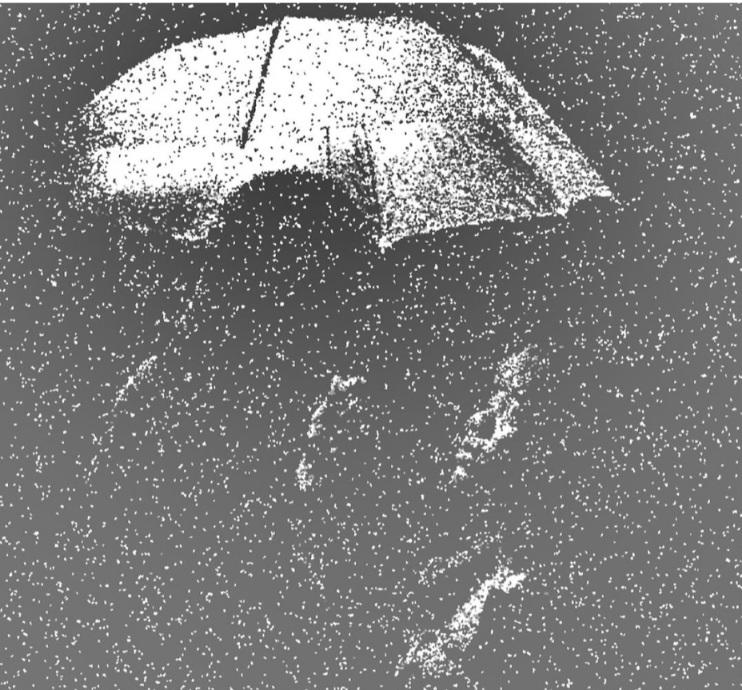
2014 was the year of the Umbrella revolution. Hong Kong; protesters were demanding the right to choose their leaders. They now fully understood the way of things: that they were just part of the mainland Chinese economic chain, their government, led by a Beijing- appointed Chief Executive was little more than a Chinese state department, unconcerned about developing their society. The ubiquitous umbrellas necessitated by a humid, rainy summer, quickly opened into shields when the police showed up with tear gas canisters and pepper spray. The government simply waited out the protest, and it dried out after 79 days. But the message had been communicated; resistance is reflex. As much reflex as raising an umbrella in the way of well-aimed pepper spray. It does not require external assistance to exist, nor an external catalyst to escalate. Protest would return to the streets in 2019, fiercer, better organized, and this time she would achieve some success- repealing an extradition bill that would have allowed criminal suspects (ahem, government opposition and dissidents) to be taken to mainland China for trial. It would take more strategic and drastic action than civil demonstration to bring the system to its knees, but that’s a conversation for another time.
Shegun Oseh’s photographs tend to be double-tongued in this way; conveying either socio-politically charged interpretations or benign ones, depending on how long you stare at them. Oseh’s signature technique of obscurity certainly plays a major role in this multi-layering, yet I suspect even he does not intend some of the dimensions his work takes. As in Umberto Eco’s theories of open art, as in Opera Aperta, he distinguishes between ‘closed’ and ‘open’ art where closed pieces have univocal interpretations while the messages of open art shape-shift dependent on context; time and mindset. Eco posits, as you might think to agree, that open works are a more accomplished form of artistry.This is a sensible conclusion as images that resist meaning/images given to multiple interpretation are more exciting than those with seemingly fixed messages, hence appear more sophisticated. Here’s an exercise; what does this image say to you? What else?

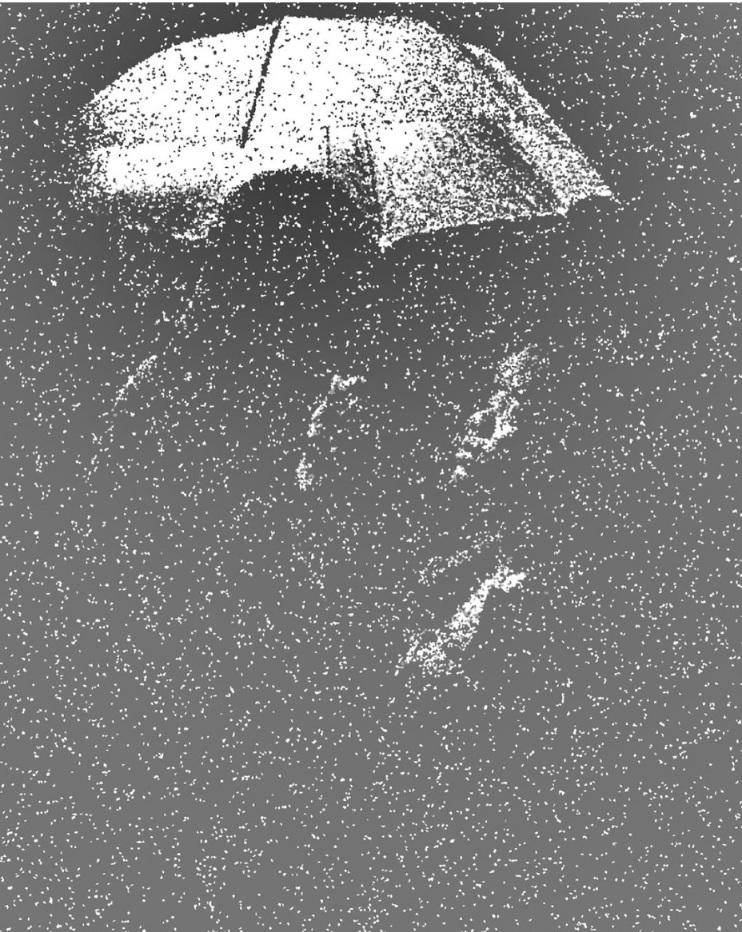
Love under the Umbrella, the image is obviously titled, is one of Oseh’s finest. There is the obvious romantic theme. The canvas- a posterized study in the use of negative space- offers pockets of detail to fall into. This whole meaning seeking business may seem contrived, and that may be correct out in nature where correlation is random at best, but this photograph has been edited with the precision of painting, every pixel placed and proportioned the way it is deliberately. I agree with Eco that whatever meaning you come away with is as valid as the author’s inspiration. One might begin to wonder, say, why the umbrella is the focal point in a story about lovers. It could be a metaphor for protection, but the more appropriate/traditional metaphor in a story about lovers should be the man, we cannot even see his face. It isn’t just a story about lovers anymore. The soft stare of the female figure is almost like a plea, the man anonymous for essential reasons, essential if he is to continue to hold defence over his beloved, like when protesters in Asia wear Guy Fawkes masks to hide their identities from surveillance. A Lok-Ting Lau would take two looks at the umbrella and have a flashback to 2014…

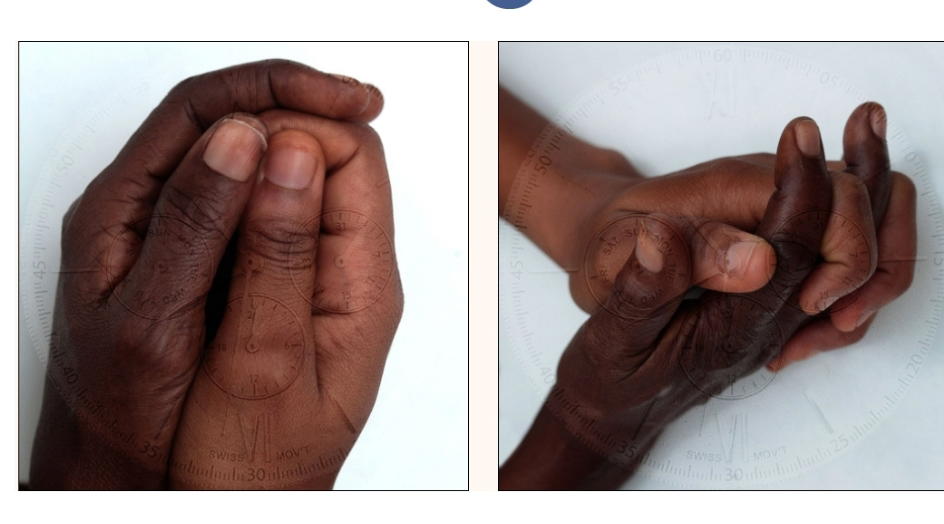
As I have written in the past, one of the marks of a good photograph is its capacity to provide both critical and entertainment value. Where Love under the Umbrella is primarily entertaining, Time will Tell excites more analytical engagement. Interlocked hands (waiting) rest beneath an overlay of faint, ghostly clock faces. One hand appears younger, less-creased and lighter than the other, blended and color-balanced seamlessly. Solidarity, generational tension, pick your themes. Interlocked hands are also a photo-journalistic motif. Now underlying sociopolitical commentary jump at you, but it refuses to be straight-forward; race? labour? or does it model a prescribed response to today’s propaganda-fueled media landscape? Do not react to the news, wait it out, be healthily skeptical, the truth unfolds over time, Time will tell.

Shegun Oseh is a creatively obscure photographer. History’s famous thinkers like Friedrich Nietzsche have written critically about obscurity, believing it to thwart the ‘enlightenment of the mind’. Siobhan Lyons’ defense of obscurantism- for our purposes creative obscurantism- would suffice; ‘Obscurantism can indeed be an effective manoeuvre, provoking greater thought-processes and intellectual investigation. This couldn’t be illustrated more clearly than in Rembrandt’s The Holy Family with a Curtain (1646). I am less concerned with the religious meanings of this painting than I am about the curtain itself; a seemingly innocuous, pointless part of the work, and yet it provokes the viewer to wonder what lies behind it. The curtain, blood red and purposefully pulled partly to the side, teases the viewer, offering not even a partial glimpse of what it completely obscures. The Virgin is plainly seen; and there is Joseph, semi-obscured in the background, near the curtain; but whatever is behind the curtain itself is left unanswered. The painting thus features three forms of creative depiction: the Virgin’s clear visibility, Joseph’s semi-obscured form, and the curtain itself, a symbol of obscurantism, or rather, of the ability of obscurity to be creative, by emphasizing the ambiguity that so often confronts us, which may however be the source of great art, and indeed philosophy.’
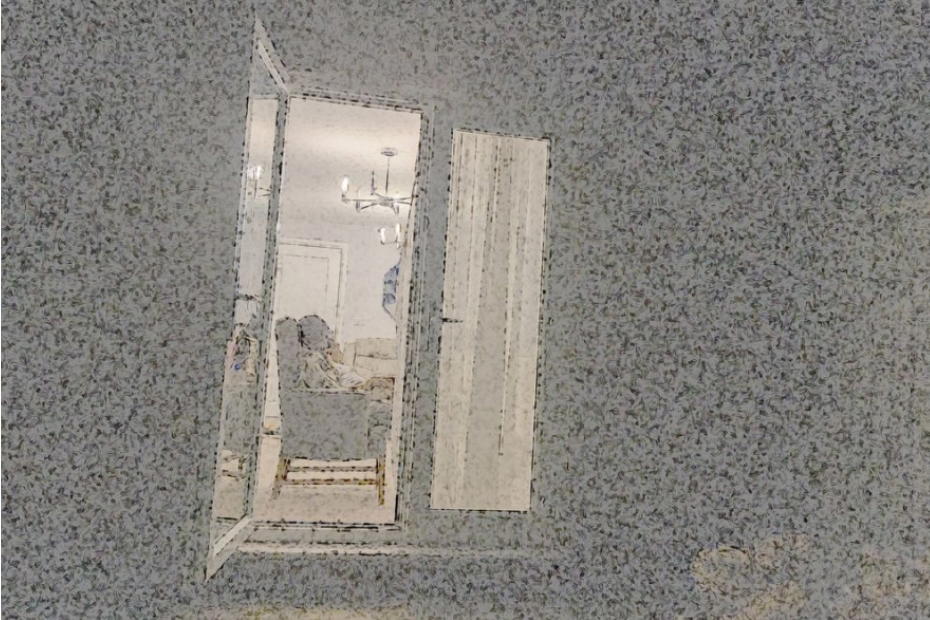
Oseh’s technique is to present a common scene and leave out a key detail (or in the first image all the details). It is usually almost imperceptible at first glance, but once you identify that ambiguity, or oddness, the walls creak and swing inward, revealing a cocktail of further unfinished stories- he actively encourages open interpretation. The submission above is christened Family Time, yet as far as we can see of the living room, there is just one person in it, possibly the mother, or father. If there is someone else there they do not appear to us. In the night of this photo-painting we begin to dart between title and the absence we now cannot unsee. Is it just tongue-in-cheek irony? Whose POV is this anyway? It is sharpened to the point of animated incoherence, a German angle, maybe it is a child returning home past curfew? Aaaah, realization falls, family time.
Perhaps Oseh’s employment of obscurantism points towards something beyond clever visual puns. He is known to tuck significant prescriptions under his multi-layered compositions, after all.
Ornate Obscurity
The quality of being elusive, hard to pin down, map out. Privacy. A timely sermon to listen to at a point in human evolution neck-deep in short form video content, a time when we as individuals and as communities have become television, the lines between what should be kept dignified private and that which could be allowed under the public’s stare get blurrier.
Perhaps, in a world with filters gone awry, obscurity is not just an artistic statement but the very safeguard of depth, mystery, and even dignity. The surface is the common place, of simple generalizations, everything on it becomes common by location. Oseh’s photographs, in how they flash the beauty of the withheld, do not just encourage open interpretation; they remind us that substance is hardly ever on the surface, all that on there is noise.
About the writer
Ebri Kowaki is a culture journalist and Afrofusion commentator. His works have appeared in The Republic, Afrocritik, African Writer Magazine, Akowdee Magazine.
Disclaimer
Comments expressed here do not reflect the opinions of Vanguard newspapers or any employee thereof.