
Genre: Poetry (a collection)
Author: Abimbola O. Alaka
Publisher: The Roaring Lion Newcastle LTD
Year of Publication: 2021
Date of Review: 21st of September, 2021
Word Count: 858
Reviewer: Afer Ventus
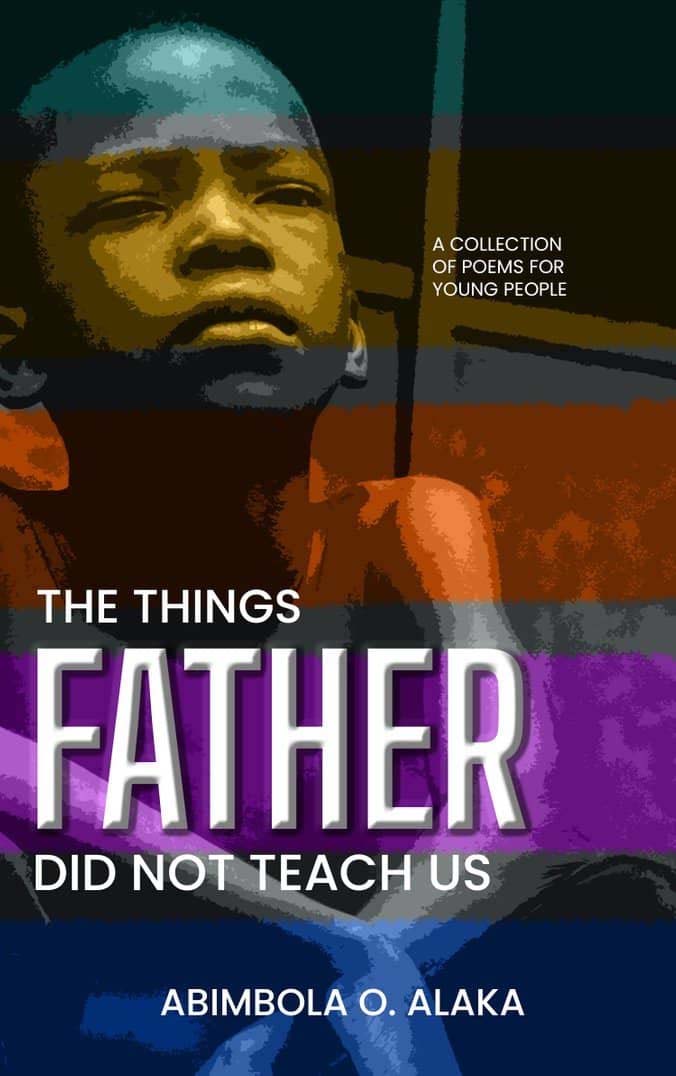
Rendering an Analysis of Alaka’s ‘The Things Father Did Not Teach Us’
‘Poetry should be great and unobtrusive, a thing which enters into one’s soul, and does not startle it or amaze it with itself, but with its subject.’_ John Keats (A Romantic English poet)
Keats’ quote is a full charge to the oppressed. It is a full charge to the weak. It is a full charge to those, of whom this carnivorous world has written off. And it is to this effect, Abimbola, the poet, who must have had similar experience to the cruelty of this world, wrote this flowing collection of thirty-one poems. If John Keats were in existence and had come to see this work, he would have agreed to its flow for ‘if poetry comes not as naturally as the leaves come to a tree, it had better not come at all.’ This is how he (Keats) defined poetry. And, Abimbola weaves pure inspirations (a collection of thirty-one poems) in like-manner, which will be analyzed mono-randomly.
In ‘The Socratic Way to Die’, the poet simply states that a persistent being would likely die faster because curiosity kills the cat. She alludes to Socrates, who, rather than fleeing into exile, preferred the death sentence by hemlock poisoning. His way of questioning was assumed to have corrupted the mind of Athens of Greece, stirring up an uprising in that political era. So, yes—one is seen as a rebel when he wants to know more as it happened to the poet at the end of the poem.
What are those things father did not teach? Well, according to the poet, father taught things but they experienced them practically which was far different from what father taught them. Looking into the second poem, ‘The Things Father Did Not Teach Us’; empathy, bravery, love and thoughtfulness they had (obviously orally) but the poet and others had to learn it on their own. For instance, in the second stanza, the poet says to be brave in this life, one has to ‘empty the river’ in his eyes and throw away his fears.
In ‘Self-Declaration (For The Girl Child)’, the poet metaphorically encourages the girl-child to see themselves as lionesses, and their heart, a gold mine.
The fourth poem, ‘You Versus the World’, the poet treats the theme of one bracing up to face the world (which in turn, has been pictured like man’s enemy). In the first stanza, the poet says that making mistakes is inevitable in life. But when it happens, ‘you don’t build a tent in the mud./You stand./You walk./You run.’ And the rest of the stanzas admonish one to be courageous and have self-belief.
Also, when you feel pressured because you do not fit into the caliber of world-like people, there is a poem for you. Many people have friends who drink alcohol and smoke—forcing them to jump onto the bandwagon. However, when you do not, they think you ‘stupid’ (as the poet denotes). The good thing is that the poet never said there would be no insults hurled at one trying to stay away but that those insults would not get into her skin or stop her from excelling (‘awakening’). This can be seen in the poem, ‘A Poem: In Which My Silence Is Seen As Everything Stupid’.
Most people do not like criticisms (especially in a bad way). This is because the mind begins to taunt one’s self to regret. So the poet makes no doubt about it in her poem, ‘How Easy’. She says that after the insult, ‘he becomes unsettled like ripples; like reoccurring/ waves; like Nigerian news (being sarcastic here about the current state of Nigeria); like…’ the ellipses at the end of the line indicates many more other unsettled things. She is certain that all of the aforementioned will happen ‘if one isn’t blocked from the criticisms;/ if one doesn’t fix his eyes on the future.’
In ‘A Poem: I Hate The Shelter of Society’, sexual assaults was directly compared to an autocrat. This is ironical and it implies that the ‘sheltered’ society is no longer a shelter. However, the poet remains optimistic that her reign will soon be in reins as ‘one day, she’ll lose her crown to the wind’.
All in all, The Things Father Did Not Teach Us teaches so much value and should be loved because of the subjects it treats. The subjects are like human ‘scars’. Though, many may live, thinking they can pack off the water (scars) under the bridge. But when they happen to stare too long on these scars, they remember where and how they were got. And for that singular realization, it could be said that the scars still live. In essence, the subjects in this work are going to be living for a long time to come. But we must continue to shield our hearts and play our cards right.
Disclaimer
Comments expressed here do not reflect the opinions of Vanguard newspapers or any employee thereof.