
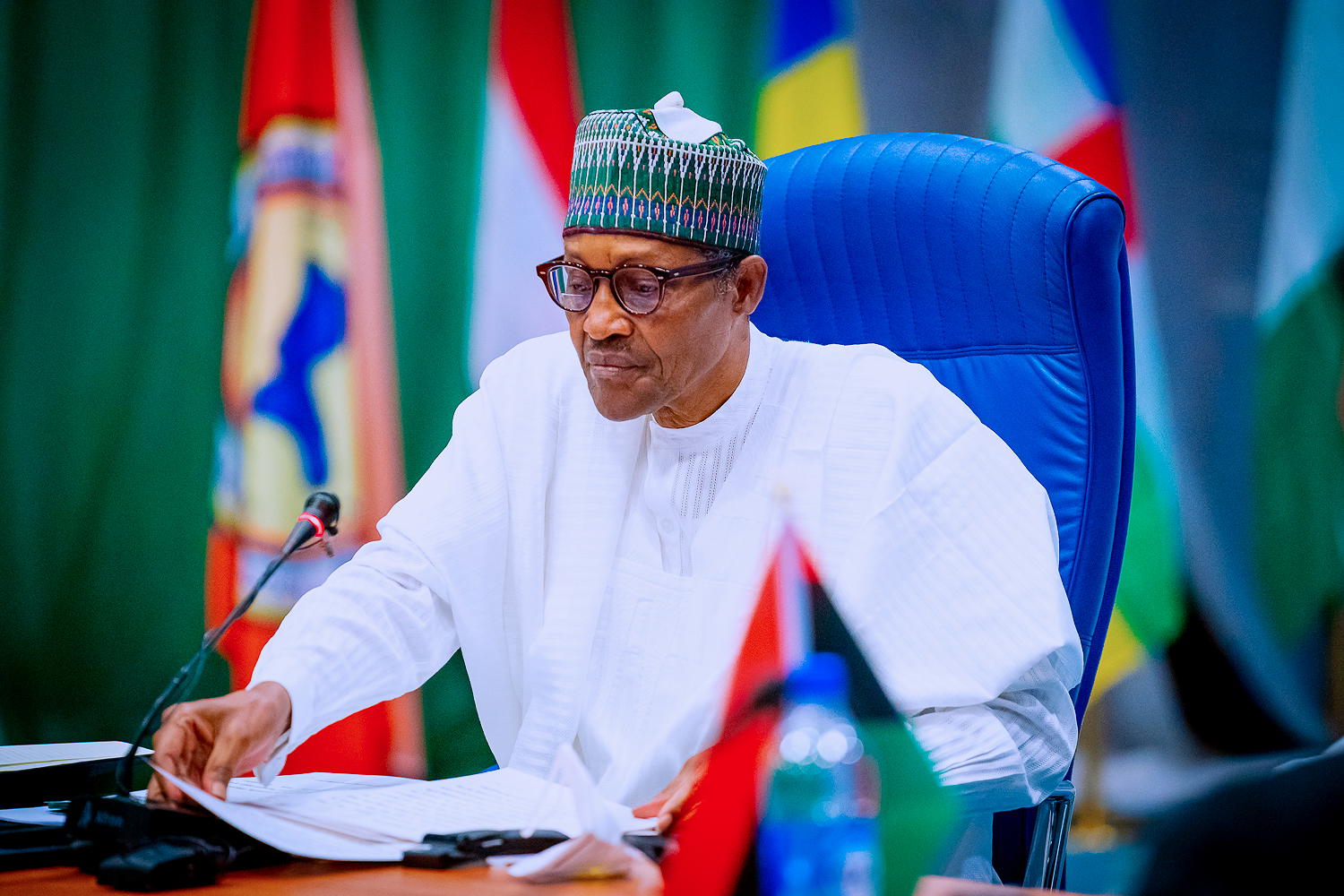
Muhammadu Buhari
Ladipo Adamolekun
The definitive retreat of General Ibrahim Badamasi Babangida from competing in the 2007 presidential elections needs to be followed by that of his predecessor as military ruler of Nigeria, General Muhammadu Buhari. This position is based on three reasons.
First, at this juncture in Nigeria’s continued apprenticeship to democratic political culture, another president with a military mind-set will not move us towards democratic consolidation.
Given what the country experienced during more than three decades of military arbitrariness and the bastardization of the federal system, and the continuation of some of these undemocratic features under a “civilianized” Obasanjo, there is need for change.
Since 1999, we have witnessed the continued over-centralization of the federal system, disregard for the constitutional checks and balances invested in the legislature and the judiciary, all spiced with some blatant military-style dictatorial actions.
The give and take, listening, and negotiations that civil governance requires in a democratic polity are practices that an ex-military ruler would most certainly find unattractive. (Some observers’ references to former military leaders who have served as presidents in the USA and France are inappropriate because these leaders never ruled their countries when they were in active service).
Second, Buhari’s understanding of governance as revealed during his 20-month rule was very defective.
His disrespect for human rights is well documented. He asserted that the ills of the economy would be cured by following the advice of the inherited government functionaries who had participated actively in running it aground.
He also advised his military governors to go to traditional rulers and take them into confidence as good and reliable allies for ensuring good government in their respective states.
While some traditional rulers enjoy credibility in their domains and could contribute, in varying degrees, to good governance, the majority nation-wide are most often beneficiaries of, and contributors to, bad governance.
There was no evidence that Buhari became aware of the bankruptcy of his two guidelines for governance in the course of his rule and one wonders if these are the same ideas that he would push if he were to be elected president in May.
Furthermore, it is not clear if his recent support for constituting the six geopolitical zones into the federating units is genuine or a ploy for winning votes in the geopolitical zones that strongly support the idea.
The significant devolution that is implicit in this regionalization fundamentally contradicts the unitary and centralized political arrangement that is consistent with his military mind-set, and the same is the preference of his emirate backers.
Third, and finally, Buhari, at different times in the recent past, exposed himself as a sectional and polarizing figure: an apostle of Sharia, a defender of ethnic interests (his visit to Oyo State Governor in 2000 to defend the interests of Fulani herdsmen), and a promoter of Christian-Muslim divide through his advice to all Moslems to vote only for (Northern?) Moslems.
ALSO READ: Halt Odebunmi’s toxic Media Bills
Although he later qualified his position on the last point, Nigeria does not need a leader who would deepen Christian/Muslim and ethnic divides instead of fighting poverty, corruption and underdevelopment.
Note: I am a political independent – a breed that is not recognized in the 1999 Constitution. The only political party membership card that I’ve ever held is that of the Action Group (1962-66).
(Published in Vanguard, March 14th 2007)
Postscript – an Apology, July 7th 2021
“PDP appears to be more for continued looting [of national resources] in contrast to credible anti-corruption position of opposition leader.” – Diary entry, March 18th 2015
“2015 election cycle began with presidential and National Assembly elections. I voted for APC candidates” – Diary entry, March 28th 2015.
One of the reasons for abandoning my well-reasoned advocacy for the rejection of Buhari at the polls in 2007 is mentioned in one of the two quotes above. And the second quote confirms that I voted for him in 2015. Yes, I voted for him again in 2019. Why? “I unhesitatingly voted for Yemi and his boss whose integrity contrasts sharply with Atiku’s notoriety as a very corrupt politician. Competence and inclusion are two challenges that Buhari must honestly tackle.” (Diary entry, March 3rd 2019).
I plead guilty to attaching a huge importance to the problem of corruption in Nigeria. A Journal article by a British scholar that I read as an undergraduate at Ibadan in 1965 – “What is the problem about corruption?” – first introduced me to the salience of the subject. Then, during my second career at the World Bank, I was involved in crafting the Bank’s strategy for fighting corruption, Helping Countries Combat corruption (1997).
The Bank’s objective was to ensure that development projects it supported in borrower member countries were free of fraud and corruption.
Significantly, I had a hands-on involvement in preventing fraud and corruption within Bank-financed projects in Kenya during my external service stint in that country between 1998 and 2000.
It is against this backdrop and strong evidence of institutionalised corruption in Nigeria from the last decade of military rule through the 2000s to 2015 that I fully bought into the following pungent observation made by candidate Buhari during the 2015 presidential election campaign: “If we don’t kill corruption in this country, corruption will kill Nigeria.” And I am also a believer in the following observation of Transparency International (TI) that is based on its two-decade-long annual survey of corrupt practices across continents: “Corruption is a major cause of poverty as well as a barrier to overcoming it.” (Source: TI website).
In my considered opinion, institutionalised corruption is a major explanatory factor for Nigeria becoming the poverty capital of the world in 2018.
However, my hopeful Diary entry in 2019 that “competence and inclusion are two challenges that Buhari must honestly tackle” now rings hollow. I unhesitatingly concur with the following observation made recently by Dele Sobowale, a Vanguard columnist: “Old men over 70 seldom change… If a man fools you once, shame on him. If twice, shame on you. Buhari fooled millions of us the first time. We fooled ourselves in 2019.” (See Vanguard, May 17th 2021).
Following this mea culpa, what would I do differently in 2023? Based on the record of the leaders produced by the two major parties since 1999, neither party is equipped to produce the development-oriented political leadership that Nigeria needs. Would a collegial presidency a la Switzerland be a better option for Nigeria? This is a subject for another day.
Professor Ladipo Adamolekun writes from Iju, Akure North, Ondo State.
Disclaimer
Comments expressed here do not reflect the opinions of Vanguard newspapers or any employee thereof.