
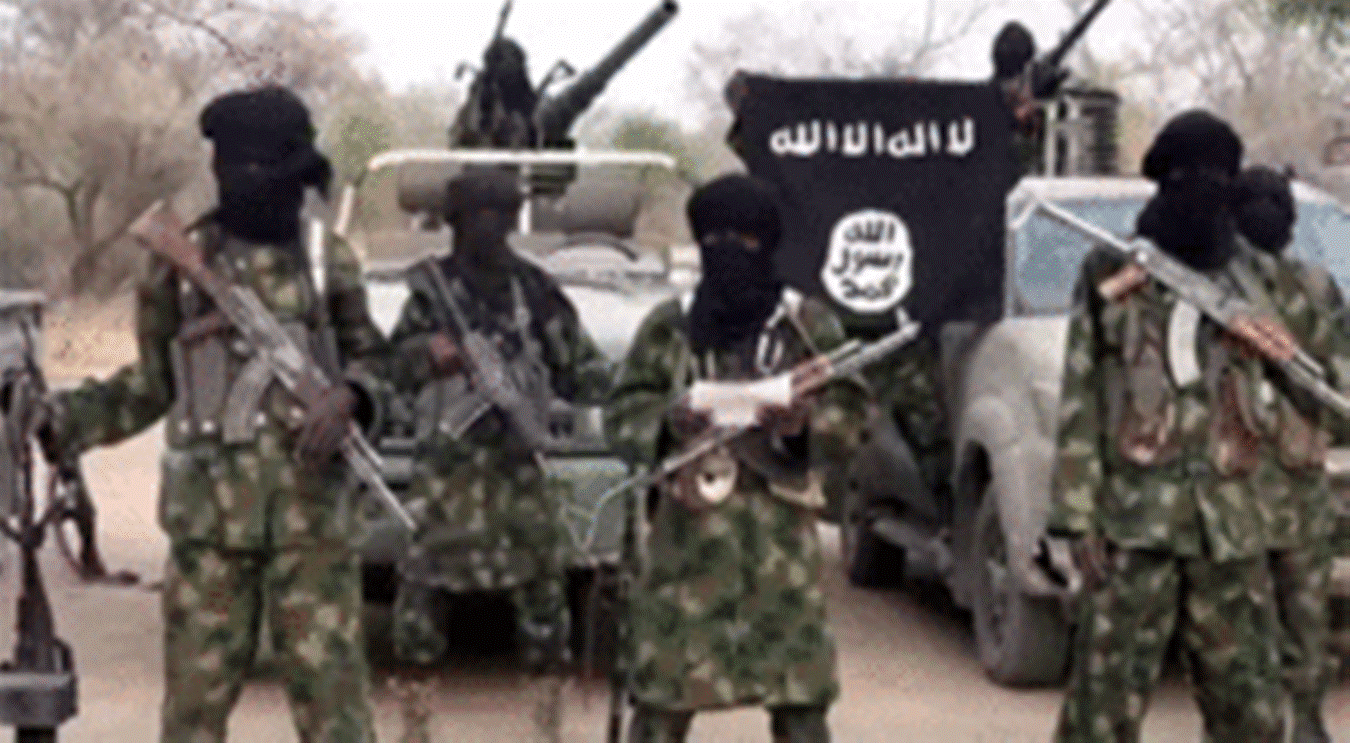
Boko Haram fighters
By Ademola Orunbon
Boko Haram: MORE than before, contemporary Nigerian society has been beset with religious conflicts that have threatened to tear the fabric of the country’s unity. To a large extent, one can say that Nigeria of the past boasted of religious flexibility and tolerance for many years. However, recently, it seems to have been shelved as gruesome stories relating to religion rear their ugly heads frequently, causing loss of lives. One can say that a curious feature of today Nigerian society is religious intolerance, most especially in the Northern and the Middle Belt regions of the country.
Religious fanaticism in the northern part of Nigeria has been hidebound and its spread is unbridled. Religious violence has been unleashed on many innocent citizens of this country, that one wonders if Nigeria is truly a secular country which gives room for religious freedom.
There is palpable apprehension among the citizens due to the Boko Haram insurgencies in different parts of the North. For over seven years, cities like Maiduguri, Bauchi, Damaturu and Gombe have been bedeviled with fear due to the Boko Haram insurgencies. Religious intolerance prevails in the country and this is an abuse of human rights.
The high rate of killings due to religious intolerance in many parts of the country is worrisome. A great concern at this alarming phenomenon is informed by the recent slaughter of Rev. Lawani Andimi who was attacked by Boko Haram at Michika in Adamawa State; though he was declared missing, later he appeared in a video released by Boko Haram on January 5, in which he pleaded with authorities to secure his release. The terrorists had demanded a ransom of two million Euros and were offered N50 million, which they rejected before beheading the cleric.
Indeed, the insurgents had the effrontery to call the wife of the slain Pastor that they will kill her husband on Saturday, but they delayed until Monday. The governments need to inhibit the superfluous of this religious intolerance and chauvinism among the people of this country. There is also another story of an evangelist, Mr. Akinyemi Oladapo, a known soul winner in the South West who was brutally attacked for his role in converting many Muslims to Christianity. It was reported that Oladapo was killed after he became the spiritual father for one Mr. Mobolaji Akingbade, the son of a popular Islamic scholar. He ran away to Abeokuta where he was attacked by some unknown assailants reminding him that he has no hiding place in the country. Since then, he has never been seen again.
We should not forget in jiffy the extrajudicial murder of a 75-year-old woman, Mrs. Bridget Agbaheme, a Christian and trader at Kofar Wambai market, in Kano, who was beaten to death by irate youths after accusing her of blasphemy against Islam, or Mrs. Eunice Elisha of the Redeemed Christian Church of God, Kubwa, Abuja, who was killed recently for preaching. Before Nigerians could comprehend the motive behind such barbarity, another Christian and carpenter at Kakuri area of Kaduna metropolis, Mr. Emmanuel Francis, was mobbed and stabbed severally by some Muslim youths for failing to observe the Ramadan fast.
READ ALSO: Boko Haram: Are we running out of options or will?
On January 20, 2020, the Islamic State West Africa Province, ISWAP, an offshoot of the Boko Haram terrorists group, released a video showing the execution of Ropvil Daciya Dalep, a 22-year-old Christian student from Plateau State. Rapvil Daciya was from Jing village in Pankshin Local Government Area of Plateau who was studying Biology at the University of Maiduguri.
He was kidnapped on January 9 in Borno State along with other two students one of whom was a 20-year-old Zoology student from Plateau, Lilian Daniel Gyang, while they were returning to the university after the Christmas. The video shows Dalep calmly kneeling down while a masked child stands behind him wielding a pistol. Before shooting Ropvil, the under-aged child, obviously acting on instruction, chanted in Arabic, and then spoke in Hausa.
Right to religious freedom is based on the inherent dignity of the human person created in the image and likeness of God (Gen. 1:27). Even in the Qur’an 2:256, it is stated that “there is no compulsion in religion”. Recent report of forcing Leah Sharibu to Islam and marriage too is unislamic, barbaric and therefore stands condemned. In the Universal Declaration on Human Rights, it is explicitly affirmed that the recognition of the dignity and the rights of the human person is the foundation of freedom, justice and peace, and that disregard and contempt for them are acts of barbarousness that offend the conscience of humankind.
The Fathers of the Second Vatican Council in Dignitatis Humanae, the Declaration on Religious Liberty, teach that the right of the individual and of communities to social and civil freedom in religious matters carries with it the right “to be immune from coercion on the part of individuals or of social groups and of any human power, in such wise that no one is to be forced to act in a manner contrary to his own beliefs, whether privately or publicly, whether alone or in association with others, within due limits.”
The acts of insecurity in the country has brought about the concept of Amotekun in the South West, to complement the mainstream security agencies in the country. Though, it is not a duplication or replacement for the Nigeria Police but it will give people confidence that they are being looked after by those they elected into office. The insecurity of lives and property in recent times was the main reason behind the formation of the security outfit.
We should remember that it was in the context of the unfortunate loss of the daughter of Pa Reuben Fasoranti, the leader of Afenifere that made the governors in the South West Zone to flag-off the operations of the Western Nigeria Security Network, Amotekun, to strengthen and complement the mainstream security agencies in the country. The floatiing of the network is without any hidden agenda. This launching of this Amotekun will reduce or abate the killing of innocent people whether for rituals, religious intolerance or political reasons in the Southwestern part of the country.
Conflict is a great predicament in any human society, and most times, it is predictable. In fact, history indicates that conflict is an on-going process in human relations and may occur within and among groups and communities. In the case of Nigeria, the frequency of religious conflicts in the northern part till date has left adverse effects on the socio-economic well being of the people. We really need advocacy for ethical principles such as the common solidarity of humanity by origin, forgiveness and tolerance that could engender cordiality and understanding rather than sustained hostility and suspicion in Christian-Muslim relation in Nigeria.
Today, most of the world’s major conflicts are as a result of religious intolerance that has been left to fester into uncontrollable spiral of violence. We must restate that religious belief is fundamental to many human identities. It is part of the ways in which human beings experience the world around them. Hence, all have the right to enjoy freedom to choose which religion that one is convenient with.
Disclaimer
Comments expressed here do not reflect the opinions of Vanguard newspapers or any employee thereof.