
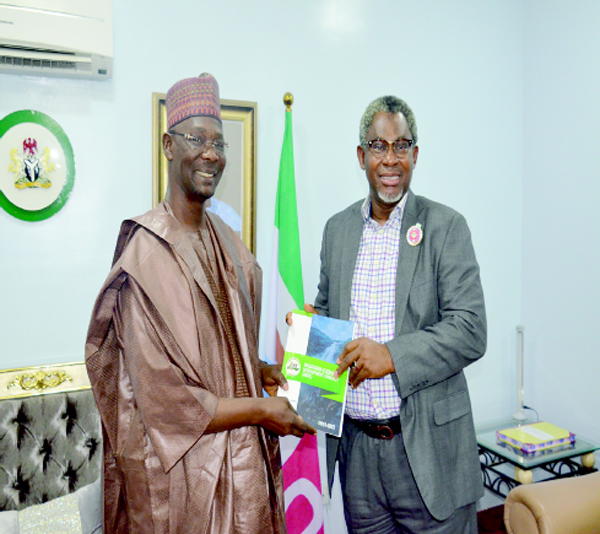
From Left, Nasarawa State Gov., Engineer Abdullahi Sule and Minister, Mines and Steel Development, Honourable Arc. Olamilekan Adegbite, during a visit to Nasarawa government recently.
Considering the position of Nigerian oil in the international market, and with the recent announcement of Honda that the company is going to scrap the production of petrol and diesel vehicle by 2022, think what will happen to us with a mono economy from oil, when oil is no longer needed globally.
Senate wants unemployment rate checked
At this juncture, Nigeria has no option than to diversify the economy via other natural endowment the country is blessed with, which is why President, Muhammed Buhari believes developing mining sector is the way forward. However, in realising this feat, the Honourable Minister of Mines and Steel Development, Architect Olamilekan Adegbite in his right thinking mind believes that the sector needs the cooperation and collaboration with states in the country where mineral resources are deposited in their soil for collective achievement and development for the benefit of Nigerian citizens irrespective of their states.
Following this, Adegbite had commenced visiting states governors to harmonise issues with those having a contrary view on mines and steel development in the country. On this note, the honourable minister on Thursday met with the governor of Nasarawa to discuss the issue of mining that often pits the state government against the Federal Government. While the state governments want revenue from mineral resources mined from their states to accrue to them, the constitution puts mining under the exclusive list which means that revenue from it has to go the central purse.
It was quoted that the honourable minister while speaking with the Governor of Nasarawa said it’s a pleasure to come to the home of solid mineral, saying that his portfolio is mineral and steel and we are here to explore the possibility of cooperation with the state government to make sure we take mining to a greater height. “The President in his wisdom acknowledged that fossil fuel belongs to the old technology and would fizzle out in a matter of time, which would adversely affect our revenue. Hence he realised the need to diversify our economy away from its dependence on oil, gas and has identified the mining sector”.
According to the source, Adegbite said that Mr President wants to use the mining sector to diversify the economy, create employment and increase revenue generation for the country. “And part of the mandate is to ensure that mining goes on in every part of the country as our country is blessed with so many mineral resources. There is no state without mineral resources. Presently illegal mining constitute some problem beyond the environmental challenges that the nation is also losing money it could have earned from royalties as this illegally mined resources are smuggled out of the country and sold at higher prices while the nation gets nothing from such.
However, it is essential for us to block this loophole which we are doing. There has been a lot of challenges between the relationship between the federal and state government. It is not misplaced for state government to want to explore the minerals in their state. What we are saying is that they have to do it in accordance with the constitution. State government are not empowered to give mineral titles. It’s only the Federal Government that can do that. But state can form joint ventures to mine the minerals in their state. We are also engaging artisanal miners who are responsible for about 80 per cent of mining activities in the country. We are organising and bringing them together to form a cooperative and also giving them training on safer mining practices”.
In addition, Nasarawa State Governor, Engineer Abdullahi Sule commended the minister the way he is going about his assignment with commitment. According to the Governor, Nasarawa has the potential to be one of the wealthiest state in the country due to the many minerals we have but we do not know what is happening. “We just want to know what is happening since we do not have control of the minerals”.
Governor Sule said that we want the economic activity of mining in this state, as it would bring about employment and revenue. “Although we have some mining licenses, we have done nothing about them”.
This is why the Honourable Minister of Mines and Steel commenced visiting state governors to smooth over relations on the issue of mining because many times state governments run afoul of the constitution which places mining on the exclusive list, when they interfere in mining activities. Architect Olamilekan Adegbite had already visited Lagos, Osun and Kogi State in which he had extensive talks with the governors on how they can partner with the Federal Government to enhance mining in the state. While speaking in Osun State, in the presence of the governor the minister said ‘mining is on the exclusive list. A constituted government should not participate in illegality. People are saying let’s bring mining to the concurrent list. But if we do that, the Niger Delta state will also cry that they should b ring oil and gas to the current list, which is also a form of mining. The money we share at the federal level largely comes from oil which is gotten from the Niger Delta. If they also clamour that oil and gas should be on the concurrent list then we will have little or no money to share at the federal level.’
FG to go tough on fraudulent miners – Ogah
To further this laudable project in the spirit of one Nigeria, Ekiti State hosted the 3rd edition of the National Council on Mining and Mineral Resources Development, Ministry of Mines and Steel Development.
In that Council meeting, the ministry source quoted Adegbite as saying that the National Council on Mining and Mineral Resources Development (NCMMRD) is an interactive platform that is advisory in role where all stakeholders in the sector converge for policy formulation, validation and advice to effectively guide government in achieving its goals for the sector. “The theme of the Council meeting on Mining and Mineral Resources Development was picked to reflect the focus of this present administration on attracting the desired investment into the Minerals and Metals Sector. It is aptly tagged: “Nigeria Minerals and Metals Sector: Spectrum for Investment Opportunities for Economic Growth and Development”.
According to the source, one of the core pillars of President Muhammadu Buhari’s economic policy is the repositioning of two major sectors – Mining and Agriculture- with a view to maximally exploit their potentials to create wealth, diversify the economy, increase contribution to GDP, create jobs, and expand the range of economic opportunities available to Nigerians.
Continuing, it was said that towards the attainment of these goals, the administration initiated a number of reforms to reposition the Minerals and Metals Sector for sustainable growth and development. “One of the significant reform strategies was the development of Roadmap for the Growth and Development of the Nigerian Mining Industry, initiated by my predecessor, Dr. Fayemi, to unleash the enormous potential in the sector and to guide the investment decisions of the Ministry over the next 25 years. The Roadmap was graciously approved by FEC on 31st August, 2016 for implementation, and the benefits are coming almost every day.
“The major highlights of the Roadmap are to be achieved through stakeholder’s engagement, which would ultimately increase Mining contribution to GDP as well as offering shared prosperity to all stakeholders in all the Mining Value Chains (MVC) such as (Exploration, Mining, Beneficiation and Trade). The sector’s Roadmap has been a major guide to what we have so far achieved in the sector. We noticed that many well intentioned policies and programmes initiated in the past, achieved very little impact for lack of broad based buy-in and support from critical stakeholders. In this regard, the Ministry has made it a priority to engage all stakeholders at the various stages of implementation of the Roadmap. We have been mobilizing all important stakeholders in the mining eco-system, working together with government at all levels, to achieve the desired objectives.
Recounting some of the achievement the sector has made in the area of poverty eradication, the Ministry has engaged other major stakeholders to ensure the formalization of the Artisanal Miners into cooperative groups for easier management and access to financial support and commodity markets. In this regard, a total number of 1,759 Artisanal and Small Scale Miners (ASM) sites have so far been identified across Nigeria. With consistent interventions by the Federal Government through the Ministry of Mines and Steel Development (MMSD), 1,346 Artisanal Mining operators have been drawn into forming registered Artisanal Mining cooperatives in readiness to access Small-scale Mining Licenses. Each of the 1,346 mining cooperatives comprises over 10 members; with additional 20 mine workers for each of the cooperatives.
In addition, the source said that the Ministry has continued to ensure that host communities to mining activities receive the socio-economic benefits of such ventures through the Community Development Agreements in line with the provisions of the Nigerian Minerals and Mining Act, 2007. To facilitate this, the ministry produced guidelines for the provision of CDA in the mining sector. So far, through the community development projects more than 250 mining communities have benefited from rural road infrastructural facilities, borehole projects, class rooms and scholarship programmes as a result of mining operations within their areas
In the same vein, the investment opportunities in the Nigerian solid mineral sector must not be over emphasized as the Nigerian economy is the largest in Africa with a GDP of USD 469 billion, as it is mostly known for its vast oil and gas resources. Although currently accounting to 0.3% of national employment, 0.02% of exports and contributes about USD1.40billion to the Nigerian GDP; the Nigeria mining sector is poised for rapid development.
Again, with 44 solid minerals found in commercial quantities in more than 500 locations in Nigeria, all 36 states of the Federation and the FCT have more than one mineral type. However, the mineral deposits that are broadly categorized according to their uses, has seven strategic solid minerals which the ministry has identified its commodities in Nigeria with potential for development, which have strategic importance in economic development.
The seven strategic minerals include, Bitumen, Coal, Limestone, Lead/zinc, Gold, and Baryte and Iron ore. Its potentials of mining, presently employs approximately 300,000 people directly and 2,000,000 people indirectly.
It has great potentials to generate more employment opportunities and wealth creation.
It is also capable of generating employment opportunities for over 5,000,000 people in the short term.
AIGC boss to FG: $600m steel plant will boost Nigeria’s economy
Backbone to cement manufacture constituting over 100% raw material input.
Disclaimer
Comments expressed here do not reflect the opinions of Vanguard newspapers or any employee thereof.