
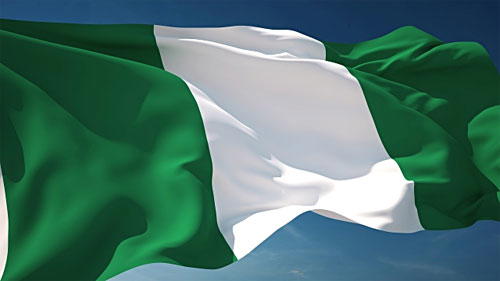
Nigerian Flag
By Paul Odili
As PMB constitutes his ‘five-star’ economic advisory economic council, a look at content and not form; is this not more of the same. Has PMB finally abandoned autarky?
Nigeria has failed’
Since the return of civil rule in 1999 the political party system has shown terrible dysfunctionality, lack of ideological clarity.
If you bother to review events you would find that Nigerians live and lament about the same issue over again ad infinitum; evidence in my view of zero progress on critical issues of importance, such as governance, national integration, education, healthcare, high unemployment, high population growth, economic crisis, poor infrastructure, intractable anti-corruption fight, insecurity etc.
If you pick a typical Nigerian newspaper today, you will feel a sense of de’juv, a sense that I have seen this story before. Because in reality an editor needs only to replace a few minor details in a given story from the past and he would be publishing the same event as if it has just happened. The subject matter remains fixated even if the cast of characters might have changed. That is how sterile politics and public discourse is in Nigeria.
The more Nigerians bemoan the fate of the country, the more it appears we arewalking backwards, yet the rich are becoming richer, the income inequality continues to widen, wage levels in private and public stagnate, insecurity grows. We see increasing privatization of profits for the corporate sector and growing debt in the public sector. Nigeria LabourCongress only recently squeezed out a thirty thousand naira minimum wage, which converted to dollars, is no more than 83.5 dollars a month. Who lives on that?
Bereft of clear perspective on the fundamental source of this national disequilibrium, we seem preoccupied with nativist issues. Tribalism is one bogeyman driven by tribal champions.The Igbo/Yoruba rivalry, Hausa/Fulani oligarchic dominationof power;others lament marginalsiation and exclusion from commanding heights of Nigerian political and economic sector. These are the focal topics of our national discourse. And not to be outdone in the race to the bottom, religion and its polarizing influence is not left out. The religious zealots and their adherents take away all the oxygen in the public space. Yet when you look at it no part of the country has been such outstanding success in terms of important index of development. Nigeria across geo-political zones is riven by poverty and underdevelopment. So what is happening? Why should the index of development be so low if someone or a group of people have such great monopoly over allocation of national resources?
Financial Times of London calls for inclusive development in Africa(Opens in a new browser tab)
Why is it that since 1985 following the wholesome adoption of neoliberal policies of the Westernmetropolitan powers directedby World Bank and IMF, Nigeria has become even moredeeply enmeshed in misery and underdevelopment? How comeaccess to national resources has remained in the hands of very few business elite and their political allies in civilian and military garb, but excluding the rest of the people? State support and subsidies have been given out generously to these business oligarchs. Social programmes are poorly funded, employment opportunities remains anemic, clearly the more money Nigeria makes from its crude oil mono-product export, the more impoverish it becomes.
The concept of neoliberalism in its simplest form is private sector led economy, less regulation, less government intervention, free market and less public ownership. By definition this is exaltation of unbridled capitalism, which promotes the survival of the fittest.In theory neo-liberalism exalts the supremacy of market, because market will always self-correct—which is complete nonsense by the way. The god of market is the god of profit, monopolistic profit in the hands of very few people: business and corporate interest. Neo-liberalism is about individual interest over community interest, it is about open market, financial capitalism that strengthens the banking cartel. It is a known fact that CBN has bailed out Nigerian banks over and over again with taxpayers money and revenue receipt from government coffers. How Nigerians can be tolerant of this is hard to understand. Ignorance and foolishness combined, perhaps. Interestingly, Femi Falana the human rights lawyer is challenging CBN to explain the right it has to give out $ 7 billion to Nigerian banks under Prof Charles Soludo. This is one example; there are several other financial give-away by CBN.
How did we get into this trap? The eight years rule of President Babaginda is perhaps the most consequential era in the recent history of Nigeria. IBB regimetotally altered the economic, social, political landscape of the country. No other regime has had the same effect in Nigeria. The coming of IBB into power ended the welfare state and the beginning of the neo-liberal era, which we are still grappling with. The welfare state left behind the British when they departed in 1960 allowed for government participation in economic sectors of the country.
In 1985 President Babangida overthrew President Buhari, whose economic policy was autarky. Notionally Babangida was right. The regime of Buhari spurned IMF/World Bank offer of assistance because it did not want to compromise Nigeria’s economic sovereignty. PMB has always been an economic nationalist and has never changed. In his first interregnum, PMB preferred countertrade and other economic policies that emphasized self-help, local content and discipline. Pretty much the sort of policy he implements today. With the overthrow of Gen. Buhari, IBB with his technocratic team decided to embrace the Washington Consensus in pursuit of economic model fashioned on neo-liberal ideology. At this time, in the west US President, Ronald Regan’s trickle-down economics was in full force. Regan’s economic theory was that a reduction of taxes on the rich and corporate players would lead to more investment and job creation—today we know better.
In the UK, Margret Thatcher had launched her war on the welfare state. She was cutting taxes for the rich and the corporate players, privatizatingpublic utilities, cutting welfare programmes, and dismantlinglabour unions. Both leaders were the leading lights of neo-liberal economic ideas. Not surprising Nigeria and much of Africa and third world became guinea pigs for this experiment. Correctly sensing what was about to be introduced by IBB, there was resistance to his neo-liberal ideas at the outset. The left ideologues warned about the implication of his economic policy for Nigeria (In those days the left were very strong and vocal and had robust platforms to mobilise public opinion, not anymore, sadly).
John Obaro seeks policies to stimulate technological sdvancement(Opens in a new browser tab)
IBB feinted by giving the impression that if he were to take the IMF loan he would need to build a national consensus on this.
Thus began the national debate on IMF loan and its conditionality that lasted a year. IBB was not able to build a consensus on this, public opinion was against the loan but he still proceeded to take the IMF loan (he denied it).Meanwhile, he went ahead to implement IMF conditionality through the so-called Structural Adjustment Programme (SAP) that ensured trade liberalization, removal of petrol subsidy, managed exchange rate floating of the naira, free market, privatization of public enterprisesand curb on public sector spending etc.
The Babangida economic reformsdeeply rooted in neo-liberalism impacted greatly the polity,such that subsequent governments have not been able to reverse it. Unfortunately, Nigerian populace, policy makers and leadership have the tendency to swallow hook, line and sinker ideological prescriptions from the Western metropolitan powers. Before 1985 the welfare state was still very strong in Nigeria. There was to a large extent security of jobs, stability of the family system, an economic system that was majorly public sector driven, and a cohesive national aspiration.
Since after SAP, all that changed. SAP promised economic structural changes but hardly delivered on any. The so-called private sector led economy has not delivered much. Yes a few nouveau riche emerged from the banking and service sector—the oligarchs. You know them, yes you. Nigeria is still dependent on crude oil export as sole earner of foreign exchange. So the structure remains what it has always been pre-SAP. Industrialization never took off, rather we have de-industrialization. CheapImports of goods and service haveescalated; the roll back of the state for private business to take over through the policy of deregulation, commercialization of various sectors and inevitably to massive privatization of public owned entities have produced little. Thus by embracing neo-liberalism Nigeria effectivelyoragnisedthe greatest transfer of public wealth to private people and this has continued since. These private business owners who took over previously public owned assets in most instances were buccaneers. They simply won cheap public assets and proceeded to strip those companies of viable assets. The promised turn-round and profitability, not to speak of employment, job growth and competitive positioning never materialized. The result it produced was mass layoffs and a graveyard of dead companies.
Nigeria has been on a downward spiral since then. Lacking answers to the national decline, the narrative has been to place the blame onpoliticians (rightly so but partly the answer in my opinion). The blame is also placed on the need to restructureNigeria (which is why theclamourfor devolution of power has never ceased to be on the front burner; a cover to continue the sharing economy). We tinker with all sorts of ideas through national conferences and yet nothing is working. And least I forget corruption—rightly so as well. On the latter the more effort is made to end corruption, the more it fights and metastasizes.
If you step back a bit and reflect, it is little wonder why for nearly 40 years, life has simply not gotten better, it is worse now than before. Nigeria has become a completely broken society. Our economy has remained undiversified. Private sector investment has not grown at a rate to drive economic growth, contrary to the promise of neo-liberalism. For the older generations the collapse of the economy and social norms is staggering. They yearn for the good old days. It is true that Nigeria was never been such a great economic success story but the decline and the anomie was not on the scale that we see today. Administration after administration has not made much progress. And if we continue on this trajectory I see no end to our national misery.
Prince Harry to meet Angolan President(Opens in a new browser tab)
So what is the way out of this? There is no easy answer to do this. First, we just have to understand the damage of neo-liberalism and put on our thinking caps and come up with something different entirely. There should be greater burden sharing at least. The rich has to contribute more.Enough of the mantra of government has no business in business. Government has business in business; it is just a matter of and patriotism and political will. After nearly 40 years of private sector-led economy, the report card has not been salutary. Neo-liberalism and its private sector led economy has not led to mass economic prosperity, rather it has been prosperity for the rich, who enjoy government subsidy, protectionism and monopoly profits.
Disclaimer
Comments expressed here do not reflect the opinions of Vanguard newspapers or any employee thereof.