
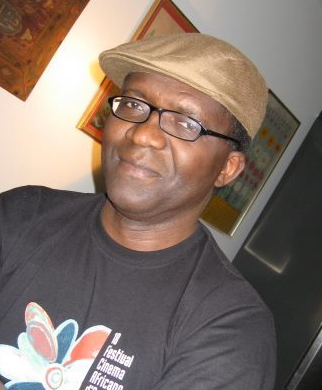
Keith-Shiri
Keith Shiri is a curator of African film, and an art exhibitor, based in Beirut (Lebanon) and London—where he serves as Programme Advisor to the British Film Institute.
Zimbabwean by birth, Shiri has been an African Movie Academy Awards (AMAA) Juror since the ceremony’s inception, in 2004.
In the second of Vanguard’s exclusive interviews, with Jurors and moviemakers, the film and television pundit makes J.K. Obatala privy to AMAA’s elaborate decision-making process.
At the same time, he also probes the attenuated evolution of cinematography on the continent decrying insufficient attention to the African aesthetic.
*****************************
Walk me through a season, of AMAA decision-making.

Keith-Shiri
Well, last year, we processed more than 800 movies. But it wasn’t just the Jury. We have people who pre-select films. The entries were eventually pruned, to about half of that number. After pruning, the residue is sent to us. And then we go through the nomination process — which, in 2017, was at Kigali, Rwanda. The next stage is the awards.
That’s when we hold the final round of deliberations. Our task, is to discuss the short-listed films and confer awards for the “Best Film,” “Best Director,” “Best Actor,” “Best Design,” etc.…
Where do most of your entries come from?
As usual, quite a number are from Nigeria. But many of those shortlisted were from Senegal. South Africa, is always well-represented. We also get film from the African Diaspora—especially South America and the U.S.A…
I hear lots of talk about a “rebirth” of filmmaking, in Senegal and the Francophone states?
No. There’s nothing like that. People are always assuming that there’s a kind of “new beginning” or a “renaissance” or something. There is a process. Africa is evolving, as are other continents. But this is not to say, that something special is happening. I think it would be wrong, to start thinking there is a “rebirth”.
But there was a time when French-speaking African countries were very far advanced, in filmmaking. Then they went into a slump and Nigeria took over, so to speak…
There’s nothing like Nigeria “taking over” …
Nigeria became more prominent…
There’s not even anything like “more prominent”. There’s no cinema, that much, to talk about in Nigeria.
I mean film…
There’s no “film”. There’s audiovisual productions—yes. But that may not necessarily be cinema: i.e., if you want to talk about the aesthetics of cinema. People should not be confused by the volume of televisual dramas Nigeria is turning out, as compared to cinema, in the aesthetic sense. It’s like, you know, an “apples and oranges” scenario.
Does the Jury judge television drama? Or only movies?
No, no, no. We talk about productions that are presented to us, as movies. Sometimes, you can disqualify something because it represents a different set of things. That’s how we prune films, in the beginning of the process. We discuss and decide, according to what we want to project, within the AMAA brand.
What genre seems to be developing fastest? Short film? Features?
…I mean, it’s so complex…Let me put it this way: All genres are evolving.
Would you expand on that?
Yes. Once upon a time, filmmaking posed a severe challenge to countries which were economically weak. You needed a laboratory to develop your film—plus all these big cans, and so on.
But that doesn’t apply, any more. I think the real challenges, are weak storytelling practices. There’s no country, no society that doesn’t tell stories. We all tell our stories. It’s a question of transformation: From oral history to written text; from the solitary performances of poets and sculptors, to the collaborative process of filmmaking. …Like any other part of the world, we have our own traditions, our own ways of telling a story—through sculpture, through painting, through music, etc.
There has always been a process. But the transformation, the challenge, is: How do we relate our storytelling abilities, to the task of transferring tales onto the screen?
How does this “transformation” relate to Francophone dominance?
In the beginning, the French intervened, with their own solution. They provided the resources for Africans—resulting in what I call, the “Francophone filmmaking model”.
The French Colonialists were looking at talented moviemakers, whom they would give an opportunity to train in Paris. They encouraged cinematography, that was in sync with their own realities… So, you had early African filmmakers in Senegal, Burkina Faso, Niger, Cameroon and virtually the whole of French-speaking Africa.
Francophone cinema, got a head start?
Well, kind of. Because indigenous filmmakers, in those regions, benefitted from the French model. They had support from the Colonial Government. But they paid a price. There had to be a political synergy with France. Hence, they were not real African cinematographers, you know. Their cinema, was in consonance with the French mandate.
It was a Colonial cinema?
Absolutely! Nigerians were kind of smart. They didn’t follow the Colonial model, quite as closely. The British were not so much engaged with cinema, as the French.
There was, a Colonial film unit. Some British were making films in Ghana, Nigeria, the Federation of Rhodesia and Nyasaland, for example, as Zimbabwe, Zambia and Malawi used to be called… But it was not cinema, as it was developing in French speaking Africa.
So, how does this play out, in the contemporary context?
Today, with the combined effects of independence, democracy in South Africa and the availability of digital technology, freedom to produce is massive and continent-wide.
Now, we are seeing many, many more films. The problem though, is that, sometimes movies are made too fast! With very little attention to the details of aesthetics — the African aesthetic.
This deficiency needs to be addressed. You have to learn film aesthetics. It’s not like painting, you know, which we’ve been doing for thousands of years. We have artists in Nigeria and in Zimbabwe. We have artists everywhere. I’m talking about the Oshogbo group of artists. I’m talking about the Zimbabwean stone sculptors… Malangatana Ngwenya of Mozambique etc. …
Africans have always been exhibiting their work—either through murals or through sculpture parks—as a means of telling their stories. But storytelling through the screen, is different…
What about countries from places like South America and the South Pacific? Are you getting any film from those regions?
Yes. We are. In 2017, we had entries from Martinique and Brazil, for instance. In fact, Brazil shared the joint award for “Best Short Film,” in the African Diaspora category.
Once again, you cannot identify a growth area in African cinema—such as the “short,” the “feature” or “science fiction”?
No, no, no. I’ve told you, I don’t quantify film, in that sense. I’d be giving you meaningless statistics. There are qualitative factors—aesthetics—that you cannot express, statistically.
Academics, often try to. That’s o.k. But it doesn’t take aesthetics—the artistic aspect—into account. African film is evolving, in this regard, like cinema in the rest of the world.
I didn’t see any science fiction nominations, last year. And you had only two animated film.
Look, let me tell you how the process works. AMAA does not put a gun to somebody’s head, and say, “Your film or your life!” People submit on their own volition. We don’t go out to source film…
AMAA is not like a festival—which actively seeks people to attend. It’s people who know about the brand, that enter their film. If more Nigerians are aware and interested, for example, more Nigerians will submit their movies. But this is not necessarily a measure of what is happening on the continent.
Tell me something about Keith Shiri.
I’m not very good, at talking about myself. I’m just a programme advisor for BFI — the British Film Institute. That’s all. I was born in Zimbabwe. And I live in London and Beirut. I read “Film and Television,” at the University of London…
How did you get to be an AMAA Juror?
Because I read “Film and Television” [Laughing]. And I do exhibitions of African cinema. I’ve also done a lot of things on African art. That’s why I talk so much about “art” and “aesthetics”.
I’m very interested in the African aesthetic. I’m interested in African storytelling and also in theatre. In short, I’m interested in African representation, if you like.
Many of the entries people were expecting to win big last year, such as “93 Days” and “’76,” didn’t do very well. No. Because we’re independent. We discuss. We all have different opinions. There’s a group of us. But we’re all coming from different backgrounds. We talk. We agree about cinema—the structure, the story and everything. And then we decide. There are five films per category—eight for the Best Film. And there are 10 of us. We each will have to look at every film, maybe, three times…So, you have to really convince me, before I vote for a particular entry.
Which categories are most difficult to judge?
It’s often “Best Director” and “Best Film” … I don’t know how it will play out in 2018. But last year, was different. Almost all of us agreed. Consequently, deciding the “Best Film” and the “Best Director” was quite easy. For the first time, during the deliberations, I was in the majority camp! I slept very well, that night!
Disclaimer
Comments expressed here do not reflect the opinions of Vanguard newspapers or any employee thereof.