
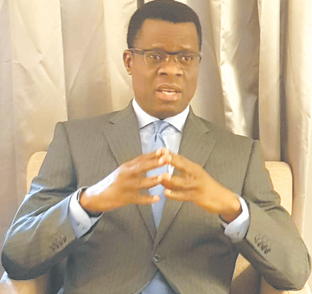
Mike Igini
By Lekan Bilesanmi
In this interview with Mike Igini, Resident Electoral Commissioners, REC, Akwa Ibom State, he discusses his involvement in the struggle to actualise the June 12 mandate. He also praises the courage of President Muhammadu Buhari who, against expectations, has recognised the primacy of June 12 in the annals of Nigeria’s history. Iguana, therefore, posits that the internalisation of the spirit of the mandate will go a long way to make Nigeria a better country. Excerpts:

Mike Igini
On the 29th of May 2018 in a television interview, you decried the continued celebration of that day as democracy day instead of June 12. What was your initial reaction when you heard that President Buhari has declared June 12 as Democracy Day?
I felt elated with a spirit and a sense of upliftment for the memory of Chief MKO Abiola that June 12 has finally been officially recognised after 25 years of denial. I felt happy in memory of a man I came to know closely in the course of pursuing the cause of justice and the call to sustain the legitimacy of a democratic mandate given by the people of Nigeria, but truncated by a few hegemons to foster the narrow interests which they elevated beyond the sovereignty of Nigerians. However, by this honour and declaration of June 12 as the real democracy day, the President has written his name in the sand of time by commencing a process of closure and healing for the injustice done to Nigerians and MKO Abiola as well as many other Nigerians who were also killed or suffered one form of deprivation or another during the struggle.
Even now that contestation by a handful of people hidding under legal hermeneutics still rages but an overwhelming number of Nigerians who are in the majority are in agreement that June 12 should really be Democracy day. Don’t forget that the choice of 29th May was deliberately chosen to obliterate the memory of that watershed event in our history by the beneficiaries of the annulment. They knew that May 29 would have been impossible if we had not experienced the June 12 possibilities, yet they chose that day just to spite us as a people that we were totally defeated on the matter of June 12 but here we are today telling the story.Without June 12 there would not have been May 29th, the day those who aborted the democratic dreams of Nigerians to return to civil rule had their way.
At some point during the struggle to revalidate June 12, it was given a regional toga by some Nigerians. Was that right or justified?
That was one of the military government’s divide-and-rule antics but that was a patently untrue accusation made against the people of the South West then in order to isolate them and make our entire struggle look like a regional affair which was not true. Expectedly, unprincipled politicians and those who were either tired of the struggle or had been pretending to be standing on June 12 found that as a convenient excuse to abandon what should be a sustained collective resistance of a common social injustice.
They failed to appreciate the saying of the elders that even though the early morning crow of a cock is for the entire community, the cock is nevertheless owned by an individual. MKO Abiola came from a family in a community located in a part of the country whose pan-Nigerian mandate was annulled. It should be expected that people from that part of the country should feel injured more than others and when he died in the most questionable circumstance, they also lost more than the rest of Nigeria by the passing away of an illustrious son and bread winner. Today you can see what has become of MKO Abiola’s empire after his death. Finally, on the useless charge that it was made to look like a South West affair, they have forgotten that their commitment to fight against that grave injustice is also consistent with their history which they also demonstrated during the Yar’Adua saga when the then Vice President Jonathan was denied the acting capacity in breach of the constitution.
The Save Nigeria Group that provided the platform to engage the state was formed mainly in the South West and not in the South South where many of its leaders opposed what we were doing and in fact some of the governors were sending video recordings of organised night vigils to Saudi Arabia to show what they called loyalty. The hypocrisy of those who made the accusation at the time, many of whom are still living had been exposed with the passage of time since 1999 and the consistency of the people accused affirmed by the fact that it has always being the South West states that have been observing June 12 as a public holiday, thereby demonstrating that the virtues of justice are universal, unchanging and good for all, irrespective of who you are and where you come from.
You were one of those who, through student union activism as President UNIBEN Students Union, fought against the annulment of June 12 presidential election in 1993. What really happened then and what emotions does that engagement evoke?
No regret at all, in fact l’m still bitter over the annulment of such a historic pan-Nigeria mandate that was scuttled. What happened then was that, as a student Union body, Parliament passed a resolution that June 12 must be realised and the Executive which I led then as the President, recognised that the Nigerian people voted for Abiola, but an unelected leader, decided with civilian collaborators- some of whom are still around and active in their evil ways annulled the election.
You may recall that as part of his efforts to also mobilise the International community to put pressure on the military government, Chief Abiola travelled out of the country for that purpose and he was accused of abandoning the struggle which was not true. Many unprincipled politicians used that as an excuse to abandon the collective efforts and the tempo was going down and the struggle needed an increased momentum and so when MKO Abiola came back from London after about a hundred days, we went to him because the student body in UNIBEN had decide to name the new Student Union Complex JUNE 12 Building as its still being called today.
We felt that since he had just returned back to Nigeria, it would give great impetus to the struggle if he came personally to open the complex and he came to Benin to officially open the ultra modern Students Union complex with all the threats of arrest and detention. During my private interaction with him, I found that he was resolutely committed to actualizing the people’s mandate. He assured us that he will not waver because he recognized that the issue was no longer his personal matter anymore. He pointedly said, “if this was just my personal transaction it would be different, this issue is now a matter of the Nigerian people and those who stand against their aspirations”. He was such an intelligent man, his depth of insight inspired hope and strength in us. In those few moments I could see in him the strength of his character why he was able to conquer his sphere of influence.
After 25 years of democracy in Nigeria, are you convinced and happy that this is the kind of democracy you struggled for in 1993?
I don’t believe we have reached where we aspire to be but democracy is not a final product that you graft into society, it grows with the growth and evolution of society. To elect representatives to make decisions on our behalf does not mean that we have given up the right to make those decisions ourselves, we have only delegated that right periodically through elections, because it is not feasible to reach quick decisions because society and the diverse things we do are now numerous and complex. But many who have been so elected to meet this goal now believe that delegated power to represent the people is an abdication , a relinquishing of the peoples right, hence they now see their role as owners of the people rather than servants. In the 19 years that we have had democracy or better put civil rule, you must understand that we have been in a weaning period, still trying to re-socialize civilian people elected to positions of authority away from the diet of military era mentality.
l believe that the ills of democracy and its challenges can only be cured and overcome by more democracy with constant practice as we aspire towards the ideal of democratic maximalism in which case the outcome for our people will get better. If we use Dhal’s framework of analysis on the progression of ideal polyarchies, such as the United States and United Kingdom, where parties have been contesting elections for over 189 years and you compare it with our current experience of about 19 years you will see that we are still at the beginning of that Dhalian progression to ideal polyarchy, from liberalization where closed hegemonic regimes become competitive oligarchies and then progresses to inclusive polyarchies. So from the June 12 experience, through the experiences of transitions up to our experiences of party mergers and defections, you can see traces of the analytic framework of Dhal that our democracy is work in progress.
Do you think that if the June 12 1993 presidential election was actualized, the country’s democracy would have been better than what we have experienced in the last 19 years?
Whatever we hypothesize, we would never know now; it was a missed opportunity. Nevertheless, the idea of a two party system which is ideal for Nigeria would have been well rooted in our practice of democracy. The issue of Muslim-Muslim candidates may not be an issue today or may just be marginal, and the fact that the system of nomination of candidates, option A4 that many Nigerians often wrongly refer to as a mode of voting would have been well developed as part of the electoral process in Nigeria. Indeed, the fact remains that the key goal of democratic governance is for the governance process to generate multiple centers of opportunities for the development and wellbeing of the citizens, this is the root of our support for restructuring of the country to make federating units more productive instead of oil revenue sharing centers. If we have had multiple centers from which opportunities where generated for Nigerians to prosper since 1993, and we consider the opportunity cost of such development given the years that were lost to the locust of authoritarianism afterwards, we can say for certain that we lost a great deal.
Why is it that the same spirit and commitment to the actualization of the June 12 is lacking among youths of today?
The youths of today face many challenges and limited opportunities, but mainly, we have lost that spirit amogst our youths because our values pyramid is now on the reverse. The present day youth have become so inundated with the wrong values such that they are now made to believe that everything now is about money. No more pursuit of ideas and committment to principles. The emerging generations of Students Union leaders have in many cases become so disoriented with the distortions in our values that some of them now compete with politicians in the use of sirens. However, as part of the development of the democratic culture we prefer that all tiers of government should create platforms of participation so that people can have more entry points for democratic participation and be able to influence democratic decisions.
When we have such processes reflexively, we will not need to have to compel leaders to do what is obligatory to their functions by civil disobedience. Additionally, the technological advancements in the information technology world has expanded the social public space such that you don’t necessarily need to go into the streets to make people aware of things you can spread within minutes to millions of people globally through facebook, Instgram, Whatsup, Tango, Viber, Line etc. Hence the discursive ambiance propounded by Jurgen Habermas that the public sphere can help to proffer solution to social problems in democratic culture by propelling action has been considerably enhanced by technological advancement.
You have been calling for legislation for a compulsory electoral debate for all elective offices like the great debate between MKO Abiola of SDP and Alhaji Tofa of NRC. Why are the elites not championing this idea?
Certainly and I will continue to advocate that public democratic debates be institutionalized, especially now that we are in the scheduled periods for Party primaries because it is an essential practice of democracy that gives voters ample opportunity to assess the competence of those who want to preside over public affairs, that someone has bags of money doesn’t make him a leader. Compulsory debate on key issues of governance that matter to the people like security, economy in terms of job creation, education, health, addressing the gap in infrastructural deficit and so on, will compel political parties to recruit competent candidates for election and this will drastically reduce the influence and number of people who have deep pockets but have little or nothing in terms of leadership competency to offer.
Debate will not only act as an institutional social filter for political and leadership competency it will also relegate the recourse to ethnicity, religion and region to the backseat of our politics. That was why MKO was able to defeat TOFA because Nigerians saw that Abiola had a better understanding of issues of governance than his opponent during the debate and so they voted massively for him hence he defeated his opponent in his opponent’s home state of Kano. Debates make candidates to self-account for their public and private records and allows the voters to evaluate the candidates’ vision for the position they aspire to and the society they want to build and add value to.
How best can we institutionalise the spirit of June 12
We must not forget that one of the key developments arising from the proclamation of June 12 as the new date for celebrating democracy in Nigeria is that an agenda has been set for every post electoral cycle. By this feature beginning in 2019 exactly 2 weeks after every oath taking ceremony on May 29th which is compelled by term limits statutes, there will now be a compulsory need to remind ourselves of a democratic reference point, namely, the June 12 elections celebrated on every June 12. Therefore, how the two weeks after such oath-taking will be celebrated will be dependent on the legitimacy of the election that precedes it. We must therefore strive to meet the electoral quality that June 12 exemplifies if the June 12 that follows any general election will not become a platform for protests rather than celebrations, because the people will always remember an opportunity missed and compare the current with the past on that date.
A good way to begin to ensure that each June 12 and especially that of 2019 is a day of celebration is therefore to work towards acceptable and legitimate elections. From our history most of the problems with elections in Nigeria often begin in the party primaries, instituting debates and a process that is transparent and acceptable to party members and the Nigerian public is therefore what helps to demonstrate our true commitment to June 12 and what it stands for. A situation where we continue to have party primaries that do not conform to basic electoral principles, where for party members to see the delegates lists for political party primaries before nominations requires a visit to the ancestors or political gods, where there are no compliance with laws that every party member can reference, we cannot build an enduring democratic society on such terms. As political parties progress towards 2019 beginning with acceptable intra-party competition before progressing to inter-party contests, this is the time to truly stand for the edifying principles that make June 12 worth celebrating.
Disclaimer
Comments expressed here do not reflect the opinions of Vanguard newspapers or any employee thereof.