
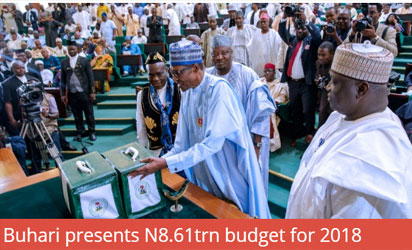
Buhari presenting 2018 budget to joint NASS session
By Henry Umoru
ABUJA— Senators yesterday began debate on the general principles of the 2018 Appropriation Bill of N8.612 trillion presented before the National Assembly by President Muhammadu Buhari.

Buhari presenting 2018 budget to joint NASS session
The senators, across party lines, did not hide their reservations as they lampooned the entire budget proposal, even as many of them declared that N11trillion collectible revenue proposed in the budget could not in any way be met, going by the experiences of previous years.
They, however, called for increase in the oil price benchmark from $45 to $50 per barrel. The purpose of the debate, yesterday, was for the budget to pass through second reading, but debates will continue today.
Senator Enyinnaya Abaribe (PDP), Aba South, who fired the first salvo, described the projections in the budget as fictitious, in protest against the position of Senate Leader, Ahmad Lawan (APC Yobe North).
It’s dead on arrival — Abaribe
Senator Abaribe said: “Since the 2018 budget is projected to consolidate on the gains made by the 2017 budget and the 2017 budget performance percentage is just about 15%, automatically the 2018 budget proposals are done on wrong projections, which to me, is dead on arrival.
“What was done in 2017 when less than 15 per cent of that budget was released? Nothing was done. That is why I call it fictitious. I withdraw the word fictitious and say that it is totally imaginary. Nothing was done in 2017. That is fact that we all know.
“This is imaginary. We beg this government to be very specific in the indications of the assumptions underlining this budget. The assumptions are totally wrong and totally off the mark.”
In his contribution, Senator Joshua Lidani (PDP, Gombe South) said the proposals and projections in the budget as far as expected revenues are concerned , are nothing but building on quicksand and very weak foundation.
Did Buhari go through the budget?
On his part, Senator Abubakar Yusuf (APC, Taraba North), wondered whether the President went through any of the budget proposals prepared for him by bureaucrats before presenting them to the National Assembly, going by the yearly heavy shortfalls in revenue projections.
Yusuf, who noted that the global economy was still unstable and thus affecting Nigeria’s economy, said: “We are still relying on oil. We have not fully taken off really in the critical area of diversification. While we are happy the foreign reserve is rising as a result of increase in oil prices, this budget will only be implemented if the federal administration is efficient.
“It is still inefficient because the revenue institutions are not performing to the expectation of the budget. The reason the revenue institutions are not performing is we have ‘fiscalised’ our revenue bases because without installing ‘fiscalisation devices‘, we will not get the revenue that will support the expenditure of the budget.”
He said rather for the Presidency critically looking into what could be done in making agencies responsible for non-oil revenue generation brace up, it keeps projecting unrealistic revenue collections on yearly basis as experienced this year, where only N155 billion was realised out of the projected N807 billion independent revenue generation.
Contributing, Deputy Chief Whip of the Senate, Senator Francis Alimikhena (APC, Edo North), who faulted the budget proposals which he described as over-bloated and unrealistic, said: “Year in, year out, we are inundated with bloated budget estimates that cannot achieve performance implementation beyond 15% it achieved this year.”
According to him, since the price of crude oil in the international market is above $60 now, the oil price bench mark should be jerked up from the proposed $45 to $50 as a way of maximising the projected N6.387 trillion oil revenue since the projected N5.597 trillion non-oil revenues are not realisable.
It’s a budget of active imagination — Ben Bruce
On his part, Senator Ben Bruce (PDP, Bayelsa East), called for drastic reduction in the cost of governance, with the scrapping of agencies performing duplicated functions.
He said having a budget profile where 25% was meant for debt servicing and 71% for recurrent expenditure showed that the country had no budgetary proposal at all in the real sense of capital expenditure.
He said: “We have downgraded our economy and the reason is that we cannot meet our revenue projections. It is understood that this is a budget of consolidation; I would rather describe it as a budget of active imagination.
“If you look at the budget from 1960 to the present, you have agencies that were designed for 1960, agencies that were designed for the Nigerian civil war, agencies that were designed to suit some certain conditions in life.
“60 years later, those agencies still exist in the budget. If you look at the budget, you will see some agencies, they get recurrent expenditure, they pay salaries, they get houses, computers, cars but they have no money to do any work; we pay salaries.
‘’Some agencies are so bloated it defies logic but these agencies exist. So, we have 2.4 million people consuming 60 per cent of the recurrent expenditure of Nigeria, it doesn’t make any sense.
“I called President Obasanjo (former President Olusegun Obasanjo) on phone two days ago and he said to me, the National Orientation Agency was necessary when we had no political party, what is the value of the National Orientation Agency in today’s world for instance? Yet billions of Naira are spent in that agency.
“Let us look at agencies that make no sense. FRCN, sell it to the staff; FRCN has 8, 000 workers, sell it to them. Sell NTA to the staff. Voice of Nigeria, who listens to Voice of Nigeria? Sell it. If the staff wants to buy, let them buy it.
‘’Set up a cooperative like Awolowo did, sell it to them. If we spend 71 per cent on recurrent expenditure, we will never get out of this predicament we find ourselves.
“The United Nations projected that in February 2018, Nigeria will have more people in poverty than in India. We have a population of 180 million people, India has 1.3 billion. Then, if we are going to have more people in poverty than India, then we have to create jobs. Once we create jobs, we can then export our Naira to China, to India or some other places.”
Let’s bring bills to cut govt size and reduce waste — Ekweremadu
In his remarks, Deputy Senate President, Senator Ike Ekweremadu, who presided over plenary, said without revenue, ‘’we would have no money to do the expenditure; we must point out in the course of the debate how we will be able to reduce the deficit. Ben Bruce has told us that some government agencies should not be in existence anymore.
“We need to point out some of these MDAs that are of no consequence or adding no value in Nigeria so that we don’t keep spending money on them because that way, we will be able to reduce the ratio between the capital and the recurrent and, of course, reduce the deficit.
‘’I hope government will listen to such exposure and be able to do away with such agencies. If the government fails to remove those agencies from our budget, we have a responsibility to Nigerians to bring bills in order to repeal the laws setting up those agencies and stop wastage of our resources.”
Disclaimer
Comments expressed here do not reflect the opinions of Vanguard newspapers or any employee thereof.