
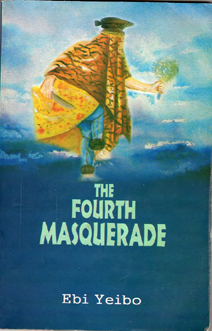
THOUGHTS OF PEACE AND REVOLT IN EBI YEiBO’S THE FOURTH MASQUERADE
BY EKANPOU ENEWARIDIDEKE
Ebi Yeibo, a lecturer at the Department of English and Literary Studies, Niger Delta University, Wilberforce Island, Bayelsa State, an indigene of Ayakoromo in Burutu Local Government Area of Delta State and Ayamasa town in Bayelsa State, the author of Maiden Lines (1997), A song for Tomorrow (2003), The Forbiden Tongue (2007) and Shadows of the Setting Sun (2012), is a young man who inhales and exhales poetry anytime he is on the stern of any canoe on River Forcados paddling away – a man who seeks nothing from Literature but only poetry as he has poetically hollowed out five dug-out canoes just enumerated. In his current collection of poems entitled The Fourth Masquerade, which is made up of 48 poems, Ebi Yeibo has amazingly deployed his age-long fluid canoe-carving skill and capability to hollow out canoes envisioned to awaken the Nigerian Federal Government and the multi-national oil companies to a looming Armageddon destined to become the ‘Revelation’ of Nigeria as a country. The ‘The fourth masquerade’ is the first canoe skillfully hollowed out by the carver Ebi Yeibo in this collection of poems.

The fourth masquerade, traditionally the last masquerade in a processional dance of masquerades, is always amazingly electrifying in its dance. The fourth masquerade, seen during the Ayakoromo Olorogun masquerade festival, runs after or pursues people frantically, though playfully, to strike. The origin of Olorogun is traced to Aye, a fisherman in whose net the fish is caught in Aghoro river and subsequently carved into a beautiful head-piece. The fourth masquerade is a masquerade that entertains and pursues runners to strike. The fourth masquerade often seeks runners to strike on Ologorun day during the season of masquerade festival in Ayakoromo. Characteristically the poet uses his pen to chart the way forward by saying that his lines are designed to awaken people to their responsibilities as:
‘These lines are the owl
Hooting ominous messages
In choking pain
In pubescent twilight’
Reminding man
Of the burden of being –
To wake his blood and dust
In the scowling mist.
Reminding man
The loaded canoe
Sails near the shoreline
Raw palm fruit causes cough’
The poet seems poised to attack and bomb those who ignore their responsibilities by eating raw palm fruit. The loaded canoe symbolizes a boat loaded with weapons. However, as a wise man, the poet imagistically disguises his intention by communicating in ambiguous language because to him:
‘The wise utters little
Sinking into the smokescreen
The unreachable depths
Of their homely skins …’
Clearly, bombs await those who ignore the didactic lines of this poet.
QUESTIONS HANG IN THE WIND
Life on earth, with all its burdens and challenges, is a place where man constantly seeks answers to impediments/problems. Though the poet satirically reveals that a change of family relationship could be the solution to life’s problems when indeed life’s problems originate from blood; only sincere attempts/hearts can remove man’s burdens and entanglements because:
‘And each step of penitence
Or rectitude or doxology
Springing from shallow depths
Only yield more questions
More complications,
More complications sweat,
Like an entangled gold fish
strangling in vain for freedom’
Only sincere approaches can guarantee disentanglement from man’s daily burdens and hanging questions.
THE BURDEN OF BLOOD
This poem echoes exploitation and mismanagement of resources to the disadvantage of Niger Deltans who are the owners of the resources. The people privileged to manage resources exploit the owners in succession. Developmentally exploited and besieged by the government, the poet adopts a militant strategy to get rid of the endless burden of exploitation and oppression when he declares angrily:
‘O give this burden a rightful name
Uproot its noxious suckers
With matching matchers and mattocks;
The Okra tree, however, tall,
Must bow to the whims
Of its indubitable owner
Along the corridors of the wind’
To the poet, develop the Niger Deltans or risk revolution.
THEY NEED NEW NAMES
(For El Rufai, nPDP & APC):
A portrait of the tragedy that comes upon PDP occasioned by the defection of its members to APC. The poet is skeptical about the change heralded by the defection; he holds the position that poetry should be consciously engaged to avoid any descent to the abyss:
‘We must paddle this heaving catch
Past swollen waves of the sea
Past hounds and bulldogs
Prying eyes of devious saints
And their double-decked munificence’
In soft homely songs of the soul’.
Skeptically fearful of the heralded change, he calls on all to play roles to avoid a repeat of the past.
THEY NEED NEW NAMES II
(For EL Rufai, nPDP & APC)
A portrait of total disgust for the new party formed out of PDP. The elements in APC have nothing to offer beyond sugar-coated preachment of functionless ideologies and sanctimonious derogation of PDP leaders. To the poet, the APC would disappear as soon as it has been used to achieve their notorious aim of self-enrichment. The red palm fruit would be discarded after it had been pecked to the shell. The poet sees nothing in the ability of APC to bring about progress as they are the same corruption-tainted elements out to hoodwink the masses.
‘The bottom of this new name
Is in the enchanting melodies
Of the sunbird gleefully pecking
At red palm fruit
As if glued to the feast
In the forest of Amatebe’
Beyond the portrait of APC as fake elements of the supposed change, the poet shines his critical light on their corrupt nature when he says:
‘So why do the new saviours
Point to the rainbow
In the not-too-distant sky
Forgetting yesterday, when they
Pocketed the communal pouch
Blinking none of the six senses
Without sweat or contrition
Surpassing the penchant of their forebears
In the acrobatic mould
Of a monkey diving at banana?’
APC is composed of elements that suck a nation dry without conscience.
RAGE IN THE DESERT:
(For Boko Haram)
Terrorists kill people mindlessly and sadistically anchored on the belief that such actions would quicken their passage to paradise. The terrorists are not appalled by their atrocities since they believe, though erroneously, that they are glorious acts in the sight of God. Beyond the sadism displayed by terrorists, the poet sees it as a product of power schemers. The scourge of the terrorists planted by power-schemers has not been degraded by Aso Rock as all their counter-efforts have done nothing to eradicate the carnage unleashed by the terrorists; so the ‘moon’ ominously continues her mating dance. To the poet, it is the wrong road cleared to power-seeking that perpetuates the carnage resulting from the terrorist thrusts. Terrorism would not have come at all but for the dirty route of power-seekers who see it as a route to power. The poet’s voice sounds clear on this position when he says:
‘O the detached logic
Of power schemers
Who see human breath
As a mere off-and-on switch
Like the cement code
Of coven kings
Takes over the cringing earth
Replacing tingling crops
With tripping tombstones’
To the poet, power-schemers are creators and profiteers of the carnage caused by terrorists in Nigeria.
WE HAWK HORRID MEMORIES
(For Boko Haram)
This is an impassioned call to put an end to all the stories of morbid achievements by the terrorists in their misguided rage; a call to an end to all stories of atrocities, miseries and tragedies of the victims of the terrorists. Let the focus centre on investigative moves geared towards eradicating the monster of this carnage. The poet calls for innovative strategies that would totally end the monster because half-hearted strategies would breed more monsters. No more glorification of the activities of Boko Haram just as there should be end to mourning of the atrocities, or stories of sympathies from statesmen and stupid active sages. The preoccupation should be on this:
‘Let us probe the masked moon
That deceived the straying cockerel
Into the depths of night;
Disarm her grinning antics
Or fall into the trap –
Except we smash the head
The wriggle of the wounded cobra
Is a steady sauce for suspicion.’
The poet calls for a radical solution to the scourge of terrorism so the ‘mocked Moon’ chastening the straying cockerel could be unravelled and light released to the joy of humanity.
FACING THE FLAMES
(For Boko Haram and Sponsors)
There is destruction and carnage in the country caused by the terrorist activities of Boko Haram, and these atrocities are orchestrated by vindictive ideologically misguided human beings. The poet calls for a merciless crushing of these destructive elements by ‘incensed green men’. Upon the atrocities unleashed on humanity, a corresponding karma will come upon the perpetrators. Specifically, the poet identifies someone who loses the vote of the people in the general election as the mastermind and sponsor of the Boko Haram. The so-called loser vents his anger vindictively on the masses by sponsorship of Boko Haram. The tag of vindictive sponsorship of the Boko Haram is reinforced by these lines.
‘Seize the wind
With bombs and bullets
Bellowed the surly voice
In the background
Rejected in the general count
Like in the guard count
Like a spurned suitor
Igniting furnaces of mass murder-
Whetstone of another war
On the back of a sullen loss.’
Beyond identifying the mastermind of the natural blaze, the poet believes that the priest of Odele can extinguish the blazing fire. Odele is a famous god in Ayakoromo in Burutu Local Government Area of Delta State that accepts live dogs as sacrificial appeasement whenever it is offended, or whenever petitions for action over particular matters are made to it. Confident in the power of Odele, the poet calls on the priest to wipe out the scourge of Boko Haram.
‘Let the priest of Odele
Sanctify the surly horizon
Save this burning place
Of yet another black plot’
Embittered by the terrorist activities of Boko Haram, the poet is not bothered that the intervention of the priest of Odele would cause further atrocities of deaths provided the terrorists are degraded.
‘To mate the menacing clouds
In the ripest season
Leaving behind
Howling offspring of carnage.’
A poet embittered by Boko Haram-induced carnage has turned a terrorist by calling on the priest of Odele to crush and cause more carnage in the land.
LEGENDS OF TODAY
(For the 26 Bayelsa unemployed graduates)
The poet is disgusted with the dead human beings moulded and celebrated as legends in Bayelsa State because these legends are the ones who suck the state dry and impoverish the masses. The poet also sees as vanity and waste of time and resources exhuming Boro’s body, taking it to a place and buried and celebrated as a legend. He dislikes the elaborate ceremony associated with this stupidity seen as desecration of the ‘aquatic splendour’ of Boro’s original burial ground. Rather than engage in the frivolities, the government should pay attention to lads turned snail-hunters in the cold and dark night in the forest, toiling to earn a living, and the children of Boro who is today celebrated as a legend. Here the poet turns a judge after a survey of the frivolities.
‘O let us look the way
Of lads carrying hurricane lamps
To find a path
In the long grisly night,
Like striplings foraging for snail
In the dark and damp corners;
Trudging with calloused feet
And dehydrated physiognomies
In clouded valleys
In the cold wind.
Let us look the way
Of Boro’s extended offspring
In their suffocating corner of the earth
So they invest the capital
Gleaned through sappy sweat
On marshy, knotty roads
In saltless horizons.
What corpse, buried,
Leaves its legs outside?’
Boro’s children and those associated with the struggle of Boro need special attention. Here the poet seems to have in mind Samuel Owonaru, Boro’s second-in-command, now wasting away in Kaiama due to lack of special attention.
THE TRIUMPH OF CHARLATANS
(For the new wave of Christianity)
Paints a repellent picture of morally putrefying and religiously rootless people seeking the face of God in the temple – morally dead people that always deprive their fellows of their entitlements like the antics of the madman of Amatebe fated for seizure of people’s stomach-offering. The poet is distressed that these rogues are seen in the temple of God. In his distress he turns himself a pastor telling them how they can be at peace with God through purgation of all types of mendacities in their dark hearts. The acts of these charlatans portend ill for the society as they give birth to more sinful acts against humanity and God. The poet’s torchlight flashed on the safe path, he maintains that sweat and bruises are the breeding ground for the emergence of legends though the imprint of destiny on man is irresistible. Though destiny plays its own role in the life of man, it is irrefutable that hard work is the portal of legendary achievement, approved of even by God, not charlatans invading the temple with dark hearts.
‘… Purge your mouth of mendacities
Tainted instincts do not fit into light’
‘Legends sprout from sweat
And the promise of bruises
In every conceivable field
Though the gods lubricate moral paths
With morning dew that dries not
Until destiny’s deal is done
In the infinite expanse of the sea
In wild wanton wavelashes.’
THE WRONG INHERITANCE
(for the middlemen of the creeks)
The agitation in the Niger Delta borne out of developmental deprivation would always continue because middlemen dispatched to seek peace are very selfish, corrupt, conscienceless, insincere and self-profiteering people who see their mediatory role as a treasure trove from which they reap millions of naira, leaving in their trail unfulfilled dreams and promises. For genuine Niger Delta agitators who are disgusted with the unfulfilled hopes associated with faulty mediatory moves, agitation muscles would always be flexed victoriously to the tragedy of the Federal Government. To the poet desirous of genuine peace in the creek:
‘So something disqualifies
These seekers of peace
On the swirling waves of the creeks
Middlemen who dance on the graves
Of saints sacrificed in the struggle
Who take the lion’s share
Of the proceeds of truce
Beyond prying eyes.’
As long as mediation in the Niger Delta problem is politicized and made a profiteering adventure for a certain class of decadent middlemen, turbulence lingers in the creek because:
‘Nimble patriots who spit on
The lingering pains and spleen
Over unfulfilled prophecies
As fiendish and foolhardy
As squabbling landlords over territory
At my Agudama* backyard
Nibbling away, in secret triumph
Like the wraith-like Odidigboigbo*’
FOR HAMZA AL-MUSTAPHA*
The dominant picture is that of corruption in the Nigerian courts. Because judges are corrupt, criminals brought to court are often confident that they will bribe their way through and escape the punitive hand of the law. This judicial corruption and sinister compromise is what the poet bemoans – the arrogance of criminals boosted by corrupt judges.
‘ The courts are a torn net
Hauled on the river; roving
Fish have a field day
Swimming through in shiny scorn;
Even the ones caught
Send a telephatic message
To their empathizing kindred
From the home-bound canoe
Through unyielding hyacinth
Not t mourn yet
Until they enter the pot.’
NO FESTIVALS HERE
The crude oil in the Niger Delta bestridden and besieged by exploitative monsters and leaders at the top, the owners are reduced to a life of existence in shacks, slums, where they work for livelihood like earthworm while the monsters enjoy the oil to the fullest. The owners are hunger-stricken in the midst of great wealth poetically cast as ‘a heaving petalled harvest hanging in the horizon.’ Reduced to life of slums and drudgery, having been conquered by the monsters at the top, the women become sexual playthings in the hands of the exploitative monsters as they are circumstantially forced to hawk their bodies for a living. In these pitiable circumstances of existence, their culture suffers irreparably as they have lost the capacity and appetite for celebration of festival with the exploitatively intrusive ‘over-spilling clouds’ over the land: Niger Deltans suffer bodily exploitation. The money from the crude oil exploitation is further deployed to exploit the women bodily.
‘Deepening strains of blood
Interlocked in the setting sky
Where midgets of men
Maul head-mountains
Or take them as footstool
Or, better still,
Image injectors, or projectors
With sprawling purses;’
What the poet brings to light is the mindless exploitation of Niger Deltans in their gradations – showing that crude oil has become a weapon to degrade, impoverish and destroy the people in every conceivable way – including the killing of their culture. No more festivals and so their love for one another and peaceful co-existence suffer too. The crude oil produces milky monsters, and produces slums, whores and poor people in the Niger Delta.
THIS LAND STANDS ON ITS HEAD
A portrayal of religious hypocrisy in the Roman Catholic Church. Beyond the showy religious fervour of the Catholic Catechist demonstrated at Angelus, beyond the religious fervour demonstrated by Reverend Fathers, Reverend Sisters in the open, the poet’s memory reveals that they are all stinking religious hypocrites full of transgressions concealed beyond the prying eyes except the poet and his bell-ringing playmates. To the poet, it is pitiably laughable too see the religious hypocrites dignify or reverence the crucifix publicly while their inner minds stink.
‘O these stars in white smock
Who pamper the crucifix in public
Cloaking lewd laughers
In inner corners of the mind’
‘Swallowing up any spark
In endless stretches
Of potholes and puddles, dismembering
Wrinkled seventh-grade cars
In freezing tales of lost limbs
With no balm for gash
And the air taut
Like a steel rat trap.’
Th poet’s memories of the sins or peccadilloes of the Reverend fathers and sisters are so ridiculously dangerous that the memories are cast in the aquatic image of turbulent waves that are eventually swallowed by waiting mermaids.
‘The snags of memory pile up
In the air, land, water
In loft jocund leaps
Like laughing silver waves
Sliding light on the ocean
Before a licentious crash
Into the cataclysmic embrace
Of long-yawning mermaids.’
Connotatively, the poet holds the view that the religious hypocrites would be destroyed like the waves swallowed by waiting mermaids. Damnation awaits cunning hypocritical reverend fathers and sisters. However, like crocodile entrails not cut open in public, the poet does not want to reveal their ‘dark entrails.’ By this attitude the poet strikes the readers as a bad person who would rather see this world destroyed by the activities of religious hypocrites.
OPEN PARADOX
It is incomprehensible that despite the wealth of crude oil in the land, Niger Deltans are still in poverty paddling away on canoes for a livelihood like a bride positioned on the back seat on her own wedding day, like a damsel wantonly dismembered after a remarkable musical performance on the podium. The aborigines of Niger Delta are leading a life of destitution despite their oil wealth which ideally should be a source of happiness to them. This paradox is what the poet paints a picture of rather sombrely when he says:
‘Yet the economy of aborigines
Shrinks in dire thraldom
In long laborious labyrinths
Baring the smudge
Of soot on the white smock
Of coast dwellers paddling
On the margins
Of their own oily swamps,
Like the strange dilemma
Of a gleeful bride
On the back seat
In her nuptials
Or the damsel in delectable apparel
Who strummed soulful songs on the podium
To a roariously doting crowd
Only to fall to a sword
In an ante-room, without a row.’
THE HOWLING WIND
The poet sees wind as an incomprehensible force expressive of the Divine Intelligence. The wind that howls is a force that is seasonally destructive and constructive in the life of man – as its howling moves produce various impacts on the activities of man. Drawing attention to the incomprehensible powers of the howling wind, his appreciation of the wind’s ubiquitous powers, admission of his powerlessness before the howling wind, he wonders if man understands the seasonal ambivalence of the howling wind when he says:
Leaves sway their wet waists
In the rapturous raiding season
In love tango with the wind
Bearing vermilion fruits
Carrying the incandescent burden
Of a squinting squire
Condemned to meandering paths or ways
Or muffing altars or temples.
Does man know
The same wind sails
Flailing mortals in the dry season
Distributing acrid desert dust
To every naked nostril
When all nature shrivels
Like a dehydrated cholera patient
Flailing to float leisurely
In the blue sky
Like the squeaky kite
Like a burst balloon.’
Though the howling ambivalently brings ‘vermillion fruits’ and acrid desert dust, what the poet has for the wind is that of total reverence and appreciation.
FATE OF MAN
The joys that emanate from victory at war over sophisticated forces using neutron bombs and howitzers cannot be caged as they storm everywhere like overflowing river bank where the tide is full.
‘Globules of triumphant blood
Gurgle in a swelling heart
Wading through boiling waters
And neutron bombs
Shaming the brittle barricade
Of hurricane and howitzers.’
The poem celebrates victory over forces of exploitation, oppression and pulverization by a people using their own war strategies. The brittle barricade lined up against them ridiculed, the oppressors run away feverishly for survival. The victory and the feverish flight of the sophisticated forces of pulverization are cast here by the poet thus:
‘The blistering sunlight overwhelms
The howling wind, the sultry birds
In forlorn feverish flight.’
Here the ‘howling wind’ is a destructive human force out to wipe out a people.
IN THIS VAST WORLD
Portrays a world where great dreams are killed by the oppressive and diabolical activities of vagabonds turned ‘inviolate titans’ who derive their commanding and controlling powers from ancient gods, Babalawos, witches and wizards in the coven. Seeing the world mangled by these forces using diabolical powers to summon society to do their bidding, dead to the light of God, the poet calls for thunder from above to end this disgusting system of things temporarily suffocating the world. The poet sees the titans and their spiritual/physical accomplices as damned souls due for annihilation by thunder.
‘May thunder release
The muffled manhood of the masses
In meteoric flight to the moon
In the simultaneous echo
Of seven primed cannons –
The hen’s sickness
Never tarries till evening;
The foliage of freedom is ever fresh
In silhouetted forest
Of shriveling thorns and cactus.’
THE CHILD CAN PLUCK THE MOON
In a world where the dreams of a child are barricaded by ‘baying hounds’, ‘sulky soldier, ants, ‘early birds, ‘Agbogidi’ and ‘morbid man or beast’, Niger Deltans find themselves in a territory polluted by oil, environmentally degraded by the exploiting agents. When the oil should catalyse the transformation of the Niger Delta, it has rather become the catalyst for environmental degradation and impoverishment of the owners.
‘We wake up in the delta
To sweltering flow stations
And oils wells colouring
Free flowing waters
The earthy blaze
And greasy chemicals
Covering the moon’s face
Harassing the deep green herbage
Wiltering tender tendrils.’
To the poet, a land without agitation suffers and dies, and agitation is fuelled by degradation and impoverishment. Lack of agitation is the bane of the Niger Delta and so he calls for move against their degradation and exploitation because a counter-force is required to salvage the region.
‘Do we need reminding
Where there is no eseni*
Agbogidi steals the show of the pot?
When a hen loses a fight
The owner shrinks in shame?’
NAKED IN THE SUN
Nothing is hidden before God no matter how it is disguised. Leaders or tyrants who are vile, bloodthirsty, who recruit layabouts or persons to murder and pretend to be good people preaching restraint, discipline and moderation are hypocrites who cannot be hidden from the eyes of God. These people have nothing positive for mankind except burning pains and scars though they pretend to be Saviours of the ordinary people.
‘Leaving livid scars in the wind
Burying incandescent stars;
Self-seeking souls in sullen tempers
Festooned in saviour’s robes
Yielding nothing salutary
Only ash and hogwash’
SONG OF INNOCENCE
A recall of childhood reminiscences ranging from listening to folktales on granny’s lap, climbing mountains and trees in the forest, to prayers to be shielded from the foul-smelling dust of the ‘midday horizon’, ‘cat’s silent steps’ at night and the temptations of gorgeously dressed girls. The poet derives nourishment personally from these reminiscences because it is a world that knows no distraction. This explains why he prays to remain in this state of innocence, undistracted by flamboyant and voluptuous girls who are famed to dazzle even the blind to paths of sexual gravitation.
‘Shield us from
The psychedelic distractions
Of whitewashed damsels
Dazzling like winged beings on high
The melting pot of the heart
Planting riots even
In the blood of the blind.’
DUNAMIS
A portrait of power rot. Persons voted for and enthroned on the weight of their slogans and promises have swept all their promises under the carpet, causing the masses to wallow in poverty. Distressingly, the man at the top of this wicked government cannot infuse sanity into them; he is part of the rot ravaging the land, part of the hypocritical leaders who win election and change their true shapes to pauperise the masses. The President of the country imagistically cast as ‘moon’ shares a measure of culpability for this abnormality which bears resemblance to Nigeria’s APC.
‘Nothing shows the moon
Loathes this weird company
Laughter lavishly sprouting
From her genial bosom
Oblivious or crassly indifferent
To the restless tongue of fire
Licking up earth’s dire foliage.’
RHYTHM OF THE FORSAKEN
The dominant rhythm here is that of a tale of betrayal and exploitation of the masses by sugar-coated politicians who tantalize the unsuspecting public with mouth-watering promises but only abandon them remorselessly after political victory. Like a whore who can never be cajoled and tricked into sex twice, the masses have been chastened by the betrayal and are likely to make a resolve to resist this machination whenever it surfaces again. The poet sees the probability of the resolve of the people to fight back when another opportunity comes.
‘The pedals of hollow wind
Surge on the spirit
Of the forsaken;
Inner fire burnishes cast-iron wills
Cascading through rustic groves and squalid seas
Into canons that nourish mortal.’
THE DEATH OF DARK MEMORY
The poet celebrates the demise of unpleasant memories. Flourishing memories bring back to the mind exciting moments of the gorgeously attired ‘fourth masquerade’ in pursuit of sportive runners; flourishing memories also bring to the mind the lore of the land. Flourishing memories are salutary in their impact on man. This is why the poet enthuses over them – an indicator that the poet has a harvest of dark memory he does not want to be awakened to.
‘A flourishing memory
Perfumes the senses
Eternal songs, they rock
The inner being
Climbing the staircase of blood
To the precincts of the pithy sun
Alien to craggy bones
Suffused in intrepid memories.’
SILENCE IS NOT GOLDEN
Niger Deltans should not be silent; they should always trumpet their encumbrances in loud voices, telling the entire world that they occupy a territory of gold. To the poet, trumpeting our problems in loud voices would produce victory and so should be embraced as a virtue.
‘O sink with a loud voice
Into the swallowing soil
Like the strident blood
Of a slit cockerel;
We tread on gold, without knowing
Without even a synthetic grin
Forged in the wind
Wake those dormant senses
Into a formidable voice in the wilderness
Into the ecstasy of triumph
Sailing swiftly on salted winds
Tickling splintered memories
Of dane guns and cutlasses and cudgels.’
PERVERTS ON THE PROWL
The sun barricaded by ‘uncluttered light’, the moon’s eyes hermetically closed, the ‘breeze bruised to the last bone’, mask stolen from owu bou (masquerade bush) and stealing in the school at night and the massacre of innocent children by Boko Haram in Potiskum in Yobe State, the entire world has been desecrated and perverted by undesirable elements. The poet is provoked by these happenings and the government’s lethargic strategy to address all these. Finding the government rather inactive, insensitive and visionless, the poet calls for the authorities to be displaced – maybe democratically or militarily.
‘O let the turgid souls
On the sirened seat
Who puke where they eat
Like a primed penis
Step aside for the suppressed
Salt of the earth
Waiting in the winds
Or be stripped of dire carapaces;
Garish cascades visionless oracles
Carrying a pile of unanswerable queries
On their vague heads.’
GIVE US SANCTITY
Even with the atrocities unleashed mystically on the personnel of Police and DSS in Nasarawa State in May 2013 by the Ombatse Cult, comparatively speaking, the most lethal god commands a higher purity than a self-consecrated church that thrives on the gullibility of the believers who are indoctrinated and imprisoned by manipulated miracles and signs. Because churches perpetrate atrocities in the name of God, the poet demands sanctity from Christians who are badly worse than idol-worshipers in their range of inanities.
‘O give us sanctity in the wind –
The first fruit of the godhead
Not luxuriant signs
And wondrous derring-do;
These can be sourced from without
Even from claws of lions
Or a vulture’s bald head –
Totems of some cruel god,
When invoked in nakedness
Cockerel in hand
In some awning darkness’
GIVE US LIFE
Convinced that persons in authority are always insensitive to, and forgetful of, the plight of the masses, they realistically demand to be given bakeries, tarred roads, virgin doves, drums and sticks. These tools, if provided for them, would transform their lives in different ways. The persons on the throne are insensitive, insincere and manipulative and would not have a clear idea of what to do for people. These demands are presented before the people in power because the masses have discovered that:
‘When men mount
The dizzy heights
Of a garlanded throne
They hobnob with birds and bats
In the boundless stretches of the horizon
And fantasize about romance
In the sappy sun and sister planets’
THE BANKRUPT MIND
A people with bankrupt mind derive morbid pleasure in oppressive gimmicks, murder, ritual killings and robbery. They are damned souls who make life horrible for people through perpetration of atrocities of all kinds without a prick of conscience and hesitation.
‘And again, in the cloak of water
In measured feline steps
They offer a sullen bowl
Of blood and beasts to their gods,
Like a feast of ants on sugar
The sweetest enters their heads.
The paddle robbers and murderers
Free of charge
To their victims’ sanctuaries
To profane pearly peace.
Disgusted with the atrocities of a bankrupt mind, the poet reasons advisably that a saint must not walk on this atrocious path.
‘This is the steely trap
Saints must jump over
Or abandon the call
Dismembered in their native communes
Scattered in lost tracks
Like a lunatic vending nothing valuable.’
THE DELTA OF YORE
Niger Delta is a place where one is nourished by sights of squirrels feeding on palm fruits on trees, canary letting out moving songs and antelopes grazing on green field in the forest but now the joy of this is no more as the land is now taken over by oil companies and Federal Government engaged in oil exploratory activities, degrading and defacing the land both developmentally and in its aesthetic appeal. These exploitative forces make life hellish for the Niger Deltans. Developmentally battered, the poet nostalgically calls for reversal of things in the land so he could enjoy again the beauty of the region in its natural cover. Towards the realization of this vision, the poet sees revolution as the road though no hint about who should lead or instigate the revolution is given.
‘O let the edenic memory
Of the Delta of Yore
Speed our steps over
These fixed crosses
These slippery paths of stone –
Stunning incendiary felons
To the bone.’
‘O let us see
Their frantic fangs
Drop with red-hot speed;
Let the mischievous wind blow
So we see the anus
Of the secret laughter
Of priests and barons and cultists and politicians
Spawning mournful moments as milestones.’
The poet want annihilated these exploitative forces that pretend to be sensitive to the developmental needs of the people.
THE NEW SCARS
This is a portrayal of a god-father habitually sucking the country dry through reckless wealth-acquisition using a mechanism more secretive than cat, more ferocious than leopard. In the midst of this ferocious wealth-acquisition, plugging all development opportunities, leaving the people impoverished, the poet holds the view that, with strong will, fearlesssness and revolutionary determination, the people, nay Niger Deltans, could still triumph over their oppressive and exploitative forces – a pointer to the survivalist capability of Niger Deltans in the midst of oppression and exploitation.
‘But we reap heaving harvests
In the middle of a maelstrom
Silently striving triumphant
Even in the midst of barren fields;
Diamonds hide in fleshy depths
Tugging at the substrates of human guts
To reap their stupendous bounties.
Swollen shoulders scratch the surface
Of the wind, rattled by its hollowness;
Shrinking guts in moments of crisis
Gather nothing, rattled
By nightmares and tumbling dreams.’
THE ROAD TO FATE
The clear message communicated in this poem is that the wounds of death cannot be healed and it is unstoppable when they come, provoking tears and sorrows always. All the rituals usually enacted to mark the passage of a soul rather reinforce the remembrance of death and the accompanying wounds, when they should be soothing elements ideally. This is why the poet says:
‘O no garland on this road
Banishes the hazy chill
Hanging in the horizon;
The soulful sound of siren
Carnivals floating in the air
For seven long days
Closing roads, streets and cities
Only hoist the hole in the heart
Print the wounded blood in the air’…
ON HUMAN RELATIONS, DREAMS & THE GOD
A portrait of a recipe for success in life. Making blind offerings to blind gods, leading a life of isolation in goal-pursuit rather than realistically pooling resources together, a life of immorality and shedding of blood of people are antithetical to success in life, as these condemnable distractions, vices, quicken one’s death without any record of achievement on earth.
‘The mistakes of blood
And the heart
Blindfold susceptible human folk
Down the abyss; without
Milestones or monuments
Without footprints or signposts.’
Being saintly and sacrificially committed to task of engagement are the ingredients of success in life as these lead to goal-achievement. This is the thesis of the poet for mankind when he says:
‘O sainthood and sacrifice serve as dew
To human dreams and fancies
Yielding clear vibes and visions
Leading to prized diadems
Birdsong seizing the horizon
In climes standing on two legs.’
DARK STARS
The portrait here is that of a bleak future created by pretentious patriots in the land. The poet contends that the power to envision the future beyond today is not a prerogative of maestros who derive their talents or craftsmanship from herbal concoction and empowerment by mermaids. Pretentious patriots parading as patriots have sucked the clan dry and so cannot lead the people out of darkness to safe paths of developmental transformation.
‘Unrepentant, like the python
In unimpeachable grip of its prey
These patriots have drained all eggs
Across the dumb clan
Even before the break of day
Scattering empty shells in the horizon.’
THE WIDE ROAD
A comparative analytical portrait of the believers of God and the followers of Egbesu, the Ijaw god of war. The directional codes of Egbesu forbid shedding of blood and all types of impurities. Beyond showy garments, the worshippers of God are full of the impurities prohibited by Egbesu. Full of impurities, the worshippers of God are destined for the wide road, not the narrow road even Egbesu worshippers befriend. The demand of purity is universal, though for the worshippers of God, this is meaningless as they glory in deception and impurities unlike the believers of Egbesu who are bound by the codes of purity in deed and action.
‘No wonder
Whoever courts the mystery of Egbesu*
Must present a white petition –
The white cloth has no hand
In the massacre of blood brothers
Not even a distant mortal
Not at crossroads with the light
Or out to mortify the white race –
A white heart needn’t fear
The mystery of the white cloth
So the white symbol
All over the universe
Dreads oil, stands above
The cabalistic crowd
Roving in volcanic summits
Above blood-sucking sophists
Who pull down the invertebrate earth
On whitewashed altars.
A LOUD HOMILY
For professed men of God, who, through deceptive sermons, deeds and actions, murder the biblical truth to the discovery of even the blind, all for their own selfish interest, killing the soul progressively, are away from the radius of God’s glory as they have been deserted by God alongside their bag of unanswered prayers. Cunning, deceptive, unfaithful, ungodly and conscienceless as these pilfering adventurists are, the poet sees them as people wasting their time on the altar because their moorings are insecure. The poet captures this position in the following lines that imagistically echoe Matthew Arnold’s ‘Dover Beach’:
‘Imprecise moorings
On the ever-swelling river of want
Watching a rightful glory
Abscond in the crashing waves
Of the vast, vast sea
The fruitless tip-toeing
To reach fleshy racks
Planting wormy pains
In the substrates of the heart
The pile of unanswered prayers
The mangled mountains
Encircling God’s shapely image…’
THE PATRIOT’S COMPASS
For a man who resists the spoils of office, mind constantly on his days of drinking garri with groundnuts and palm kernel, joy dwells in his heart. Thoughts that dwell on the fear of death from six-inch blocks tied to the waist and dipped in deep waters for stealing and the fear of being celebrated by vultures, swallows and eagles at death strengthen the resolve of a patriot to resist the temptation of pecking at the public purse. Thoughtfully moving over repellent images that result from embezzlement – all in a flight of memory – are the directional moral tools for the patriot whose mind becomes purified and chastened beyond the stain of office, beyond the celebration of vultures, swallows and eagles.
‘Vultures cross the mental horizon
Flapping wet wings, in ominous knowledge
Of the password to hell;
And swallows and eagles,
Not to be outdone,
Fly around the mind
Shrieking in pregnant relish
Like a kingdom’s elated spokesman
Announcing a long-delayed coronation.’
RISING ABOVE THE TIDE
Sees danger of deception and lies roaming the earth. The danger threatening the land emanates from enthronement of certified tramps in position of leadership – tramps who are dead to wise counsel but sensitive to pandering lies manufactured by ingratiating fans. To ward off the disaster of tramps clothed as saviours and leaders – made possible by the benevolent spirits of Chinua Achebe’s Things Fall Apart – the poet calls for cleansing in the Sacred Waterfront and attitudinal change seen as the refuge of the people. Collective dismantlement, displacement, dethronement, of the tramps is the thesis of the poet.
‘This earth needs sunlight
In her innermost chambers –
The heart, together
With elemental prayers
To rise above the tide
That is neck deep
Evolve a new foliage
In the steaming horizon
Over the remaining seasons.
Not soulful isolation
Masquerading as contentment –
The goat that avoids yam
Has a broken set of teeth;
Not souls strained in the
In fresh morning dew
Parading as the chosen ones –
A frightful apocalypse
In garments of promise.’
What the poet demands is that they should collectively participate in the cleansing, uprooting and the replanting of new trees. Dolphins have become wary and watchful because tramps have been crowned to lead through the instrumentality of benevolent spirits.
‘The mistake in destiny’s map
Carries certified tramps in frenetic tides
Toward a crown of needles
And a teeming conundrum.
Towards a mass of green vegetation
Transmuted into a brown cellar
O man’s tremulous moods!
It is not for nothing, comrades
Dolphins sleep with one eye open
The crocodile is blind to colour.’
THESE YAWNING OMISSIONS
Paints picture of a world where Niger Deltans are developmentally abandoned and neglected, where the agents of exploitation showily demonstrate readiness to address their problems in public where insincere speeches are made; a world where the ravaging storm is unstoppable; where the oppressive agents do not even have respect for God in their dance of exploitation; a world where crow and carrion are over the airspace in lordship over the wind; a world where the oppressors daily carry charcoal-coated hearts, diabolical and resistant to sunlight; a world where the owners of the oil wealth are reduced to scavengers who paddle ‘across seven seas’ under rain and sun in search of survival. Neglectful of Niger Deltans, and pretentious efforts at problem-solving by the government, the poet sees a land plagued by hopelessness and disillusionment – beyond redemption
because he sees the situation as one irredeemable. The poet does not even see the propriety of lamentation, as merely lamenting would not address the problems or remove the man-made rot.
‘How can the bard lament
The bars of a rosy race
Sinking into smudged depths
Beyond the punting pole
When the world
Surges gingerly forward?’
THE KINGDOM OF SELF-SEEEKERS
Every step or action of man provokes a corresponding irreversible karma as when one sees ‘deadly spirits’ in Ndoro Bou Forest. Man is responsible for his action. There are two categories of self-seekers who often search and go home with varying harvests in life: ‘Disillusioned initiates’ and ‘satiated souls’. For disillusioned initiates they are full of distressing stories, unfulfilled dreams and complaints; for the satiated souls, they are happy and calm. In the journey in search of betterment or dream-fulfillment in the kingdom of self-seekers, the harvests are varied but irreversibly karmic, as it is man’s lot to claim responsibility for his actions or deeds – bad or good. This is what the poet draws attention to below:
‘O see the wanton cracks
In the kingdom of self-seekers –
Covert, inconstant, in form and frame,
Which accepts no kola nut
For a truce; no palm wine
For violent surges on the sea’
ON THE MEDIA, INTELLECTUALS AND MARABOUTS
Angry at man’s iniquities and God’s slow response to the iniquities, the poet creates a world where the beautiful ones are not yet born – an irremediable universal moral decay equivalent to Ayi Kwei Armah’s vision of Ghana in his The Beautyful Ones Are Not Yet Born. The new patriots collude with intellectuals, marabouts and heathens and deprive the land of warm light. The resources of marabouts, heathens and intellectuals placed at the disposal of the patriots, the clan is deprived of light and direction. This diabolical collusion turns the land away from development. The poet is embittered that intellectuals are part of this diabolical collusion much as he is stung by God’s slow response to the iniquities. If Odele (a god in Ayakoromo town, Delta State, Nigeria) were God Almighty, the response would have been as swift as the poet wants it. Over the light-deprivation roaming the country, which is a product of diabolical collusion, the poet seems more terrified by the involvement of intellectuals who, ordinarily, should be voices of truth and direction.
‘This lair of bearded prophets
Inconstant in colour, like the chameleon
Ever warm, like a doting cat;
This macabre melody
Primed by the pen people
Pulling the wide world along
One smoldering bout of itchy fever.’
PLUGGING THE HOLES
Portrayal of a nation’s failing and man’s feeble attempt to salvage it. Nightly meetings are invariably held to salvage the sinking ship but this has not yielded any result as the ship is beyond redemption – because the despotic leaders who thrive on the problems of the masses have caused it. The leaders who should have led the people rightly have misled the people out of selfishness and self-aggrandizement. So the people are suffocated as the leaders, pathfinders, have turned against them like a cripple to whom a walking stick is given. The power given to the pathfinders has been used to suffocate the masses.
‘O these stilling potholes
The horrid handiwork
Of pathfinders with no soul;
Give a walking stick to a cripple
He lashes at you right away
Smothered by the strident colours
On your flag, hoisted
On far too high hills;
Smothered by your overbearing pastimes
The unbearable puff of your breath
Scattered on common souls
Without the echo of being
Eternal self-slaves; ensnared by hollow winds.’
THE LAUGHTER OF LIGHT
Presented here is a world of contraries – a word of light and darkness – a world where the wizard of Amatebe spiritually attacks people at night, making it impossible for them to concentrate on their reading, attacking them while they are sleeping. This wizard looks innocent and cheerful in the daytime but full of destructive arrows at night. This confirms the poet’s belief in the existence of witches and wizards who have capability to harm people at night – as he declares unambiguously thus:
‘Nothing is utterly strange
Under the tropical sun
Debonairs in the day
Turns commanders at night.’
To the poet, there are some Africans or Nigerians who are witches and wizards.
THE DILEMMA OF THE PASSOVER TRAIN
For a lustful man, chronic womanizer giving to drinking, carnal pleasures, merriment with immoral and promiscuous pleasure-seeking women, they are often jeered and booed, far away from God’s shinning light and the narrow road passed over by the Passover train like the five foolish maidens because they are full of sins of lust beyond cleansing, redolent like rotten tilapia head and a fart imprisoned in the belly for one week.
‘Who do we pass over
With all souls lost to lust;
Even the finest fisher of men
Bathed a million times
In the baptism of the spirit
Oozes like rotten atabala* head
Or a fart saved for seven days
In a rumbling stomach?’
HOLLOW CLAIM
The poet is pained, provoked and appalled by carnal atrocities perpetrated by priest and believers of God who claim and proclaim holiness despite these bodily transgressions. On account of these carnal pleasures, transgressions, the poet calls for end to all kinds of pretence in the sanctuary of God. The poet wages war against men of God who mount holiness and defile the sanctuary of God through carnal pleasures.
‘Remove the carapace of sanctimony
Swamping the altar
Seeing hot beads of mating sweat
On the wrong mattress
In the cell along the passageway
To the inviolate sanctorium;
O remove the carapace of sanctimony
Swamping the altar
See globules of larceny
On disparate properties and purses.’
THE RATS OF MCIVER
WATERSIDE
Society becomes endangered when a pugnacious patriot enthroned fails to address the yearning of the people; when the Bomadi River god selectively consumes only strangers leaving the aborigines, when the Bomadi River god has alliance with a stunted occultic tree that protects criminals that seek its protection at night, when men are lustful and sleep with women at night, when senators in Abuja give themselves life pension without solving societal problems, when senators pave the way for old men to marry under-aged brides. To the poet, society will never move forward with all these negative developments around.
‘And the tremors of the earth
Multiply, unending
Like cooking manatee meat
Leaving the last tongue of dissent
Floating in the hot afternoon wind
Of a yellow voyage into oblivion.’
The poet also reasons that a leader who fails to perform has a corresponding Karma awaiting him. In this poem there is a cascade of meaningless images such as ‘patriot’, ‘overfed rat’, ‘Jesse fire’, ‘river god’, ‘occultic tree’, ‘Abuja senators’, ‘immoral men’. This is a meaningless imagistic parade because these images do not advance the argument provoked in the two stanzas.
DREAMS
The mind of a lazy man is always filled with grand and magnificent plans that give varying degrees of enchantment though transient and unrealizable. A lazy man’s mind harbours ornate, gaudy, pictures of grandeur and success that keep the mind bloated, swelling like rising tide, and end up begetting no tangible thing. To the poet:
‘In the vast clearing
Of the mind
Lost stars find a way
To the main course
In dampening tunnels and turmoil;
Tendrils sprout beyond
Love’s fertile furnace
Beyond Onobrakpeya’s* animated colours
That beget swelling seasons
Stepping on star-lit staircases
To the howling wonders on mountaintops
In the ceaseless laughter of loins.’
MYSTERY
A portrait of Asiyaibou forest in Kpakiama in Bomadi Local Government Area of Delta State. In this forest birds musically entertain visitors, the vegetation untouched by visitors, the ground of the forest littered with fruits but everybody is forbidden to pick the fruits; no visitor looks left because it is the seat of the shrine. The poet recalls his visit to the forest through the forlorn path. The poet believes that man’s encumbrances could come to an end if man and god strike a partnership devoid of intrusive taboos in the sacred forest – a line of thought unacceptable to Asiyaibou Sacred forest.
‘I remember the forlorn footpath
To Kpakiama* market
Through the chilly
Precincts of Asiyaibou*
Exuding deep green vegetation
Unaxed and uncutlassed
From the beginning of things
Where birds sang enchanting tunes
In long deafening unison;
Here the ground was littered
With lush and lickable fruits
One couldn’t pick, for fear
Of the god’s wrath
Hanging on a still gust
Of wind, in the eerie horizon;
Was it not a strident taboo
To look left, where
The shrine was stationed,
So mortals did not
Behold a god’s face?
O one thought
Man and god needed to tango
In one eternal clasp
Like mortar and pestle
To fashion a decent voyage
Against the roaring tide.’
GENERAL COMMENTS
In the The Fourth Masquerade Ebi Yeibo’s preoccupation centres on exploitation of Niger Delta and the mismanagement of the crude oil resources, castigation of the APC party mantra of change/their visionlessness, the scourge of Boko Haram terrorism, religious hypocrisy and the damnation awaiting sinners, judicial corruption, intellectuals as colluding agents of oppression and decay, the virtue of patriotism and purity, government insensitivity to the plight of the masses, elevation of believers of Egbesu above believers of God, the inevitability of karma for every step of man, abandonment of electoral promises, destruction of rural life environmental pollution, a failing nation, enthronement of vagabonds as leaders, his haunting nostalgia for the past simple life of childhood days, call for Niger Delta agitation, the dangers of power rot and corruption in the high places, the beauty of the Niger Delta region and the disappearance of its beauty and endless suffocation of the Niger Deltans. Against the backdrop of these issues and the barbarities unabatedly unleashed on Niger Deltans by the power-wielders made up of the Nigerian
Federal Government and the multi-national oil companies, Ebi Yeibo poetically highlights the desirability of change in Nigeria, though he sounds ambivalent in his strategy here – as he comes with both peace and revolution. For those who are poised to enslave and pauperize Niger Delta, he will go after them armed with weapons of mass destruction like the fourth masquerade running to strike arrogant runners who mock it with feints for not being nimble enough to catch up with them; for those who are ready to develop the Niger Delta, he will be friendly and conciliatory towards them like the fourth masquerade which dances mesmerizingly to friendly ovations and playfully runs to catch frolicsome runners without striking them with his cutlass. It is up to the Nigerian Federal Government to take a decisive stand between the two choices ambivalently presented by Ebi Yeibo. The talented canoe-carver he is right from the days of his maiden lines, there are, unmistakably echoes of soothing poetry in this dug-out. Soothing and electrifying as the poems are in this collection, there are still some cracks in the dug-out that need to be caulked.
The issue of power rot and Niger Delta underdevelopment still preponderate this collection in a repetitive permutation, though the degree of occurrence is lesser than that of Shadows of the Setting Sun. Even if these two issues preponderate here, this collection enjoys thematic variability much more than the Shadows of the Setting Sun. Though the themes of power rot and developmental pauperization of Niger Delta run through most of the poems, the evocative power of the poet invests them with striking images and freshness that apparently move one beyond boundaries of boredom. Though the images are striking, the thematic repetition of power rot and Niger Delta under-development raise questions as to whether Ebi Yeibo cannot thematically move beyond this territory of theme-repetition. Has his famed imagistic fluidity and maturity become a license for unappetizing theme-repetition in his poems? Any covert artistic vision targeted?
Ebi Yeibo’s penchant for over-versification, over-ornamentation, over-communication and superfluous explanation, even after ideas had been strikingly communicated in the preceding stanzas of a given poem, features in three different poems in this collection. The last stanza of the poem ‘The road to fate’ (87) is meaningless and irrelevant because it still achieves its thematic purpose without the addition of this stanza. The whole stanza is an extraneous intrusion upon the preceding stanzas as highlighted below:
‘Out of breath
The pursing fourth masquerade
Remembers the prize of penitence
But already, the human race
Has sunk irretrievably
Into the bland confines
Of mass discoloration.’
In the penultimate stanza of the poem ‘On human relations, dreams & the gods’ (The Fourth Masquerade, 89), is not relevant to the poem which thematically maintains that being saintly and sacrificially committed to task of engagement are the ingredients of success in life as these lead to goal-achievement, not blood-shedding and immorality. This is a striking instance of over-ornamentation and extraneous intrusion upon the thought- form of the poem, as it can still effectively communicate this thematic purpose even without this extraneous stanza:
‘Yet some expired maestros regale us
With craggy phallus and orifices
Long lost their friction, in high life
Mating wild clouds on the sky
Begetting weird offspring
Timeless scar of mauled moments,
Like a leopard’s hapless victim.’
In the third poem entitled ‘A loud homily’ (The Fourth Masquerade, 94), the second stanza is totally irrelevant because the first stanza has imagistically established that ‘pilfering adventurists’ are not contrite. The second stanza vacuously reinforces this idea contained in stanza one in the dance of over-ornamentation and extraneous imagistic extension. The second stanza ends up as a mere repetition of the image of ‘contrition, which is uncharacteristic of poetry, which demands economy in the communication of ideas. Read these two stanzas below and see the poetic verbosity, verbiage, inserted into stanza two even after the first stanza had imagistically communicated the sense in the poem:
‘A contrite thief treads softly
Even with a masked visage;
For pilfering adventurists
On some garlanded throne
Contrition floats on the mind
Like a long dead log.
For pilfering adventurists
On some garlanded throne
Contrition is a lifeless word
Consigned to lexicons long forgotten,
Or offering quiet service
To loud sanctimonious hymns
On some insignificant altar.’
Graphologically Speaking, some of the stanzaic divisions in the poems of this collection are rather arbitrary, disjointed and meaningless. Normally, the division of a poem into stanzas is guided by a thought-unit, but the stanzaic divisions that characterize some of the poems here lack any thought-unit: they are clearly arbitrary and therefore questionable. For the purpose of exemplification, two lines each are quoted below from the poems ‘The death of dark memory’ and ‘Give us life’:
‘And I remember
The unassailable lore of the land:
The fish in biran’s* company
Exudes the same buoyant aura
An unflagging star with a stuttering start
Can seize the season, like serena slam
Like a stammering thunderbolt.’
(The Fourth Masquerade, 71)
‘When men mount
The dizzy heights
Of a garlanded throne
They hobnob with birds and bats
In the boundless stretches of the horizon
And fantasize about romance
In the sappy sun and sister planets
Stumbling into the patriot’s petitions
And the strident clamours
Down below, in a distant haze.’
(The Fourth Masquerade, 78).
In the quoted lines of the above poems ‘The death of dark memory’ and ‘Give us life’, the division into lines is rather arbitrarily done without being guided by the principle of thought-unit possession. In both lines the sense embodied is not completed before it is broken into stanzas. Except the poet is being experimental in the division of his lines in these poems and a few others using a principle we are not yet conversant with, except the arbitrary lineation is a product of typographical error, this casts some dark spots on the radiance of Ebi Yeibo’s poetry.
Besides these highlighted cracks, Ebi Yeibo is, imagistically, an exciting poet whose language is characteristically made complex by the frequency of rankshifts, elliptical structures, exophoric references and synaesthesia. Majority of his poems yield no meaning by their individual compositions except one takes a recourse to the Niger Delta which constitutes the background against which he poeticises. Beyond the use of extra-linguistic factors in the penetration and interpretation of Ebi Yeibo’s poems, one had to apply the operative principle, as Professor Mabel Osakwe would in her THE LANGUAGE OF SOYINKA’S A SHUTTLE IN THE CRYPT, to generate meanings for most of the poems – poems whose complexity only parallels that of his Maiden Lines (1997). By and large, Ebi Yeibo is a great poet whose evocative prowess remains unbeatable despite the intrusive occasional disfigurement that characterizes some of his poems in this collection. For a writer who has chosen poetry as his only creative vocation over and above prose and poetry, and correspondingly deploys his talent in this direction prolifically, producing in totality six collections of poems, poetry would never lose its characteristic radiance in this generation as long as Ebi Yeibo lives on earth.
BY EKANPOU ENEWARIDIDEKE
Writes from Akparemogbene,
Delta State.
Disclaimer
Comments expressed here do not reflect the opinions of Vanguard newspapers or any employee thereof.