
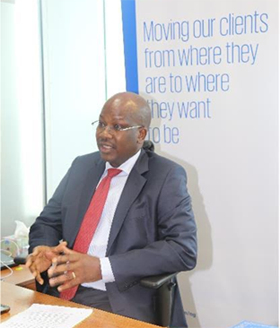
Olumide Olayinka, KPMG-Data Analytics Head
… says banks, telecommunications and even government can use data analytics to improve service delivery
Living in Nigeria, most individuals and organisations have their personal or corporate data captured on several occasions. Regrettably most of this information is not properly mined with a view to enhancing strategic decision-making or developing strategies for the improvement of the standard of living and for overall development of the country. The Partner & Head of Risk Consulting and Innovation of KPMG Advisory Services – which comprises ‘Internal Audit, Risk and Compliance Services’ (IARCS), Financial Risk Management, Accounting Advisory and Forensic services – Olumide Olayinka, in this interview with Ediri Ejoh, expresses his disappointment over the suboptimal processing and utilization of the huge volumes of information being collected in Nigeria on a daily basis.
He also highlighted his recommendation for the country to advance in this field, and positively impact the socio-economic landscape. He further insists on urgent regulation as a key requirement. Excerpts:

Olumide Olayinka, KPMG-Data Analytics Head
To start with, why do we need data analytics?
Data analytics is the structured reuse of data for the generation of insights. In deriving more value from your customer base for example, when your data is in an organized framework it helps you gain insights into your customer’s behavior and their needs; it can also help you to provide better services. In this competitive environment, it can help to drive quality decisions, provide business insights that you might not have known before and also position you ahead of your competitors.
How available is data in Nigeria?
The availability of useable data is an issue in this country. This is because on most occasions we collect data manually and therefore it is difficult to even share the collected data. Data collected digitally is also not properly stored.
How far has Nigeria been able to explore this opportunity?
In the world today, 90 percent of data we have was created in the last two years, this is facilitated by the fact that there are about 6 billion mobile phones globally, performing several functions in the lives of their users. In Nigeria alone, we have about 150 million mobile phones and this has led to an upsurge in available data. This data can help us create more value but the opportunity is underutilized.
For instance, the government collects a lot of data from us but the usage is still suboptimal. If you live in Nigeria, your data can be captured in as many as 15 different places. From government agencies, to driver’s licenses, passport offices, voters cards, national ID cards and even pension offices; data is collected and you start wondering why this process needs to be repeated on each occasion.
In other part of the world, once your data is captured you don’t need to repeat the process at every occasion all you need to do is to revalidate it if necessary. The country needs to set up a central data recipient agency which will be accessible to other agencies in need of information about a particular person. Instead of going through the whole process of capturing information about a particular person, an individual will only need to authenticate existing information which is already on the database.
What about private sector?
In the banking sector some significant progress has been made with the Bank Verification Number or BVN; this has helped the system a lot. With the introduction of BVN, banks are now aware when it is the same customer they are dealing with.
In the private sector, we have seen a lot of improvement in data usage, particularly in the financial and telecommunication industries, but this can still be improved upon because these sectors are not quite where they should be where data analytics is concerned. For instance, before a customer walks into bank for a retail loan, the bank should know a lot about him or even go to him before he comes and provide services from a proactive perspective. This can be achieved with the appropriate data analytics framework.
What do you consider as the way forward?
The government needs to set up an agency that will be responsible for coordinating data collection and mining; the agency’s output should be made available in a secure way to other government agencies, which ordinarily have mandates to collect personal data. This will significantly reduce the resources expended in repetitive data capture, and also enhance the quality and consistency of public data.
We need to also make data easily available digitally. The era of manual computation is obsolete. As a country we need to bridge the skill gap; right now we do not have enough data scientists and engineers to power the needed change. Tertiary institutions need to start introducing curricula that will expose and empower students with this skill set. Government can roll out sponsorship programmes to promote the knowledge and understanding of D&A.
What is KPMG’s perspective to data analytics?
In our business, our data analytics capabilities help us to analyze large volumes of information accurately and quickly. We utilize data analytics to help our clients make accurate decisions, be more competitive, and ultimately win in the market. With data analytics, you can actually predict future events and plan ahead to manage the impact on your business or other endeavor. It can give you foresight into what will happen in the future and help in the detection of fraud among other insights.
On regulation?
There is little or no regulation for this field in Nigeria today and there is an urgent need for a defined structure. Currently, a lot of collected information is used inappropriately, so I think regulation will need to come into play to curb abuse. We especially need an enhanced ‘privacy act’ to ensure that people stay protected after their information is collected. There is also the need to bring awareness to the populace about how their data can be used to positively influence government decisions.
How can organisations acquire data analytics capabilities?
There is clearly a skills shortage when it comes to data analytics skills. While there is no local structured program that develops data science skills, we are beginning to see individuals and non-governmental organisations demonstrate interest and somewhat start to build capacity in this competency area.
In the midst of this skills shortage, KPMG Nigeria has the requisite skill base and access to global resources to deliver on several data and analytics initiatives. As long as there is available data, we believe we are the clear choice in help organisations derive value from their data.
Even when our clients don’t have the data to solve the identified problems, we help them define their data strategy – the kinds of data to collect, and the most efficient means of collection, and transforming such data into value.
We have over 125 (and growing) analytics solutions across industries. There is hardly any client data/ analytics challenge that we don’t have a solution that can be adapted to solve the identified problem.
Forrester Research recently recognized KPMG for Insight Service Providers, what is it all about?
In recognition of our data and analytics capabilities, Forrester Research recognized KPMG as a leader when it comes to leveraging of data & analytics capabilities to deliver insights for our clients.
In ‘The Forrester WaveTM: Insights Service Providers, Q1 2017’, KPMG is recognized for having cracked the code for balancing business and technology expertise and for being on the forefront of innovations. The recognition is for leaders that have both strong current offerings and compelling strategies. These recognized providers deliver comprehensive analytics services, effective insights-to-execution support, and impressive partner ecosystems.
Any final words on this?
As we get deeper into the data age, the quality of data and the insights that come from it will be critical for most decision-makers across all fields of endeavor. We are now at a point where trusted analytics is crucial to the most important decisions in business or outside business.
The ability to turn data into insights, and subsequently into value is, and will continue to be a major determinant of success for most businesses and endeavors. KPMG believes businesses that are able to crack the data and analytics challenge will stand in pole position in their competitive environment.
Disclaimer
Comments expressed here do not reflect the opinions of Vanguard newspapers or any employee thereof.