




CJN: Don’t threaten Buhari to perform his duty, Justice Onnoghen begs Nigerians
The Acting Chief Justice of Nigeria, Justice Walter Onnoghen, on Thursday, asked Nigerians to give President Muhammadu Buhari a free hand to perform his constitutional duty concerning his confirmation as the substantive head of the Judiciary.




















NECO to begin sales of NCEE forms soon
The National Examinations Council (NECO) says it has concluded preparations to begin sales of its 2017 National Common Entrance Examination (NCEE) forms.

Igbo Presidency without restructuring will not end ethnic agitations – Ohanaeze Ndigbo
THE Igbo apex body, Ohaneze Ndigbo yesterday insisted that Igbo Presidency without restructuring the nation’s political sphere will still not end the agitations coming from various ethnic groups across the country.


Ex-NIMASA DG, Akpobolokemi attacks female journalist at court premises
Ex-Director-General of the Nigerian Maritime Administration and Safety Agency (NIMASA), Patrick Akpobolokemi has, in a video footage trending on the social media threatened to slap a female journalist in the premises of the federal high court, Lagos.


We won’t allow 2Face anti-government protest – police
Nigerian police said Thursday they would not allow an anti-government protest planned in the commercial hub Lagos by music star 2Face.

Housewife docked for allegedly maltreating 7-year-old step-daughter
A 30-year-old housewife, Zubaida Mohammed, who allegedly fractured her 7-year-old step daughter’s ribs and leg, on Thursday appeared in a Jos Senior Magistrates Cour.


Trump threatens Berkeley funds over Breitbart protests
US President Donald Trump threatened Thursday to withdraw federal funds from UC Berkeley after violent overnight protests against a planned appearance by a controversial editor of conservative news website Breitbart.

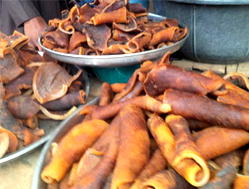
Why bankers, many Nigerians find it difficult to part with Ponmo delicacy
“I have been making up to N60,000 per day for many years on sales of ponmo, ” a seller, who simply identified herself as Alhaja Risikat at Laketu Foods Market in Ikorodu, Lagos, said.
Skins of cows, goats and sheep (hides and skin), popularly known as `ponmo’ has become a delicacy in many homes in Nigeria.
The delicious succulent texture of ponmo when cooked and seasoned, makes it a favourite food of many Nigerians.
However, in many developed countries, skins of cows, goats and sheep are not consumed but used in production of leather and related products.
Economic xperts are worried that Nigeria is losing out in the pack of countries competing for the huge global leather industry because of the high rate of consumption of ponmo.
Risikat, who thrived on sales of ponmo, narrated that she had customers in corporate organisations, who she delivered the commodity (ponmo) to.
She said that the meals of the customers were never complete without the delicacy.
“I have customers in banks and other corporate organisations. They call me on phone and I deliver it through my sales girls.
“ I have been making up to N60,000 per day for many years,’’ Risikat said with enthusiasm.
In spite of reports regarding the adverse results the consumption of ponmo posed to human health, many could still not do without ponmo in their pots.
Recently, there were warnings against eating some species of ponmo burnt with tyres on the basis that the processing was not hygienic.
In spite of the health hazards posed by those burning ponmo with tyres, the level of sale and scramble for the commodity in markets nationwide continue to rise unabated.
During the production stages, the commodity is subjected to naked flames to burn the skin of the animal.
According to research, during the burning process, a lot of unhygienic substances such as trash, wood, charcoal, rubber tyres and so on, are thrown into the furnace to sustain the blazing heat.
The black ponmo is burnt, while the white ponmo is boiled and the flesh is scrapped.
A further survey of markets in Ikorodu, Lagos, revealed that many people, even the elites, could not do without the delicacy.
Some sellers of the commodity told NAN that they were fully in the business.
A seller of the commodity in one of the abattoirs in Ikorodu, who chose anonymity, said he had been in the business of sales of ponmo for 20 years.
He added that there had never been a time he never made huge sales.
Another woman, operating a beer parlour along Ijede Road in Ikorodu, Mrs Alice Maduka, said her customers preferred to drink their beer with ponmo, garnished with pepper.
“My customers prefer ponmo with peppered stew than beef, so I buy in bulk daily,’’ she said.
Also, a Manager of a cafetaria in Sabo Market in Ikorodu, Mr Alex Ndigwu, said his customers preferred ponmo “because it is bigger and cheaper than beef’’.
“ My customers prefer to eat ponmo because it is sweeter and bigger than beef; so I usually get it in large quantity,’’ he said.
Heath experts, however, expressed mixed feelings about the nutritional value of ponmo.
Some dieticians and food scientists warned that consumption of ponmo is dangerous to health, adding that some of the animals suffered skin diseases.
They also said that the tyres used in burning the animal skin could cause cancer and some other killer diseases.
Recently, the Director-General, Nigerian Institute of Leather Science and Technology (NILEST), Zaria, Dr Isuwa Adamu, said that consumption of the product “as meat is dangerous to health’’.
“Scientifically, ponmo does not have any nutritional value to human health.
“Scientific research has shown that ponmo does not add any nutritional value to human health.
“Some of the animals where ponmo is gotten from are usually sick and harbours dangerous injected chemicals and this leaves the consumers vulnerable to the chemicals in the animal skin,’’ Adamu said.
An 85-year-old man, Mr Alaba Taiwo, said he never believed ponmo could be hazardous to health.
“I have been eating ponmo right from my childhood and if truly ponmo causes many hidden sicknesses, i would have died a long time ago.
“As I am, I like ponmo than real beef and I am medically fit and sound,’’ he said.
Mrs Ijeoma Ugba, a Nutritionist at Foods Guts and Psychology Centre, analysed that ponmo was medically proven to have calories (150g); and Total fat (4g); Saturated fat (1g); and Poly-saturated fat (0g).
She mentioned Mono-saturated fat (0g); Trans fat (0g); Cholesterol (0g); Sodium (0mg); Potassium (0mg); and Total Carbohydrate (0g);
Ugba talked about: Dietary fibre (0g); Sugars (0 per cent); Proteins (0 per cent); Vitamin A (0 per cent); Vitamin C (0 per cent); Calcium (0 per cent); and Iron (0 per cent).
Dieticians and food scientists suggested that government should come up with policies to reduce the consumption of ponmo.
Apart from the debate over health hazards of the commodity, a reduction in its consumption, would provide more raw materials for the tanneries.


Gambia puts down killer dog that bit Barrow’s son to death
A dog that killed the son of Gambian President Adama Barrow has been put down, an agriculture ministry source said, with mystery over the circumstances sparking witchcraft rumours amid political turmoil in the country.

We’ve set up task force to check high cost of food – Lai Mohammed
The Federal Government has approved the setting up of a Task Force to address the rising cost of food items across the country.

Report filling stations selling petrol above N145, DPR tells Nigerians
The Department of Petroleum Resources (DPR) in Bayelsa says it has stepped up its regulatory activities to check unauthorised hike in the price of petrol by marketers in the state.
IBB University rolls out N25bn 5-year strategic plan
The management of Ibrahim Babangida University, Lapai in Niger has unveiled a strategic development plan that would cost the institution N25 billion over the next five years.


Army loses three soldiers, but kills six insurgents
The Nigeria Army has killed six terrorists, but lost three soldiers in an encounter between troops and Boko Haram insurgents in Damboa Local Area of Borno.

New national minimum wage coming
The Technical Committee on National Minimum Wage, saddled with the responsibility of reviewing workers’ salaries to reflect current socio-economic realities, will submit its report next week.

Breakthrough: Michael Okpara varsity discovers cure for HIV/AIDS
Prof. Francis Otunta, the Vice Chancellor (VC), Michael Okpara University of Agriculture, Umudike, in Abia, has confirmed the discovery of a new drug for the treatment and cure of HIV/AIDS.


Late UNIMAID Prof’s. brother writes letter to Boko Haram leader, Shekau
Malam Usman Abbas, a younger brother to late Prof. Aliyu Usman Mani, who was killed during a suicide bomb attack at the University of Maiduguri (UNIMAID), has said Abubakar Shekau is a “dead man waiting to go to hell”.