
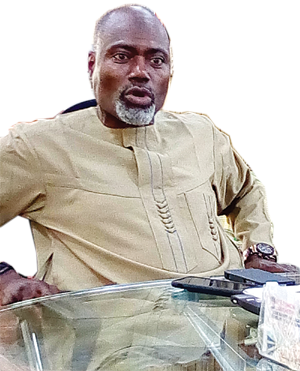
Yusuf Ali …Nigeria is a rife market for rumours
By Demola Akinyemi
Mallam Yusuf Olaolu Ali (SAN) is the CEO of GHALIB Chambers based in Ilorin. Yusuf Ali, who obtained his first degree from University of Ife,now Obafemi Awolowo University, Ile-Ife, went back for his master’s in law in the same university.
A philanthropist, he donated a fully equipped IT building to Kwara State Polytechnic for which he was honoured with the award of Fellow of the institution.
In this interview, the legal icon speaks on the state of the nation.
What is your assessment of the anti-corruption war of the administration of President Muhammadu Buhari?
At the presentation of my book’, Anatomy of Corruption’ in Abuja in May 2016, in my speech, I said categorically that top to bottom approach on the fight against corruption can never work. If you want to fight corruption, you must create a mass movement. Majority of Nigerians must buy into it, but you arrest three people out of 10,000. What have you achieved? What is going on is fight against corrupt people not against corruption.

Yusuf Ali …Nigeria is a rife market for rumours
Corruption is an institutional thing, so the fight against it is more than what we are doing. Because if we are not careful, things we are not doing properly may become a culture. If you want to fight corruption, you have to dig deeper.
I tell people that for the street to be clean, every member of the street must keep his corner clean. Corruption is symptomatic of a deeper problem. When we talk about corruption, we should not limit it to bribery. Bribery is a fraction of corruption. Nepotism is corruption; ethnicity is corruption; tribalism is corruption and influence peddling is also corruption. Just fighting public officials is a tip of the iceberg.
Police still stop motorists on the highway extorting money from them. What do you say to that? There are all sorts of corrupt, on allegations about government officials. It is a good attempt that we are trying to fight corrupt people, but we should attempt to fight corruption itself.
How do you think the acting CJN can tackle corruption in the judiciary?
Nigerians are skeptics. We don’t believe in our leaders and our institutions. And you can’t blame them. Maybe it is a product of their experience of having been let down by the system. I have said this severally, it takes two to tango. Before you can see somebody who takes bribe, there must be a giver. Usually we go after the takers. The givers are there still waxing stronger. Until the day the Nigerian elite start to think that justice could not be bought, we will be running in circles. The truth is bitter, but we must say it. The average litigant in Nigeria believes you can buy justice. So, with that frame of mind, it is a very difficult challenge. That attitude of believing that you can buy justice must stop. What I have said is apparent from the way litigants react to judgements. Somebody who had tried to reach a judge unsuccessfully, if judgement goes against him, he believes the other person has given higher bribe which may not be true.
But more than it all, Nigeria is a very rife market for rumours. Tell people to come and tell you what happened, they begin to scratch their heads.
Generally, African leaders do not seen to be doing enough to help their people out of poverty, what is the problem with African leaders?
A country gets the kind of leader it deserves. And that is why I am always against the setting up of special courts. I ask, are you going to bring people from heaven to come and sit in those courts? We are having those problems because of leadership and followership problem. Look at the campaign rhetoric of Donald Trump before the US presidential election. Look at what is happening now because he knows his society would not accept certain things.
Nigeria and by extension African society is where anything goes. If we want to hold our leaders accountable and we want them to be upright, it must start from all of us. All leaders have their evil tendencies; it is the society that disagrees with them. We don’t have minimum standard for our leaders. The American society is what it is today not because their leaders are superhuman but because the average American would insist you do what is right. Watch this hacking by Russia preparatory to the American presidential election, you will see the outcome, because that is a society that digs deep unlike us that are very superficial here. Here we try to look for quick-fix solutions.
There is nothing inherently wrong with Africans, it’s just that we are too lazy. You have just do-little belief that you have excelled, whereas people outside there, for everything they do, they have to improve.
The award conferred on you by the polytechnic, will it spur you to do more philanthropic works?
My philosophy about life is that anytime something good comes your way, it is an invitation to do better. And the prize for doing well is to do better still. To me, recognitions like this humble me and make me know that what God wants to do He does, irrespective of who your parents are,who you know and who you don’t know? This award came from the blues; I wasn’t expecting anything at all. The day the Rector of Kwara Polytechnic, Alhaji Mas’ud Elelu and his team came here and said that they were planning their convocation and that they wanted to give fellowship awards to five eminent Nigerians. They mentioned Governor Abdulfatah Ahmed, Aliko Dangote, Erisco and chief executive officer (CEO) of Kamwire Limited. I know the CEO of Kamwire is the largest employer of labour as an individual in the whole of North-Central. Those who work in that company would be more than 1,000 and then they mentioned my name. I asked ‘why me?’ So I see this honour as an invitation to do more for the society to justify the confidence the people reposed in me. That is the way I see it.
What is your view about the present economic recession in Nigeria?
The problem of recession, to me as a layman, is the reflection of the lack of confidence in the Nigerian market and economy on the part of people who want to bring their money here for investment. Simple! What caused it I don’t want to dabble into that; the way out is for us to go out and market our country.
After all, there was a time in this country that oil was selling for $11 and we were doing well. And we were producing 2.2 million barrels. Now even at 40 something dollars, we are not producing well. So it is not about oil, it is about lack of confidence in Nigeria.
There is craze for certain courses in our tertiary institutions today,what is your view?
The colonialists gave us the kind of education they wanted, just to have a pool of averagely educated people that would be used in the civil service and other places. When they left, unfortunately we never thought that was a problem. The chicken has come home to roost. Every person who went to any higher institution in Nigeria looks for government employment. The way the new set of universities are going, which is entrepreneurship, is the best option. We must prepare our graduates for the world outside the universities and for the world outside of paid employment.
What is your view on the rejection of Ibrahim Magu as substantive EFCC chair by the Senate?
I am not sentimental about issues. The president has done his own side by submitting the name of Ibrahim Magu to the Senate for confirmation and the Senate has also done its own side by rejecting his confirmation as substantive Chairman of the Economic and Financial Crimes Commission (EFCC).
In fact, there is nowhere in the Nigerian Constitution that says that the Senate must give reasons for the rejection of his confirmation. I don’t think people should start reading their personal interest into the Senate action. It is unnecessary. The Senate merely looked at the report presented to it by the Department of State Service (DSS),and the report questioned the integrity of Magu.
Disclaimer
Comments expressed here do not reflect the opinions of Vanguard newspapers or any employee thereof.