
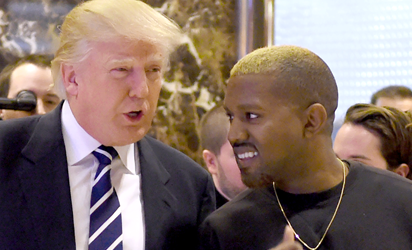
Singer Kanye West and President-elect Donald Trump arrive to speak with the press after their meetings at Trump Tower December 13, 2016 in New York. / AFP
By Douglas Anele
Secondly, we have human passion. Hegel correctly observes that human desires, passions and personal aims, people’s drive to satisfy their selfish interests – which means the entire infrastructure of our subjective wills – are the most effective springs of human actions. In apparent agreement with David Hume, the Scottish philosopher who claimed that reason is the slave of the passions and can pretend to no other office, Hegel affirms that passion, not rationality, motivates human beings, that “nothing great in the world has ever been accomplished without passion.” It follows that human beings are propelled to action by their own inner subjective wills to satisfy their natural instincts, inclinations, interests and needs.
We now come to what Hegel provocatively calls “the Cunning of Reason,” which, in my view, is the most interesting, intriguing and tantalizing idea in his philosophy of history and the center of gravity that holds together our analysis of Donald Trump’s upset victory at the polls. Briefly stated, the Cunning of Reason is the power of the Absolute to deploy the formidable force of human passions as a means to its goal of substantial freedom for humanity.
To achieve this goal, the Cunning of Reason uses the great nation-states which appear from time to time in history and world-historical individuals who bring about profound changes in various historical epochs. The language, art, religion, philosophy, science – in short, the culture – of the great nation-states determine the “spirit” or style of their peoples and are reflected in all their undertakings. Therefore, cultural differences between nation-states largely explain the distinguishing characteristics of every civilization that has emerged on earth.
According to Hegel, heroic world-historical individuals like Alexander the Great, Julius Caesar, and Napoleon Bonaparte (we can add Adolf Hitler to the list because Hegel was fascinated with warmongering rulers) are used by the Cunning of Reason for its own purposes, to bring about a new stage in history towards the further development of the consciousness of freedom. Now, inasmuch as Hegel acknowledges that the Cunning of Reason also uses the desires of ordinary individuals to maintain the ongoing functions of the great nation-states, each of which embodies a stage in humanity’s consciousness of freedom, he emphasizes the significance of world-historical individuals as change-agents. For example, Napoleon was motivated by his ambition for political power: yet, in conquering several other nations, he was actually serving the Cunning of Reason in bringing to those nations the new freedoms of the Enlightenment that his country, France, had attained.

Singer Kanye West and President-elect Donald Trump arrive to speak with the press after their meetings at Trump Tower December 13, 2016 in New York. / AFP
Now, such paradigmatic individuals, in their single-minded pursuit of personal desires, had no precise idea of the bigger picture, of the larger goals of the Absolute that they were unwittingly and unconsciously serving. As change-agents, these individuals must destroy existing institutions and peoples that constitute obstacles in their path. All of them, Hegel remarks, are practical political men who had insight into the requirement of the time – what was ripe and mature for development. Interestingly, once these heroes of history have achieved the goals for which the Cunning of Reason used them as means, they fall off “like empty hulls from the kernel of corn.”
The same fate also befalls leading nation-states: after they had been used in history to develop a new stage in the consciousness of freedom different from what obtained earlier, the Cunning of Reason moves on to another nation-state to crystallize or concretize the next stage in the development of freedom, leaving the previous leading nation-state to stagnate and lose its historical significance. In any specific historical period, only a single nation-state is the vehicle of freedom. Hence, “This people is the dominant people for this epoch – and it is only once that it can make its hour strike.”
Overall, the disasters and tragedies of history are not really evil in Hegel’s philosophy of history. Instead, each disaster has a part to play in the actualization of the greater good which the Absolute has in store for humanity. Evils are instruments used by God to increase goodness in the world. As a result, human failures and foibles are successes for the Absolute. This vindicates God against the accusation that he has allowed too much evil to exist in the world. Of course, for an atheist like me, Hegel’s theodicy or philosophy of history is gravely flawed, although I know that even bad ideas can be fruitfully applied to illuminate a particular problem or subject-matter.
On that basis, I will not criticize Hegel’s theory since my main objective is to use it as a philosophical model for interpreting the upset victory achieved by Donald Trump in the last election in America. it must be noted, however, that although the theory presents a fascinating account of world history, its transmutation of evil and suffering into a tool deployed by the Absolute can be used to justify any regime no matter how totalitarian and inhuman it might be. Therefore, in using it as an interpretive paradigm for explicating the Trump phenomenon, one must be careful not to overlook the serious problems inherent in Trump’s emergence as America’s President at this time.
When Trump declared his intention to run for President on the platform of the Republican party, many self-styled experts in America’s presidential elections likened his chances of becoming President to those of Leicester football club at the beginning of last season winning the English premier league – but Leicester eventually won, to the astonishment of the “experts.” Probably, at the outset, only Trump believed that he could succeed Obama in January 20, 2017. In spite of his bigoted rhetoric, strong anti-immigration and anti-muslim stance, and condescending attitude to the disabled, women and other minority groups, Trump defeated establishment Republican candidates, notably Ted Cruz, Marco Rubio and Jeb Bush in the primaries to emerge as the presumptive Republican presidential nominee.
It was at this point that millions of Americans realized that Trump’s ambition for the White House was not as farfetched as they previously thought. But he still had to beat a more formidable opponent than Cruz and others to get there, Hilary Clinton, who was selected as the Democratic presidential candidate ahead of Bernie Sanders partly through some underhand maneuverings by entrenched Democratic establishment caucus members. All through the months after the primaries to the day of the election, Trump was declared the underdog by political pundits in the United States and beyond. In fact, most of the major polls in America indicated a Clinton victory over Trump. In the Cable News Network (CNN), veteran journalist, John King, using his magic electoral board, repeatedly referred to the “steep hill” Trump had to climb to win the presidency.
These predictions of defeat were based on the presumption that majority of American voters are so reasonable that they would not want to elect a politician without any record of public service, a brash, overconfident business tycoon who promised to build both physical and psychological walls between people, deport millions of undocumented immigrants, and undo some of the good works of President Obama. Trump ran a highly divisive campaign and many of his most ardent supporters were white supremacist bigots who wanted to annul the gains made by the civil rights movement of the 1960s.
On the other hand, Hilary Clinton presented the image of a potential President with the requisite temperament and cognate experience to lead America for the next four years. Her campaign slogan of “Stronger Together” resonated with broad sections of the American public horrified and repelled by Trump’s incendiary remarks in the media and at campaign rallies. However, Hilary Clinton had serious problems of her own as well, particularly the last-minute reopening of her email case by James Cooney, director of the Federal Bureau of Investigation (FBI) and the myth of untrustworthiness created around her by Trump and his diehard supporters. Given Trump’s obvious lack of relevant experience for the job coupled with his numerous scandals and personality deficiencies, countless people around the world, including Americans, thought that Hilary Clinton will make history as the first female occupant of the Oval Office. But the Cunning of Reason had other ideas: America was not ripe yet to have a female President.
Hilary Clinton was an establishment candidate with an impressive curriculum vitae and experience for the job, whereas Trump, a political neophyte who made a fortune for himself in real estate and entertainment, campaigned on the platform of change. Trump cleverly tapped into, in the words of Hegel, “what was ripe for development” in the consciousness of millions of Americans – jobs and change.
Surely, Clinton’s problems, when juxtaposed with those of her opponent, are less weighty, which implies that Trump’s victory is an oddity unless it is interpreted as the outcome of the Cunning of Reason deciding to demonstrate once again that in human affairs hardly anything can be ruled out completely. To be continued.
Disclaimer
Comments expressed here do not reflect the opinions of Vanguard newspapers or any employee thereof.