
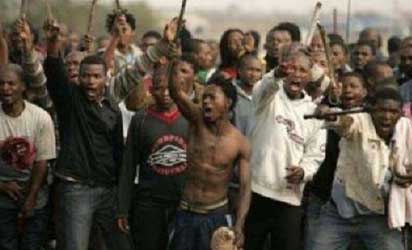
Alleged thugs
By Owei Lakemfa
VIOLENCE rampages large parts of Nigeria and most of Africa. Generations are born into violence who grow from innocence to stoking its wild fires. A cross section of people including diplomats, intellectuals, journalists, retired generals and representatives of the Chief of Army Staff and the Inspector General of Police gathered in Abuja, seeking a solution.
Professor George Obiozor, the 74-year old former Nigerian High Commissioner to Cyprus and former ambassador to Israel and United States, led the discussion. He argued that Nigeria is paying too much attention to critics and not enough to its admirers. He defined international relations as “a game of selective morality, outrageous paradox and double standard, where to win you must continuously recognise your own interests and protect them with ruthless courage.”
He said the most important objective of Nigeria’s detractors is to lure the country and its leadership into controversies abroad and at home “in order to precipitate a synchronized national crises within Nigeria.” He advised the country to reduce the level of serious threats to its survival by reducing the level of its national crises that attracts international attention.
Professor Thomas Akhigbe Imobighe, Director, Centre of Strategic Studies and Development, Ambrose Alli University, Ekpoma, delivered the lecture titled “Weaning Africa from violence: Nigeria’s contributions to Peace and Stability on the Continent.” He posited that given the rapid phase sophisticated arms are being made and sold, violence must be minimised if humanity is to survive.
Imobighe, author of a number of books including Nigeria’s Defence and National Security Linkages argued that it is a badly managed conflict that snowballs into violence. He said peace as a concept has no precise meaning but that to some, it means the absence of war. He posited that peace must start from meeting the basic necessities of life.
He said a major problem in many African states, is the perpetuation of unhelpful force and the unrelenting strive to acquire power. Nigeria he said, must abandon its concept of security based on arms, and embrace the concept based on human needs adding that the strategy to ‘fight to finish” has not led to the elimination of opponents, rather, it has led to the spread of violence.
He said while no African country is in the league of the first one hundred highest arms producers in the world, by 2013, the continent spent $402 billion on arms purchase, that is one fifth of its GDP. He said that while two thirds of African states are experiencing increased military spending, the European Union is experiencing reduction in such spending. To demonstrate the destructive nature of violence in Africa, the lecturer said that in 2013 the continent produced 12.5 million refugees or a third of the global total.
Imobighe cited the examples of post-electoral violence in Kenya, Zimbabwe and the Nigeria of 2011 when people just engaged in violence with any prior discussion. He also mentioned the herdsmen and farmers circle of violence in Nigeria. He wondered how Africans are always able to raise funds to buy arms and why the arms producers are always eager to trust their weapons in our hands.
The defence and security expert said anytime people are involved in conflicts, what they really need is negotiations, more negotiations and more negotiations. He expressed his strong believe that if peace is to be achieved in our life time, we must engage in concrete engagement with other people. He quoted Martin Luthr King Jnr who in his 1963 , ‘Letter from a Birmingham Jail’, wrote:
“Men often hate each other because they fear each other; they fear each other because they don’t know each other; they don’t know each other because they cannot communicate; they cannot communicate because they are separated.”
Imobighe wondered whether there is absence of peaceful mechanism, or people no longer have confidence in it. He said there is need to subscribe to a new global coalition for peace and development.
In his lecture, Imobighe had made a critique of the Presidential Amnesty Programme claiming that its youth empowerment programme was restricted only to those who bore arms while those who did not engage in violence were left out. This he argued, gives the wrong impression that violence pays and that this is responsible for the rise of new militant groups in the Niger Delta. I made a gentle correction of his hypothesis pointing out that in the conception of the Amnesty Programme, care was taken to also empower youths in the Region who were not involved in the armed conflict. I gave as an example the statistics of Niger Delta youths who were empowered by being given scholarship to local and international tertiary institutions. It showed that of the 3,042 youths given scholarship by the agency, only 1,242 amnesty beneficiaries while the balance 1,800 were youths from communities impacted by the violence but who were not engaged in armed struggle. Imobigbe accepted the correction.
Dr. Wilson Ejide, a retired Army Colonel who was the discussant, said the continued use of violence merely multiplies violence.
Rear Admiral Tony Isa (Rtd) said unfortunately, the country’s institutions are weak and that Nigerians must decide what positive values they want to project. Professor Warisu Oyesina Alli argued that the resurgence of violence is the result of unmet social expectations. He said in the past, this could result in revolution, but that now, it is disorganised violence.
Ambassador Gregory Okon argued that the balance of power between the state and non-state actors which used to be in favour of the former, is now tilting towards the latter. He advocated military training for the National Youth Service Corps members so they can provide some security where they are posted.
Emeritus Professor, Anthony Ashiwaju wondered “How do we talk about weaning Africa of violence when we have not weaned ourselves?” The country he said must address the issues of mass unemployment and illiteracy as part of the process.
Major General L.P. Ngubane (Rtd) regretted that elections in Africa are more of a selection process. He said American President Barack Obama’s admonition that “Africa doesn’t need strongmen, it needs strong institutions” rings true.
Professor Nuhu Nuhu Yaqub, the Chair of the Society for international Relations Awareness, SIRA, organisers of the event, said it has become the organisation’s tradition to make available to the general public, current issues in the Nigerian Foreign Policy. He said attention should not only be on the commercialisation of violence, but more on the cost to the people who are the victims.
Mr. Ulrich Thum, Resident Representative of the Friedrich Ebert Stiftung,FES, which facilitated the event, said Nigeria is facing security challenges from within and outside its borders and that protagonists like SIRA are required to contribute to its resolution.
Disclaimer
Comments expressed here do not reflect the opinions of Vanguard newspapers or any employee thereof.