
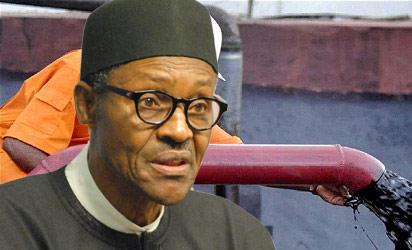
Buhari
By Sebastine Obasi
Full liberalization and deregulation of Nigeria’s downstream oil sector, with removal of all hindrances and bottle necks is needed for the improvement of private investment and market competitiveness, industry stakeholders have said.
Speaking at the end of the Oil Trading and Logistics, OTL, Africa Downstream Week, in Lagos, they averred that a mitigating policy that will best serve the public and cushion the unstable operating environment be put in place by the government.

Buhari
Reginald Stanley, former Executive Secretary of Petroleum Products Pricing Regulatory Agency, PPPRA, and Chairman, Board of Advisors, OTL, Africa Downstream, said that it is imperative to establish and empower a strong independent regulator to oversee activities in the subsector and ensure implementation of open and transparent rules for the downstream value chain. According to him, to minimize or eliminate oil theft, security measures such as the Oil and Gas Protection Squad should be implemented as soon as possible, together with full deployment of technology and observance of international monitoring standards.
He explained that Governments and private investors should be encouraged to explore and undertake shared infrastructure to ease movement of products particularly trans-regional pipelines and rail connections.
Stanley believes that government should expedite the passage of the Petroleum Industry Bill which should cover full deregulation of the downstream sector, while the Cabotage Act, as well as the Local Content Laws need to be optimized in the implementation by the Nigerian Maritime Administration and Safety Agency, NIMASA, and other regulatory bodies in the downstream sector to ensure more participation of Nigerians.
Also speaking, Emeka Akabogu, Chairman of OTL Africa, stated that payment of charges in foreign currencies by indigenous operators to agencies like NIMASA, Nigeria Ports Authority, Department of Petroleum Resources, and others should be stopped forthwith and the Naira prioritized as the means of exchange to maximize the value to ship owners and improve competitiveness at the ports.
“To encourage increased local and foreign investment in the downstream, government must prioritize enthronement of a stable and predictable foreign exchange policy. Industry calls on the Central Bank of Nigeria, Federal Ministry of Finance and Ministry of Petroleum Resources to jointly address this as a matter of urgency.
“There is need to urgently review the administration of the current ineffective foreign exchange intervention in the downstream sector in view of the timing gap between the offer of foreign exchange and the opening of letters of credit. which often erodes the value and usefulness of the offer.
“There is need for government intervention by way of policy on liquefied petroleum gas to facilitate its growth and make it easily available and accessible,” he added.
Disclaimer
Comments expressed here do not reflect the opinions of Vanguard newspapers or any employee thereof.