
By Emma Aziken
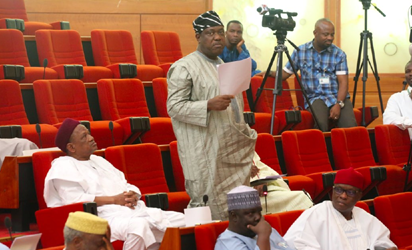
It was an unusual meeting at the Maitama, Abuja residence of the Senate President, Dr. Bukola Saraki last Wednesday. His guests were the principal officers of the Senate and their corresponding colleagues in the House of Representatives who were led by Speaker Yakubu Dogara.
The regularity of such joint meetings of the leaderships of the two houses of the National Assembly has, over time varied according to political expediency—mainly, the influence of the presidency on the two chambers.
The leaderships of the two chambers of the various Assemblies adapted to one another sometimes with warmth and sometimes with official bureaucracy that belied the hostility between their leaderships.
Who would forget the scene in the year 2000 when Speaker Umar Ghali Na‘Abba led House members in a march into the chambers of the Senate to express solidarity with the militant leadership of Senator Chuba Okadigbo. It was no surprise that after the impeachment of Senator Okadigbo that the Na‘Abba leadership became cheeky towards the Anyim Pius Anyim leadership that took over from Okadigbo.
The relationship between the Saraki leadership in the Senate and the Dogara leadership in the House was supposed to have been the most cordial ever since the advent of the Fourth Republic. The reason for such expected amity was based on the fact that the two presiding officers in the Senate and the House came out from a joint rebellion that benefited both men.
Saraki’s emergence as Senate President boosted Dogara’s aspiration as it helped to convince North-East legislators to rally behind Dogara given that the option was between him, Dogara and another Yoruba man, Femi Gbajabiamila. The thinking was that it would be awkward for the two presiding officers of the National Assembly to be Yoruba.
On the other hand, team Saraki had also quietly forged an alliance
with team Dogara with the hope that support for Dogara would undermine the prospect of Saraki’s main challenger, Senator Ahmad Lawan.
So, given the kind of collaboration that existed between Saraki and Dogara, the expectation was that both men would have immediately struck a partnership on confronting the assault that came the way of the two men.
While Dogara sought conciliation with their All Progressives Congress, APC, Saraki for one reason or the other, forged an independent streak that later metamorphosed into what his associates alleged to be a persecution of the country’s number three man.
The alleged persecution some said was seen in the trial of the Senate President for alleged corruption and false declaration of assets when he was governor six years ago.
Saraki’s and the Senate’s misgivings towards the presidency was worsened by the decision to also try Saraki alongside his deputy, Senator Ike Ekweremadu for the “offense” of forgery of the Senate’s Standing Order.
While Saraki moved from court to court, Dogara, on the other hand, waxed stronger in his relationship with the Presidency.
It was as such not surprising that during the last Islamic month of Ramadan that while Dogara led House members to break fast with President Muhammadu Buhari, that Senator Saraki was conspicuously absent.
That custom of divide and rule has been the practice over time, and it has been successfully used by the Presidency to achieve its desire against the legislature. Keen observers would recall that in the period after the late President Umaru Yar‘adua settled into office in 2007/8, that his inner circle developed a relationship with Speaker Dimeji Bankole who subsequently wielded influence in the presidency that none of his predecessors ever did.
Whether the relationship between the Bankole House and the Yar‘adua presidency rubbed positively on the polity was, however, open to question. The House probe of the investments into the power sector by the Olusegun Obasanjo administration was one of the acts allegedly masterminded by the presidency Turks or cabal as they came to be later known in the Yar‘adua presidency.
Just about that time also, the cabal also allegedly got their collaborators in the House to stymie the work of the National Assembly Joint Committee on Constitution Review through an unfathomable crisis over the chairmanship of the committee.
A process that had hitherto been done without rancour as a joint committee was derailed leading to separate constitution review processes that inevitably raised the cost. While some alleged at that time that the split was directed towards undermining Senator Ike Ekweremadu who was to have been the chairman, others said it was part of the conspiracy plot by the cabal to use the House to undermine the Senate led by Senator David Mark who the cabal was supposedly dreadful of.
It was as such noteworthy that the two leaderships met last Wednesday, joining heads to oil the frictions that had been placed by those who would want to divide and conquer the National Assembly!
Disclaimer
Comments expressed here do not reflect the opinions of Vanguard newspapers or any employee thereof.