
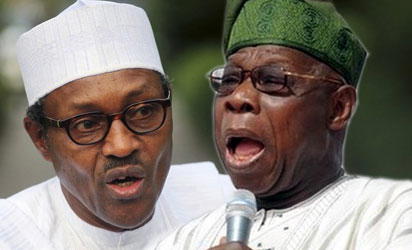
Buhari and Obasanjo
By Douglas Anele
Take the current recrudescence of gitation for the establishment of Republic of Biafra in the South-east and some areas in the South-south more than four decades after the civil war ended. With the possible exception of former Presidents Olusegun Obasanjo and Goodluck Jonathan, Ndigbo, the people who have contributed more than any other ethnic group to national development, have been treated as third class citizens by previous leaders especially in key federal appointments.
With the “second coming” of Buhari, the absurd situation has degenerated further. In fact, a plausible case can be made that President Buhari probably has a deep-seated dislike for Ndigbo, considering his unwillingness to appoint qualified Igbo sons and daughters to key positions in his government. To be sure, I am an Igboman but not an Igbo irredentist. Yet, even if I was not and another ethnic group is exactly in the same position as Ndigbo in the current dispensation, my argument would still have validly applied to that very ethnic group as well. In a highly diverse country such as ours, a sagacious leader must take decisions that give people from different parts of the country a sense of belonging.
This can be done in several ways, one of which is to ensure that key appointments are distributed fairly and equitably across the country without sacrificing merit. But President Buhari seems indifferent to the complaints that he is northernising the federal government, thereby unwittingly providing rationale for separatist groups such as the Mass Mobilisation for the Sovereign State of Biafra (MASSOB), Indigenous Peoples of Biafra (IPOB) and the Niger Delta Avengers (NDA). Now, by showing obvious bias in favour of the north, is the President saying that there are more qualified Nigerians from the north than from the south, particularly the south east, to occupy most offices in his government? Since when did the north surpass the south in having highly educated and qualified personnel to fill vacancies in federal government agencies and parastatals? In my opinion, by his lopsided appointments, the President is actually playing into the hands of those that see him as an ethnic champion solely concerned with the interests of the ruling cabal or invisible government domiciled in Northern Nigeria.
President Muhammadu Buhari’s recent reaffirmation of the combative assertion that Nigeria’s unity is not negotiable demonstrates beyond reasonable doubt that he is operating with the conqueror mindset typical of military dictators.
Buhari probably has not learnt appropriate lessons from the civil war: he still believes that the quest for self-determination by any marginalised ethnic group can be destroyed through military action. But he is wrong. Biafra, like every other utopia, is an ideal that cannot be annihilated by brute force, even if the attempt to actualise it concretely had been crushed earlier. Therefore, shooting at mostly unarmed youths exercising their democratic right to protest unjust decisions by a pachydermatous leadership can halt agitations for Biafra temporarily – it cannot eradicate it as long as unfairness in the distribution of both benefits and responsibilities among the federating ethnic nationalities persists. It follows that the only reasonable way to deal with the centrifugal forces that threaten the continued existence of Nigeria as a sovereign geopolitical entity is for the ruling elite to address the root causes of discontent in different parts of the federation.
It is amusing that some pigs in the big animal farm called Nigeria hastily dismiss agitations for self-determination as useless, as the handiwork of undesirable elements and unemployed youths either seeking opportunities for self-enrichment or serving as willing tools used by enemies of government to disrupt the rhythm of change promised by President Buhari and his party leaders. In the case of pro-Biafran movements, for example, some pseudo-intellectuals and cash-and-carry politicians some of whom are Ndigbo fail to understand that as long as the issues that led to the emergence and secession of Biafra in 1967 remain unaddressed, the quest for its actualisation by any means necessary will rear up periodically. The same thing applies, mutatis mutandis, to the agitation for self-determination in the Niger Delta region.
The Niger Delta area accounts for over seventy-five percent of our national revenue. Yet, the region has been horribly devastated for decades mainly due to the exploration and exploitation of crude oil and natural gas. Of course, the developmental crises there is also the result of greed, corruption, visionlessness and poor planning by political and community leaders from that region. That said, the desire by the people to control their resources and pay an agreed tax to the federal government is legitimate and proper: it should be supported by all Nigerians who desire to live in a federation where each federating unit can develop its natural resources to meet its developmental challenges and aspirations.
There is no doubt that well-meaning Nigerians abhor violence: the devastating Biafran war brought into bold relief the extreme negative consequences of using military force to subdue legitimate demands for self-determination. At any rate, if President Buhari were a good student of history, he would not be repeating the same threadbare rhetoric about Nigeria’s unity being out of bounds for negotiation and possible reconstruction to create a functional federation. The persistent demand for greater fiscal and political autonomy by the Igbo and indigenous population of the Niger Delta is largely due to the faulty foundation on which our political architectonic was build since the abolition of regionalism in 1966.
Given that the basis of Nigerian unity hammered out during the constitutional conferences which led to independence in 1960 envisaged a federal structure with a relatively weak central government and largely autonomous federating units, and that that very structure has been mutilated by military dictators, it is imperative for us to revert to a modified version of regionalism. As I have always maintained, a return to functional federalism in which the federating units are empowered by the constitution to exploit the human and natural resources in each unit to serve its people would not transform our country into an El Dorado overnight. Now, even the best political system cannot achieve sustainable positive results without good leaders supported by enlightened and alert citizens over a reasonable period. Yet, it must be acknowledged that for every society at a given point in its historical evolution, some political systems are more suitable than others for delivering quality political leadership and service to the people. In this connection, the APC government is making a huge mistake if it continues to ignore calls for reconstructing Nigeria in such a way that the generally accepted six geopolitical zones become the fountainhead or nucleus of a resurgent Nigerian nation.
As I indicated earlier, President Buhari believes that he can use all the military might at his disposal to suppress non-violent protests in Igboland and the new militant groups emerging in the Niger Delta region. However, he should be reminded that there is a more reasonable, less disruptive, cost-effective and peaceful option, that is, sincere efforts to reconstitute Nigeria using recommendations of the 2014 national conference as a guide.
I do not understand why the President is dogmatically fixated against devolution of powers to the six geopolitical zones. Perhaps such a measure negates the hegemonic agenda of some key conservative elements in the North and their British and American collaborators. Earlier, I alluded to the claim by Balewa that if British colonial administrators had left Nigeria, the northern people would have continued their uninterrupted conquest to the sea. Balewa’s vision of Nigeria mirrors exactly Alhaji Ahmadu Bello’s concept of a Nigerian state in which the north dominates the south in a master-servant relationship despite the economic and educational superiority of the latter. That grotesque vision, the silly notion that northerners are ordained by providence to rule other Nigerians, is the ideological compass that dictates the actions and reactions of a section of the Northern ruling elite to national issues up to this time.
To be continued
Disclaimer
Comments expressed here do not reflect the opinions of Vanguard newspapers or any employee thereof.