
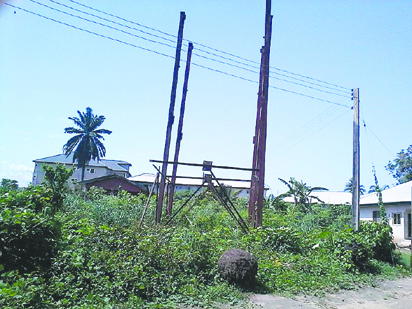
NDDC abandoned project
A bill that will put constituency projects as part of the annual budgets of the Federal Government has passed the second reading in the House of Representatives.
If it becomes law, the Federal Government will be compelled to set aside, at least, 2.5 per cent of its total appropriations for concrete projects which members of the Senate and House of Representatives will “attract” to their constituencies, as opposed to merely making laws for the country.
Members of the Legislative arm have been struggling since the introduction of our presidential system of government in 1979 to be “more relevant” among their constituents by being able to bring home amenities to help in improving their quality of life. They have often run into odds with the Executive branch because constituency projects are seen as a Legislative trespass into an area reserved for the Executive.
We are firmly opposed to this constituency projects pursuit by legislators, as that is ultra vires to their place in the presidential system we are practising. It is an executive function. Any lawmaker who is interested in carrying out contracts and projects should consider contesting for executive positions.
Constituency projects proliferation will worsen the effect of over-centralisation of governance in an atmosphere where the calls for decentralisation are becoming more strident. It also stands the risk of increasing the number of abandoned mushroom projects as lawmakers come and go, since every lawmaker would want to point at things that could be exclusively credited to him or her.
We urge political actors to resist the temptation of crossing the lines when it comes to legislative and executive matters. These are clearly spelt out in our constitution. It is only in a parliamentary democracy that legislators could also be cabinet members and thus combine legislative and executive functions.
The Presidential system of government draws a clear line between the Legislature and Executive under the principle of separation of powers. The essence of this is to encourage checks and balances and prevent dictatorship and overbearing attitudes among governmental actors.
However, the system also envisages that both arms of government should work in harmony for the wheel of good governance to roll smoothly. The operation of the presidential system makes a big demand on the sense of maturity and statesmanship of its actors on both sides of the governmental scale.
We, therefore, urge the House of Representatives to step down this “Constituency Bill” even before it gets to the President’s table, where it might not be honoured by being signed into law. Legislators’ powers of appropriation, legislation and oversight render them relevant enough in governance.
It smacks of legislative impunity to attempt to short-circuit the system.
Disclaimer
Comments expressed here do not reflect the opinions of Vanguard newspapers or any employee thereof.