
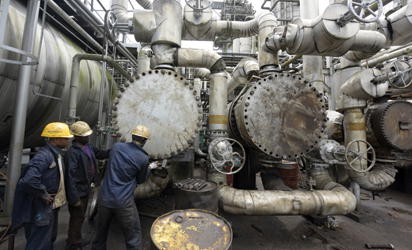
File image.
PRINCE OKAFOR
Nigerian National Petroleum Corporation, NNPC, said it is making moves to make Nigeria self-sufficient in the supply of petroleum products, as the country suffers from constant fuel shortages.

The Group Executive Director/Chief Operating Officer, GED/COO, Commercials, NNPC,Dr. Babatude Adeniran, said this during the recently concluded, African Modular Refinery Seminar in Lagos.
Adeniran said: “The current situation being experienced by the general public with respect to the lingering scarcity, calls for a new thinking towards making the country self-sufficient in the supply of petroleum products.
“NNPC has commenced the process of increasing the refining capacity of the existing refineries through co-locations of private refining infrastructure. This is to balance the country’s needs, as importation of petroleum products doesn’t create jobs, rather it causes loss of tax income to the government, and also creates a large amount of emotional backlash when people have to queue for days looking for fuel.”
Adeniran, who was represented by the General Manager, Business Development, Downstream, Mr Luke Anaele, also said: “Nigeria is a top African producer of crude oil, and a leading member of the Organisation of the Petroleum Exporting Countries, OPEC. But for some years now the issue of inadequate fuel supply to power and sustain the growth of the nation’s economy has eluded us.”
He noted that given the operating ages of refineries internationally, Nigerian refineries are relatively not as old as European refineries, adding that due to failures of essential maintenance including turn around maintenance, they have not been working optimally.
Refining capacity
Adeniran, He lamented that with the whole refineries operating at optimal capacity, the output from the existing refineries can only supply a fraction that is less than 50 percent of the nation’s daily consumption of 40 million litres of premium motor spirit, PMS also called petrol.
He further said: “Although there is no doubt that overtime, our economy has grown considerably since these refineries are built. Presently, petroleum products importations have been impaired by inadequate supply of foreign exchange, FOREX, the full burden of importation of products is currently being handled by NNPC, as private product marketers have stepped back from importation given the market condition and economic uncertainties.”
He argued that the current low oil price regime has not helped the situation, as Nigeria’s FOREX earnings is mostly from crude export. With the continued depletion of the nation’s foreign reserves, and the present state of the economy, it has become absolutely necessary for Nigerians to look inward with a view to reducing and consequently putting an end to petroleum product importation.
Private refinery
On the issue of private investment in the refining sub-sector, he recalled that government had since 2002, granted licenses for the establishment of private refineries to address the problem of inadequate fuel supply and products importation in the country. However, most of these licenses were for the establishment of modular refineries, while the others were for conventional refineries.
He noted that these licenses are yet to be utilized, with the exception of the only modular refinery established and commissioned in December 2011, by the Niger Delta Petroleum Resources Limited, at Ogbele in Rivers State, as well as the ongoing work at the DangoteRefinery Complex.
He argued that the non-utilization of these licenses suggests the existence of some fundamental issues that are yet to be addressed, stressing that many investors have adduced reasons for their inability to utilize the licenses, which include access to finance, uncertainty in sourcing for crude amongst others.
On his part, Igwe Godwin, a professor of chemical engineering and Pioneer Director of Centre for Gas, Refining and Petrochemicals, Institute of Petroleum Studies, CGRP/IPS, University of Port Harcourt, said that “It is the role of government to create enabling environment for both local and international investors.
“The Federal Government can fund the development of modular refineries in the country. Nigeria relies majorly on importation, creating jobs for people overseas, thereby increasing unemployment in the country,” he added.
Disclaimer
Comments expressed here do not reflect the opinions of Vanguard newspapers or any employee thereof.