
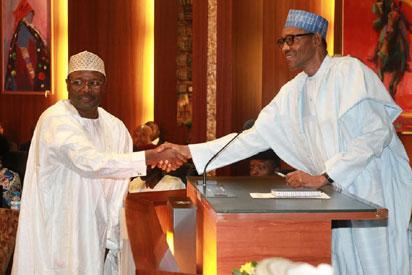
President Muhammadu Buhari congratulating the National Chairman, Independent National Electoral Commission, Prof. Mahmud Yakoob during the swear-in ceremony of the INEC Chairman and five National Commissioners at the Aso Chambers, State House, Abuja. Photo by Abayomi Adeshida 09/11/2015
•Rivers election crisis and the complicity of the electoral umpire
•Card reader: How APC and PDP politicians fooled Nigerians
That President Muhammadu Buhari has admitted failure in the three elections conducted under his watch only confirms Sunday Vanguard’s insistence that the era of free, fair and credible elections may have gone for good. And whereas the drumbeats of war, which came from both the All Progressives Congress, APC, and the Peoples Democratic Party, PDP, were enough to elicit the type of outcome witnessed in the Rivers State re-run elections, the less than efficient activities of the Independent National Electoral Commission, INEC, introduced a dangerous dimension, to further inflame an already combustible situation.
This report will show that the President’s condescending disposition towards INEC, is partly responsible for the shambles being witnessed, just as it would point out why, if these inconclusive elections are anything to go by, the APC Federal Government may be suggesting to Nigerians that it is not interested in free, fair and credible elections. Read the facts as they speak for themselves.
By Jide Ajani
HISTORY OF RIVERS ELECTIONS, RESULT SHEETS AND INEVITABLE VIOLENCE
For those who do not know, the current political crisis in Rivers State is a carry-over of the PDP leadership crisis in that state.
It would be recalled that the crisis over who controls the PDP in Rivers was actually lost by the former Gov. Rotimi Amaechi group on account of the fact that, during the election to choose the party’s state executive, a group had the original copy of the election result whereas the outcome of the proper election was recorded on a photocopy or duplicate.
In the court case that ensued, the original result sheet was tendered with the name of the current Chairman, Mr. Felix Obuah, as the winner of the election, hence, the court declared him as the duly elected Chairman.
This was one of the underlying reasons that led to Amaechi’s exit from the PDP to the APC, since his former Chief of Staff and then Federal Minister, Nyesom Wike, had taken over the control of the PDP machinery in the state.


President Muhammadu Buhari
Since then, the quest for control of election result sheet became a significant strategy known by politicians.
For that reason, in the 2015 general elections, the entire hoopla in Rivers was about the alleged absence of original “result sheets” at the polling units. In fact, it was the non-availability of the original result sheets that frustrated Amaechi – who had been cheated once – such that he walked away from the polling station when his insistence on seeing the original result sheets met a brick wall.
Once again, this was the main issue in the recently partly conducted and partly suspended elections in Rivers – in the LGAs where elections were suspended, there were allegations that both ballot papers and result sheets were snatched by politicians.
Compounding the issue even more, key political stakeholders in the state were shocked to hear that, in very adversarial elections, INEC sent some flawed but unchecked sensitive election documents with no water-mark into the field.
Naturally, this further heightened distrust and confusion; and it also left a lot of questions about the organizational abilities of the current INEC leadership.
SUPREME COURT DECISION ON CARD READER; HOW POLITICAL PARTIES CONSPIRE TO EMBOLDEN ELECTION RIGGING AND VIOLENCE
Another factor, which has not helped the seeming disarray in INEC, is the legal status of the card reader, an election tool for authenticating or validating the identity of voters in the voter register.
The unintended consequence of the refusal or failure of the highest court in the land to accord legal effects to the use of the card reader (even though the court curiously commended it as a good innovation that would sanitize the electoral process in Nigeria) has emboldened politicians to regress to the old ways of using violent means to snatch ballot papers, and, more importantly, original election result sheets. In commandeering these election materials, they allocate votes to themselves, particularly in areas that have been used to election rigging.
These loopholes created by legal uncertainty, is what played out in Rivers; hence politicians went all out to get the result sheets, regardless of the stage-by-stage procedures that should determine what would be inputted into the result sheets.
Where card readers are used diligently and the authenticated voters recorded, election results must corroborate the records of validated voters, giving election riggers very little room for result manipulation, as these varying pieces of evidence must add up in court if scrutinized.
Unfortunately, the prevaricating and hesitant leadership of INEC; after Jega’s exit, has been unable to make the case forcefully in the various tribunals for strengthening this pivotal role which the card reader is meant to play, in limiting the illegal conduct of political parties by empowering voters.
CARD READER: HOW APC AND PDP POLITICIANS FOOLED NIGERIANS
Prior to the 2015 elections, the impression in the public domain was that it was the ruling party (PDP) that was afraid of the use of the card reader.
However, Sunday Vanguard investigation into why it was only in the 2015 elections – since 1999 – that the nation was not given a new Electoral Act, despite the repeated altruistic claim by INEC, that it had made submission to the 7th Assembly, of some sections of the Act that needed to be amended to accommodate its innovation, revealed – and, shockingly so – how Nigerians were fooled through a grand conspiracy by politicians of both the APC and PDP, who concealed from the public new amendments titled, “Electoral (Amendment) Act, 2015) signed by the Clerk of the National Assembly, on March 26, 2015, two days to the March 28 presidential election and the governorship/state Houses of Assembly elections that took place in April, 2015.
These amendments would have guided the conduct of the 2015 elections and the election tribunals.
These amendments of the principal Act, obtained by Sunday Vanguard from the National Assembly, contains a provision that not only empowers INEC but also secures and accommodates the use of the card reader.
They categorically state in the amendment of Section 52 with a new Subsection “2”: “Voting at an election under this Act shall be in accordance with the procedure determined by the Independent National Electoral Commission” . This provision expressly and explicitly leaves the method of “authentication of voters” to be determined by INEC.
The questions now are: Why were these amendments hidden from the INEC and the general public all through the period that election petitions were on-going in various tribunals up till the Supreme Court? How could it be explained that even members of the APC in the National Assembly could have been ignorant of this and, therefore, by commission, be part of this conspiracy if it was actually true that it was PDP members that had hesitation over the use of the card reader? Have these findings not confirmed what Nigerians have been saying that both the APC and PDP politicians are the same and could work together to undermine whatever they consider may affect their political fortune even though it will empower the Nigerian people such as the card reader benefits?
WHY ELECTIONS WILL REMAIN CHAOTIC AND INCONCLUSIVE
No organization can perform beyond the capacity and knowledge of its key decision makers and management. Prior to the Prof. Attahiru Jega transition, INEC was carrying out series of innovations – like the PVC and the card reader.
Now, by doing away completely with credible actors who brought the innovations into INEC, and instituting this “half Board” – where, mind you, only Hajia Amina Zakari remains the principal link to institutional management memory – most of the new people have no clue about such innovations and may not be on the same page with her as revealed by an insider privy to a recent meeting where majority supported a position contrary to Madam Zakari’s view.


INEC boss, Mahmood Yakubu
For the record, Sunday Vanguard’s position, regarding the brouhaha over Madam Zakari’s appointment, in acting capacity, was based purely on legality and constitutionality and never about her competence. At the meeting in question, Madam Zakari’s point of view was actually what ought to be the right thing to be done, regarding a decision to shift dates fixed for the conduct of election requiring engaging affected stakeholders.
There was no proper hand-over process and detailed briefing to the new INEC leadership by the Jega regime that initiated these innovations. This chasm has obviously affected the performance of the current Commission as exemplified by a series of inconclusive and controversial elections that have been witnessed so far.
Besides, some of those recently appointed as representing some zones came as a shock to some Nigerians because of the alleged cobwebs in past public records, some of which elicit disdain from internal and external stakeholders. For instance, some insiders in INEC revealed that a National Commissioner, who was supposed to be in his zone to supervise election two weeks ago, as well as the Rivers’ election, was in Kenya and in Italy, when these elections were conducted, leaving a very pressing INEC assignment unattended to, for foreign trips.
HOW IT BEGAN WITH THE EXIT OF JEGA
The loss of independence of INEC, the electoral chaos and erosion of credibility currently besetting the election management body is easily foreseeable by any political analyst. It follows the first interference with the internal administration of INEC, occasioned by President Muhammadu Buhari’s reversal of the internal administrative procedure of the Commission, which occurred when the President appointed Madam Zakari, a National Commissioner, as “Acting Chairperson” of INEC, a title and position unknown to the Constitution as a power exercisable by the President; moreover,this was also done without recourse to the Council of State and the Senate as required by the Constitution. Many observers believe that Buhari made a mistake, with his knee-jerk action thereby creating, rightly or wrongly, the impression that INEC is at his beck and call. It is a well-established principle by administrative gurus that “structure follows strategy”.
Having signaled this as its intended strategy, political stakeholders began to watch the nature of the institutional structures the Presidency will erect at INEC to ensure “command and control” instead of “autonomy, distance and deference” as envisioned by the Constitution.
For months, civil society groups and opposition parties raised the red flag but nothing changed. Sunday Vanguard was consistent in maintaining that the non-challant attitude of the Buhari regime to electoral institutions in Nigeria was not just shocking, but also unbecoming for a government that is the beneficiary of the process of free, fair and credible elections that were conducted by some individuals with integrity and honour, and which made it possible for the opposition to win the 2015 presidential election.
It was clear from the outset that the Buhari regime intended to “kick-the-ladder” with which it climbed to power after three attempts, by making it inaccessible to others as noted above with the controversial appointment of a relation as Acting-Chairperson of the Commission. The latter issue impacted negatively and terribly eroded the credibility and autonomy of INEC, as political stakeholders pummeled the portents of such a move.
Not done with this controversial issue, the President ignored the statutory requirement to constitute a full 13-member Board of INEC, a constitutional matter that Sunday Vanguard severally reported, until a legal authority in Nigeria, Mr. Femi Falana, SAN, reiterated the contents and letters of one of the publications and reminded the Federal Government of an extant court judgment, in which Mr Falana himself was a counsel, pointing out that Buhari was dealing a dirty slap on the 1999 Constitution. In the aforesaid suit, a court affirmed that the minimum constitutional 1/3 (5) quorum of members, determined only from a full 13-member Board of INEC, shall take decisions needed to make the conduct of elections legal. In response to this legal advisory, the President only made half-hearted attempts to meet this judicial order/interpretation and the constitutional requirement in Section 159 of the Constitution, by appointing six new people, making a total of seven members, instead of constituting the full Board of INEC – and to this day, nothing has been done and the constitution of the Board of INEC remains inconclusive.
At the state level, the situation is worse, to the extent that, as of the time of this report, more than 22 states, if not more, have no Resident Electoral Commissioners and these sensitive offices are in the hands of civil servants called Administrative Secretaries, in breach of the constitutional provision under Paragragph 14(3) of the 3rd Schedule to the Constitution which states unequivocally:”There shall be for each state of the federation and the federal capital territory, Abuja, a Resident Electoral Commissioner…”
It appears from the observation of some stakeholders that, the President believes he is saving money by failing to properly constitute such statutory institutions; a few political observers have scoffed at this notion, pointing out that the aim of government is public benefit and public welfare, not profit or stupendous savings of funds while public institutions degenerate.
Furthermore, in global body management literature, the election body is an important national institution that is not toyed with because of its implications for political stability and national development. This school of thought pointed out that Buhari failed to realize that, if elections had failed in 2015, the citizens and politicians, by now, will be busy hiding in the bush from bullets and machetes, rather than expressing concerns about the economy. This is why electoral scholars are insisting that the process of election begins with the erection of constitutional structures and institutions which enable elections; whereas, conversely, election fraud could begin with interference or inaction, to do what is required to position the election management body to properly discharge its responsibilities.
GROWING LOSS OF PUBLIC CONFIDENCE IN INEC AND ITS PROCEDURES
Beyond the deficiency of the Commission’s institutional structures that have been engendered by the current government, there is a grim realization of a growing lack of confidence on the part of the public in the procedures of INEC that appears to have gone to the dogs under unsure, hesitant and apparently non-autonomous leadership. This is unlike the Jega regime that was so trusted by the Nigerian people (though not without human frailties), that elections could be postponed on the eve of polls, yet Nigerians would accept without distrust because the people believed in the sanctity of the process and, therefore, had credible expectations in the outcome.
This emerging procedural uncertainty, or even decay, was first noticed in the Kogi election, when INEC declared an election inconclusive based on improbable statistics. It purported that the number of voters in the areas where election was canceled were significant enough to impact the extant result at that time.
Whereas, the actual number of possible voters, when determined by the number of voters with PVC, was not enough to make a difference in the declared result. As of the time the APC governorship candidate, Abubakar Audu, died, the declared result showed that the difference between him and the next candidate, Idris Wada, of the Peoples Democratic Party, PDP, far exceeded the number of voters with PVC in the areas with canceled election. It is common and accepted fact that, no voter without a PVC can vote by extant electoral laws in Nigeria. Worse still, it is even questionable if INEC, as constituted before the Kogi election, had powers to conduct elections. How INEC came to the decision which declared the election inconclusive at that point is now a matter of legal contest.
But given that even the current INEC Board is not properly legally constituted and only a legally constituted Board of INEC comprising not less than five members determined from 13 and not five or six out of seven, the legality of the decision to conduct the Kogi election is likely to have been questionable. It is left to the tribunal to examine the Board resolutions, the attendance list and the quorum where such a decision was taken, because it may be difficult to find anywhere in the electoral law where “half a Board”of INEC, instead of the constitutionally envisioned 13 members, is empowered to conduct elections.
Further decay of INEC processes was on display again in Bayelsa State, as the Commission floundered to explain its limitations in not providing electoral materials as and when due, to some constituencies, despite a very long notice given for the election. This led to another inconclusive election carried over from 2015 to 2016, when the exercise was concluded, after so many lives had been lost.
Although failure of election security arrangements has been given as the principal cause, the prevailing atmosphere before the election was perceived, rightly or wrongly by key stakeholders, suggested that INEC may skew the process to favor a party.
Take, for instance, the issue of quality control and how documents were printed without INEC officers ensuring sanity at the printing level? How were the documents packed and sealed without INEC officials? When the materials were received in Rivers State, INEC officials, party agents, the state Police Commissioner and the DPOs at LGAs were supposed to scrutinize the electoral materials. So, how did they get to the field without these controls? These procedural shortcomings exemplify the litany of shortcomings now bedeviling the Commission as its credibility continues to erode. Dependable sources in INEC offices in Rivers hinted that the Commission lost every claim to neutrality, when both the REC and Administrative Secretary, who worked together in Delta State in the 2015 elections, where the issue of tampering with result sheets days before elections was an issue, were both brought to Rivers State to conduct the re-run.
Sunday Vanguard discovered, during investigations, that, in a petition sent to Chairman Jega before the election in Delta dated March 31, 2015, disclosures were made of how “…in the course of collecting the materials to be used for the presidential and National Assembly elections, it was discovered that a parcel containing materials, particularly the original result sheets to be used for the governorship election fixed for April 11, 2015 in Delta State, had been opened and several of the result sheets littered the floor of the vault”,
This same REC, now moved to Rivers, was alleged to have sidetracked the operations department by becoming solely responsible for the shortlisting of election ad-hoc staff, while the Administrative Secretary, on the other hand, was alleged to be under the influence of a National Commissioner from the East and both of them were pursuing the agenda of a political party.
Therefore, with what appeared to be a fragmented leadership at the state level of INEC, and with its management at such counter-poised influences, violence was bound to occur because stakeholders already knew the direction of the sympathy of officials of the Commission in the state.
More significantly, if the Commission is unable to organize elections in states at a time, can it be trusted to organize general elections? Why is it that the Chairman, who declared, on the day he assumed offices that “INEC work is the easiest job to do” and, who wondered why people have been unable to rise up to the occasion, is now floundering? It shows that, indeed, those who consider Jega and his team’s monumental accomplishments as an easy task must be finding out that, as far as elections are concerned, “talk is cheaper than action”.
IS INEC UNDER BUHARI BECOMING A SHADOW OF ITSELF?
Any lingering doubt that INEC is becoming a distant shadow of the organization under Jega faded as INEC again conducted another inconclusive elections in Rivers State.
These make the third inconclusive elections conducted by the Commission under the Buhari regime. This trend, since the exit of the Jonathan administration era of peaceful conduct of credible elections – exceptional in its own way, since the return of democracy in 1999 – has created doubts in the minds of Nigerians on the commitment of the Buhari regime to free, fair and credible elections.
Many Nigerians and members of the international election observer-groups are intensely concerned that free, fair and credible elections that were witnessed in 2011 and more so in 2015 – and, that was almost being taken for granted – are gradually regressing under the Buhari government, with all that the situation portends for the future of Nigeria’s democracy.
In particular, fears are being expressed – while significant doubt is being created in the minds of Nigerians as the 2019 general elections approach – that the APC government is not committed to democracy and the rule of law, given the shoddy and condescending way the current regime has related with INEC.
This is why the Buhari regime must sit up and make amends to the degeneration of INEC or face possible infamy in 2019.
Disclaimer
Comments expressed here do not reflect the opinions of Vanguard newspapers or any employee thereof.