
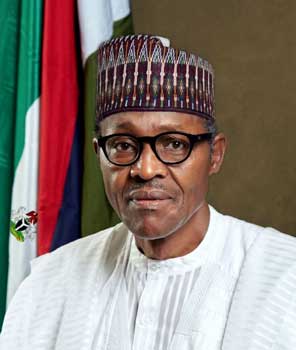
President Muhammadu Buhari
By Henry Boyo
President Muhammed Buhari’s is proposing to spend over N6trillion in the 2016 Appropriation bill, even though government ‘reasonably’ expects to earn about N3.8trillion as revenue. Indeed, according to the budget proposals, N984bn will be borrowed in Naira from personal and corporate holders of surplus cash to fund the shortfall, while $4.5b (N900bn) will also be borrowed from the international market at the current exchange rate of about N200= $1 and prevailing commercial interest rates will apply.


President Muhammadu Buhari
In practice, a ready market for government borrowing is clearly a demonstration of investors confidence on the resilience of an economy and the ability to pay back, when the loan matures. Nonetheless some critics may recall, that we were once beguiled into an oppressive debt trap, by the popular refrain of international financial experts, that Nigeria was grossly under borrowed; the effusive flattery worked and government rapidly liberalised external borrowings until re-payment became a challenge and Nigerians were subsequently ‘bullied’ to ultimately part with about $18bn to obtain partial debt forgiveness from creditors in 2006.
Sadly, our national debt is, unexpectedly, presently more than double the $32bn debt, which was considered dangerously high with unsustainable related service charges, only ten years ago. Incidentally, if CBN’s Treasury bill borrowings are included, the present proposal for $9bn loan will propel our debt burden closer to $100bn. Furthermore, the unfortunate history of poor implementation and rampant corrupt practices may not inspire public confidence that a fresh N2Tn loan will be judiciously applied, despite Buhari’s renowned integrity factor, if Honorable members of the legislature, and their counterparts in the civil service do not wean themselves of the gluttonous appetite that comes from the pervading mindset of “ it is our time to chop”!
Clearly, a deliberate increase in total projected expenditure by over 30%, despite the dismal prospect of dwindling revenue, does not suggest best practice or responsible financial management which advises that, you cut your coat according to your cloth. Thus, it is more appropriate to adopt a balanced budget in austere times rather than a heavy commitment to further borrowing just to fund a spending spree which will not generate additional revenue, but will inevitably further compound our debt obligations to spike related service charges beyond an already precarious level. Indeed, the IMF’s Christine Lagarde recently aptly described the 2016 fiscal plan as akin to applying 35kobo out of every Naira we earn for debt service annually.
Although, the 2016 capital allocation of 30% has been celebrated as appropriate, there are real concerns that the increased expenditure, may not, as usual, be applied to critical infrastructural projects that would touch the lives of more Nigerians nationwide. Furthermore, financial waste will become grossly magnified, if the present Administration decides to commit to fresh projects with long gestations, without first identifying and completing those viable and socially supportive, ongoing projects that were inherited from previous administrations.
However, cynics may suggest that such a responsible approach to project selection and implementation would diminish the ‘beef’ in contract awards and the provision of jobs for the boys; afterall, we must remember, that not all politicians were as lucky as Buhari who did not have to sell property or obtain loans to contest elections for a lucrative stint in public office. Unfortunately, not even a contrite Buhari, who has already confessed to being shackled by the Judiciary in his anti-corruption crusade, will be able to stop desperate political buccaneers from their ‘harvest’ of closer access to easy public funds.
Nonetheless, in place of the proposed 30% deficit in 2016, the size of loans required to fund a 60% deficit in the initial N8Tn budget estimate canvassed by Vice President Osinbajo, would have clearly compounded our national debt well beyond N100bn, with increasingly oppressive related service charges that would inevitably remain troublesome for this generation as well as for millions of Nigerians yet unborn.
Although, some experts have suggested that, Nigeria’s current debt to GDP ratio of barely 12.5%, presents no cause for alarm, it would clearly be suicidal, nonetheless, if over 35% of projected annual revenue is simply dedicated to debt service; such a horrid imbalance would invariably lead us, ultimately, into another death trap with possible loss of financial sovereignty, to our historical saber-rattling shylock creditors. Ironically however, Buhari’s plan to borrow almost N2Tn to fund the 2016 deficit is totally in contrast to Christine Lagarde’s observation, during her trip to Nigeria, that Nigeria does not need to borrow and that the IMF was not currently in talks regarding loan support with Nigeria.
Inexplicably, however, barely a month later, the Finance minister, Kemi Adeosun, has elatedly announced that IMF would fund $2.5b of the external loan component in the projected deficit in 2016, while the African Development Bank would fund another $1b; apparently, a balance of $1b will be sourced at higher commercial rates of interest, which could be, between 7-10%. Nonetheless, it is hardly contentious that with interest rates usually below 3%, and the extended moratorium and generous payment terms, the IMF and ADB loans should be welcome, provided the proceeds are strictly dedicated to specific, visible, critical social infrastructure projects such as comprehensive networks of road, rail, gas and fuel pipelines or indeed, the East-West Road and the 2nd Niger Bridge, for example.
However, even if the IMF/ADB loans appear friendly, we may be well advised, to avoid non multilateral commercial loans which are usually subject to international cash flow volatility, which could be injurious to our Stock market and Naira exchange rate, and could also trigger destabilising consequences for the economy and our ability to repay our external debts. Conversely, the N9bn Naira domestic loan is less risky, even though it attracts much higher average interest rates around 15%; sadly, such rates are invariably also inappropriate for risk free sovereign debts such as ours.
The critical question, however is whether or not a N2.2Tn budget deficit is a responsible response to the collapse in revenue from our major traditional source of income. Thus, with no end in sight for low crude prices, the budget will again inevitably accommodate higher deficits in 2017 and further instigate additional borrowings that may soon require the dedication of over 50Kobo out of every Naira Nigeria earns to service debt annually.
Presently, only the National Assembly can redeem us from this oppressive predicament. There is clearly an urgent need for patriotic and socially sensitive parliamentarians to firmly stand up against such reckless debt accumulation which will mortgage the future of Nigeria, by demanding a thorough overhaul of the 2016 budget to produce a more sensible and responsible balanced fiscal plan that is in tune with the current austere times.
Disclaimer
Comments expressed here do not reflect the opinions of Vanguard newspapers or any employee thereof.