
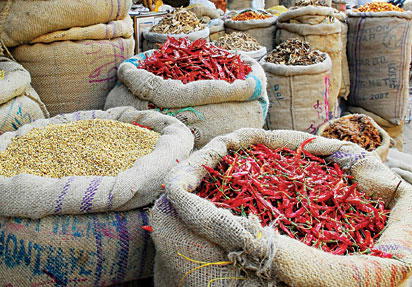
food-items
Stories By Aderonke Adeyeri
A few days after the commencement of Ramadan fast, the prices of foodstuffs and other essential commodities have escalated in most markets across the country.

Traders attributed some of the reasons for the hike in price to the Ramadan fast, heavy rain in the North, high cost of transportation, amongst others.
In some major markets in Lagos, our checks revealed that the prices of rice, beans, fruits, and beverages have gone up with about 15 per cent increase.
Some traders attributed the rising cost of fruits to “high demand during the Ramadan fast, the rainy season which has led to flood in some parts of the country especially where such foods were grown. Others attributed it to rising cost of transportation.
In Mile 12 market, Lagos, survey showed that the prices of a bag of the various brands of imported rice are sold between N8,500 and N8,900 as against the former price of between N7,200 and N7,300 a few days ago.
Similarly, a bag of beans, which formerly sold for between N19,000 and N23,000 had also increased to N20,000 to N25,000.
The price of fruits like oranges, pineapples and banana had also witnessed astronomical increases with a bag of oranges being sold for between N10,000 and N12,500 from N5,000 and N6,000 a few weeks before Ramadan.
A big bunch of banana is sold for between N500 and N1,000, while the price of a dozen of water melon is been sold between N3,900 and N4,000 which formerly sold for N1,800.
Mrs Olusola Osoba, who deals on fruits in Ile Epo market in Oke odo metropolis of Lagos state, attributed the rising cost of fruits to “the Ramadan fast, the period of the year, in addition to personal costs incurred by retailers”.
The survey also showed that the price of perishable goods like tomatoes, bell pepper (tatashe), and scotch bonnet (rodo) had gone up. A big basket of tomatoes is been sold for between N22,500 and N30,000 as against the former price of between N8,000. A basket of bell pepper goes for N14,000 against the former price of N7,500 and N8,000. A basket of scotch bonnet is been sold for between N17,000 and N17,300 as against the former price between N7,500 and N7,800.
Abubakar Rasheed, a tomato seller who decried the high cost of foodstuff at the start of the Ramadan period, appealed to traders to shun the craze to make quick money during the period. However, he attributed the hike to the heavy rainfall in Kano state.
Also, the prices of imported food items like rice, and frozen fish, moved up this past few days.
The cost of frozen fish had increased with a carton selling for between N9,300 and N9,400 as against the former price of N7,200. The cost for a carton of turkey now N7,800 against the former price of N6,500.
Moyosore Ireti, a trader in the market Bodija market in Ibadan said that a carton of Peak powdered milk is now selling for N10,200 as against the former price of N9,600 and its refill goes for N9,000against the former price of N8,500.
According to her, a carton of top beverages now sells for N8,600 against the former price of N8, 000. A carton of sells for N9,000 against the former price of N8,400.
Moyosore accused some wholesale traders of hoarding essential commodities at the beginning of Ramadan to create artificial scarcity. She said that the same applies to the other fruits such as mangoes, pineapples, water melon, banana, apple and cucumber.
Alhaja Sekinat Abdulakeem, a retired teacher who came to shop for Ramadan expressed that the hike in the prices of food items should not be linked to Ramadan but the greediness of the traders who wants to make quick money.
Aminat, another buyer at the market said that increases in the price of food items will force many families to reduce their shopping menu.
“I enjoy breaking the fast with fruits, but I cannot afford many as the prices have soared now,” Aminat said.
Disclaimer
Comments expressed here do not reflect the opinions of Vanguard newspapers or any employee thereof.