
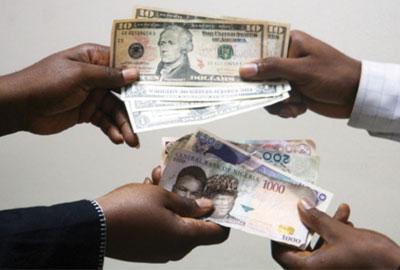
Naira-Dollar
By Emeka Anaeto, Economy Editor
Investors in capital market appears to be facing more headwinds in the weeks ahead as key factors that led to recent market declines are stiffening. The key factors are foreign portfolio investor’s (FPI) apathy and weak corporate earnings.

As a result most FPIs are downgrading the value of their investments in Nigerian equities, fueling steep decline in the overall market performance.
Reacting to the development, analysts at Afrinvest Group, a Lagos-based investment house, said last weekend that ‘’equities market as at last Thursday had declined 13.1per cent since it reached its 2015 high of 35,728.12pts on April 02, 2015 following the successful conclusion of the presidential election as investors continue to price in FX devaluation risk on investment valuation’’.
They added that ‘’currency market uncertainty coupled with absence of fiscal direction of the new administration and weaker earnings projection of quoted companies have sparked off a bearish run in the financial market’’.
Consequently they projected that ‘’amidst domestic macroeconomic uncertainties and unexciting global events, we expect the lull state of the equities market to likely persist baring any unexpected cheery news that could turn the tide. Also, we believe local investors will still continue to find the fixed income market an attractive safe haven in order to absorb the various macroeconomic and monetary policy shocks’’.
The National Bureau of Statistics (NBS) has reported that growth momentum slowed to 3.8 per cent in the first quarter of 2015 relative to 6.2 per cent in the corresponding period of 2014. This was a fallout of weaker consumer spending power, tighter monetary policy and political uncertainties that doused consumption spending and fixed capital formation in that period.
But unfortunately the political uncertainties which cleared with the successful general elections and smooth hand over of political power eventually transited to lull in governance and economic policy uncertainties.
In addition NBS also reported last week that headline inflation has accelerated for the 7th consecutive month to 9.2 per cent in June 2015, a 20bps increase compared to 9.0 per cent in the previous month. This, according to them, was as a result of the pressure on supply-side cost arising from petroleum products scarcity and weaker Naira/Dollar exchange rate.
While these factors continue to threaten real return on investments in the financial market, issues around the foreign exchange market, according to analysts, is expected to dominate economy discussions in the weeks ahead.
Several foreign exchange policies have left investors (especially foreign) with uncertainties about investing in the country. The most recent was the contentious removal of 41 products from items valid for foreign exchange funding at all segments of the market. This has resulted in the widening of the exchange rate spread between the official and parallel markets (now 24.4 per cent or N48.05/US$1.00), creating a fertile ground for round-tripping, currency arbitraging and speculation.
We anticipate that the recent foreign exchange policies in Nigeria will affect local manufacturing companies who depend on the importation of some of the listed items for raw material. This may further have an impact on growth rate and inflation in Q3:2015.
Standard & Poors (S&P) recently declared that Nigeria cannot avoid a devaluation. As the currency situation in Nigeria continues to remain a concern to both domestic and foreign parties, we expect that the CBN will maintain policy rates at the next MPC meeting, although increase in the intervention rate in the Interbank market may not be unlikely.
Disclaimer
Comments expressed here do not reflect the opinions of Vanguard newspapers or any employee thereof.