
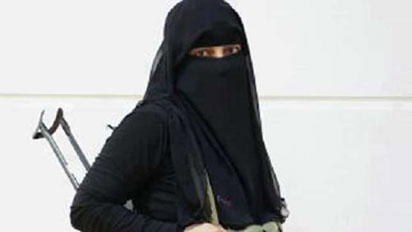
Female suicide bomber
By Emmanuel Edukugho
For over six years now, Boko Haram insurgents unleashed a reign of terror which claimed thousands of lives with Borno, Yobe, Bauchi, Gombe and Adamawa States badly hit, later degenerating into suicide bombings. Girls are recruited as suicide bombers.
The typical terrorist bombers could only be men – males of 16 to 45 years of age. No thought was ever given to females becoming terrorists. But terrorists all over the world seek out vulnerabilities in government’s counter – operations and the lack of scrutiny of females now used for terrorism. Suicide bombers are today’s weapon of choice; an action that was once so surprising, horrific and terrifying has become a common phenomenon. From Jerusalem to Beirut, Damascus to Baghdad,Tripoli to Mogadishu, suicide bomber is clearly the weapon of choice for international terrorists.
In terms of casualties, suicide attacks are the most efficient form of terrorism. Although suicide attacks accounted for 5% of terrorist incidents, it caused half of the total deaths from terrorism. Nigeria too is not spared of girls being used as suicide bombers. The success of suicide bombers is dependent upon the factors of surprise and accessibility to targets. Both of these factors have been met successfully by using females. The recent spate of women suicide bombers in different countries and by different terrorist organisations testify to this.
Worried by the trend, the UN Secretary–General, Ban Ki Moon, called for more action towards preventing the use of females by extremist groups.
“From Nigeria and Somalia to Syria and Iraq, the bodies of women have been transformed into battle grounds for warriors carrying out specific and systematic strategies often on the basis of ethnicity or religion”, Moon stated, calling on the world to respond to the targeting of women and girls by violent extremists.
On the way out, the UN scribe said that some progress had been made over the past years with more access in education for girls, more presence in business, governments and global organisations as well as progress in maternal health.

Meanwhile, the use of females as suicide bombers posed some problem between fundamental religious leaders’ beliefs and the tactical need for a more vicious weapon. The spiritual leader of Hamas, a Palestine organisation, Sheikh Ahmed Yassin, in January 2002 renounced the use of women as suicide bombers. In March 2002 after the second Fatah bombing, he stated: “Hamas was far from enthusiastic about the inclusion of women in warfare, for reasons of modesty.”
That position dramatically shifted in January 2004 with the launching of the first Hamas female suicide bomber. Yassin defended this change as a “significant evolution in our fight”. He added: “The male fighters face many obstacles, and, therefore, women can more easily reach the targets”. He affirmed that “women are like the reserve army – when there is a necessity, we use them.”
Consequently, terrorist organisations use women as weapons because the method provides:
*Tactical advantage: stealtheir attack, element of surprise, hesitancy to search women, female stereotype (e.g. non-violent).
*Increased number of combatants
*Increased publicity
*Psychological effect
Human precision bomb’
Magnus Ranstorp, Director of the US Centre for the Study of Terrorism and Political Violence, shed more light on this. “It is the ultimate asymmetric weapon, you can assimilate among the people and then attack with an element of surprise that has an incredible and devastating shock value”, he stated.
A commander in charge of training future suicide bombers was quoted as saying, “The body has become our most potent weapon. When we searched for new ways to resist the security complications facing us, we discovered that our women could be an advantage”. One trainer even described female suicide bombers as the new “Palestinian human precision bomb.”
For those who studied Middle East cultures, another reason for the use of females in terror attacks is that, “the use of female suicide bombers by Palestinian militant groups is designed to embarrass the Israeli regime and show that things are so desperate that women are fighting instead of men”.
Suicide bombers provide the low-cost, low-technology, low-risk weapon that maximizes target destruction and instills fear – women do that even more with increased accessibility and media shock value. Profiles have been developed for specific sets of suicide bombers – like being young, unmarried, attends mosque regularly and so on.
Ariel Merari, a leading Israeli authority on suicide terrorism, and Boaz Ganor agree on this assessment. Many suicide bombers tend to be of average economic status although some come from refugee camps. But as logical as the poverty – breeds-terrorism argument may seem, studies showed that suicide attackers are rarely ignorant or impoverished.
Two other critical findings were that more than half had spent time in Israeli prisons and had expressed the desire to avenge the death or injury of a relative or close friend.
Research indicated that the reasons for females participation in deadly attacks vary. In Nigeria, some parents sympathetic to Boko Haram ideology of Islamic fundametalism have lured their teenage daughters into becoming suicide bombers. However, female suicide bombers, just like their male counterparts, have a common characteristic – they are young.
Recruitment
The average age varies from 21 (in Turkey) to 23 in Lebanon, even younger ages of 15 or less in Nigeria. Some are minors, widows, others unmarried, many are unemployed, while others are professionals of one kind or another, some are illiterate, poor and others are middle class. Analysts have compared the Black Widows in Russia with the Palestinian suicide bombers as both appear to struggle for national identity with religious undertones.
The selection of women for suicide operations and the methods used to persuade them are generally similar to those employed for men. The recruiters take advantage of the candidates’ innocence, enthusiasm, personal distress and thirst for revenge after loss of close friend or family members. The recruiting strategy for female bombers is to get them while they are young, personally brainwashed. You need complete control of all their conditioning usually from the age of 11 or 12 years. Many believe that female suicide bombers are “sold”to terrorist organisations, drugged to perform such deadly acts, and or raped and blackmailed if they do not participate.
Reward
Generally, there are religious, nationalistic, economic social and personal rewards for becoming suicide bombers. According to findings, there are few differences between a man and a woman carrying out such a mission. Motivations are simply the same: they believe that they are committed, patriotic combined with a religious duty. Religious and criminal terrorism (as we have in Nigeria – Boko Haram) is a particularly potent form of violence because it claims the religious justification for committing horrible acts. Islamic and religious fanatics attract suicide bombers using rhetoric to stir up feelings of neglect, poverty, hatred of the ‘enemy’ and a profound sense of victimization.
Therefore suicide bombers see their actions as being driven by a higher order who provide rewards for them in after life. Muslim extremists believe that in death, every martyr, male or female, is welcomed by a minimum of 70 apparitions of unnatural beauty who wipe away his sins, open the gates of heaven and provide him with all the pleasures that God has given to mankind. After her death, the suicide bomber’s family is showered with honour and gets substantial financial rewards. She sees herself as envied by those she left behind.
In Nigeria, plagued by the deadly Boko Haram insurgency with a controversial ideology against Western education because it teaches evolution, capitalism and many other things that conflict with Islamic fundamentalism, female bombers have been deployed on targets.
In what was described as a bloody Monday on December 22, 2014, at the busy central market in Bauchi, a female suicide bomber planted a bomb near a fully loaded passenger bus getting ready to depart which exploded killing 10 people. Earlier same day, bombers hit Dukku Motor Park, Gombe, killing 20 persons and injuring 25 others seriously.
On July 28, 2014, two female suicide bombers struck in Kano within five hours of each other, killing five people.
Another female bomber blew herself up at a police checkpoint at Gidan Murtala by Kofar Nassarawa over-head bridge. According to the Kano Police PRO, the female suicide bomber blew up herself as she was about to be screened before entering the premises. When she approached security men conducting the search, she detonated the explosive device hiden under her hijab. A second bomb attack by a 19-year old lady occurred at the entrance gate of Kano Trade Fair Complex in which six persons including two policemen were injured. The suicide bomber died.
In Yobe State, on February 24, 2015, a female terrorist with an Improvised Explosive Device (IED) hidden in her flowing veil detonated the device, killing 16 people at a crowded motor park. The incident came about 48 hours after another female suicide bomber killed herself and five other people with explosive hidden in her veil at the Potiskum GSM Market. In the Yobe park blast, according to eye witness, the female suicide bomber alighted from a tricycle and ran into waiting passengers before detonating the explosive.
The most recent of female suicide attacks in the country occurred at Tasha Market/Motor Park in Damaturu, Yobe State in which a 10-year-old girl detonated an explosive in the middle of a crowd, killing seven persons and injuring 31 others.
Meanwhile, the Nigerian military, in cooperation with some West African allies, seems to be winning the war against Boko Haram, liberating captured territories including the dreaded Sambisa forest which was the fortress of the insurgents.
Nigeria has a Countering Violent Extremism (CVE) mechanism which had been laid out for world support at the UN involving de-radicalisation programme, strategic communication, counter – radicalisation and economic regeneration.
Disclaimer
Comments expressed here do not reflect the opinions of Vanguard newspapers or any employee thereof.