
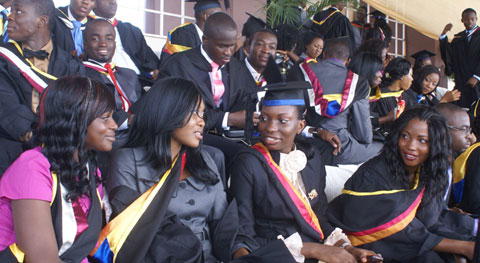
A Cross Section of the Final Year Students Photo By Diran Oshe
By Dele Sobowale
“In consonance with his calling and disposition, he should line up behind seemingly [underlining mine] powerless conscience in its struggle against conscienceless power, as [Ben] Bruce has surprisingly done.” Prof. Kayode Soremekun, NOUN UNIVERSITY, PUNCH, June 2. 2015, p 29, in an article titled ‘Ben Bruce, Akinnaso and Noam Chomsky”.

A Cross Section of the Final Year Students Photo By Diran Oshe
In the first part of this series, I had predicted that Professor Niyi Akinnaso, was asking for an avalanche of rejoinders, even hate mail, in response to his articles asking for upward review of tuition and other fees in Nigerian universities – presumably, public universities; since private universities don’t need anybody’s advice.
Private businesses determine their own price, which as any economist knows, is the synonym for things like tuition, fees, levies etc. There might have been others, but the first rejoinder to come to my notice is the one mentioned above and it can, in many ways, serve proxy for all the others that will follow.
It has summarized all the arguments which have always been made whenever the issue of raising tuition fees is on the national agenda. In fact, Soremekun’s entire argument consists of a lot of contentious submissions which could be reduced to one word – DON’T.
However, that “don’t” position rests on a number of outright fallacies and some half-truths, mingled with accepted “truths”. Permit me to start with the statement quoted above, which comes from the last paragraph of the article. Implied, but not stated, is the fact that the matter of appropriate tuition in Nigerian universities is part of the class struggle involving the “masses” and the “wealthy” – in other words, the “Haves and Have-nots” (Miguel de Cervantes, 1547-1616).
According to him, “the level of poverty here is daunting.” While grinding poverty is a reality in Nigeria, it would amount to stretching the truth to breaking point to assert that the matter of university education affects those living on less than one dollar a day. The real truth is that those living in abject poverty seldom send their kids to school; so university education for their kids is their last concern.
Invariably, people like Soremekun had often used the masses as an alibi on a matter like this which concerns only the middle class and the upper income groups. There is a bit of intellectual slight of hand involved in that. Corruption in public service, as well as the situation where “a few elected officials monopolise the resources of the country, living a champagne life while a majority of Nigerians live below a dollar a day”, have always been used as a reason for delaying addressing the issue of realistic tuition.
Here again, Soremekun is only half right. Yes, the condition he paints undeniably exists, but they existed when the tuition fees prevailing now were agreed in the past. Why should those social maladies now become the reason for ignoring an urgent problem? Are we supposed to wait until Nigeria is corruption-free and when there is more equitable distribution of wealth? Even, Prof knows that will amount to waiting for ever.
At any rate, with respect to the monopolization of resources by few elected and appointed officials, Prof needs to be reminded about two facts of life. First, Joseph De Maistre, 1754-1821, already told us that “Every nation has the government it deserves.” If we have allowed selfish individuals to rule us for almost sixty years, while calling them Your Excellency, Distinguished Senator, Honourable Member, etc, we deserve the consequences of our collective servitude.
Second, Albert Camus, 1903-1960, reminded us that, “There is no equality in the world of power, the masters calculate, at a usurious rate, the price of their own blood.” (VANGUARD BOOK OF QUOTATIONS p 195). To use an expression by late Bob Marley, “we stand around and look” as the Revenue Mobilisation Allocation and Fiscal Commission, RMAFC, the greatest collection of “Prodigal Sons” ever produced by any nation give public officials outrageous remuneration packages which have left little for education – which is a capital intensive undertaking.
Along the way, a Minimum wage law was passed under which rich states (Lagos, Akwa Ibom, Rivers, Delta, Bayelsa, Kano) paid the same insane emoluments as poor states (Ebonyi, Ekiti, Plateau, Nassarawa, Gombe) and their governors were/are at liberty to appoint a lot of parasites.
Meanwhile, the iron laws of economics, which respect nobody, continue to operate. From the time the current tuition fees were approved till now, prices of all inputs to university operations have gone up by over 200%; salaries also went up – not to talk of the cost of fuel to power generators. Which of these other prices waited for the poor to obtain justice or for more equitable distribution of wealth before being adjusted upwards in the face of prevailing economic realities?
The Nigerian Labor Congress, NLC, is again talking about Minimum Wage increase – despite the fact that the NLC represents a tiny minority, less than five per cent, of Nigerians and they exclude those living in grinding poverty who will also suffer from the inflation induced by across the board wage increases. Would they wait until justice is done to everybody? It is doubtful.
Disclaimer
Comments expressed here do not reflect the opinions of Vanguard newspapers or any employee thereof.