
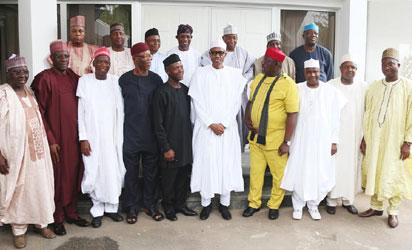
BUHARI MEETS APC GOVS/GOVS-ELECT—Front row from left: Govs Tanko Al-Makura (Nasarawa); AbdulFattah Ahmed (Kwara); Abdullahi Umaru Ganduje (Kano); National Chairman APC; Chief John Odigie Oyegun; Vice President-elect, Prof Yemi Osinbajo; President-Elect; Gen. Muhammadu Buhari; Gov. Rochas Okorocha (Imo); Speaker and Sokoto Governor Elect, Aminu Tambuwal; Kebbi Governor-Elect Senator Abubakar Bagaudu Atiku and Deputy Governor-Elect, Ngeri. Back row: Governor Kashim Shettima (Borno); Muhammad Bundow Jubrilla (Adamawa); Kaduna State Governor-Elect, Nasir El-Rufai; Governor Rauf Aregbesola (Osun); Governor Mohammad Abubakar (Bauchi); Plateau State Governor-Elect, Simon Lalong and former Governor of Ekiti State Dr. Kayode Fayemi when the President-Elect met APC governors and governors-elect, yesterday in Abuja to kick-start the new government as May 29 hand-over date approaches. Photo: Sunday Aghaeze.
By Paul Odili
ALL Progressives Congress (APC), on Tuesday, June 9, got a lesson in how not to be a majority party! Like many Nigerians, I was intrigued by the drama in the National Assembly.
Beginning with the pre-inauguration footwork of members of the National Assembly and the final act on the floor of the two chambers, curious Nigerians wanted to see how the minority PDP, long Nigeria’s dominant and once self-proclaimed Africa’s largest party (surprisingly, APC is yet to wear a similargrandiloquent toga), was taking up its new role as the opposition party for the first time in 16 years.
Will the PDP, shaken to its overwhelming loss at the general elections, find the chutzpah of the old PDP—the swagger and rumbustious show of dominance-or would it struggle to establish its new identity as opposition party? No one was sure. But as it turned out, there was the still old trickery left in the bags of a once ‘dying party’.

Dogara and Saraki
APC is rightly embarrassed over the turn of events and have not hidden its frustration. Clearly, this type of baptism into national politics was not what they bargained for. The shrill denunciation of the outcome of events by Lai Mohammed, Bola Tinubu and other South West APC chieftains makes good newspaper copy but little sense in real politick.
However, as things stand, the APC just gave the PDP a shot in the arm. If APC loses the general elections in 2019, the foundation was its loss of the National Assembly.
Weeks before the inauguration of the National Assembly, APC faltered on several grounds. The party’s decision on the allocation of offices, the zones and the candidates of choice rapidly deteriorated into a fiasco. It could not decide, one time it lurched towards zoning and the other decided against zoning. The party wanted to be different. APC was disdainful of PDP zoning formula without offering a superior alternative, which did not help the confusion it was entering.
Then the party decided that it was going to allow its offices open to everyone, but along the way, decided that (well, seems, to me zoning of APC has variety), it would not allow the Senate presidency to go to the North-West because the presidency is already there and there was the question of whether the South-West should actually get the Speaker, considering that it already had the vice presidency.
Amidst this confusion, it appears the debate shifted to the North-East, which staked a strong moral claim the Senate presidency against North Central, which was also in contention. Along the way, there was personality politics. Bukola Saraki, Ahmed Tinubu, George Akume, etc flexed muscle.
Tinubu, the National Leader of APC, was at the centre of this or so it appear. If media reports were to be believed, Tinubu had talked Akume out of the Senate presidency and sold him the deputy slot. He was said to have wanted the North-East to have a shot at it and North-Central to deputise, which at the moral level was not a bad argument to offer.
However, his feint to have South-West produce the Speaker did not quite jell with the moral platform he articulated, although it might be argued that since the South-South and South-East, by their voting pattern, did not give APC much, it was very convenient for Tinubu and his manoeuvre.
However, it does appear that in constructing his power base, Tinubu did not quite reckon with the other political forces. Saraki and perhaps Yakubu Dogara had no interest in his plan. This is so because Tinubu’s plan is a typical South-West template.
As APC leader,Tinubu is pretty much the juggernaut who fashion’s the South-West political structure in the manner he deems fit. The trouble is that finally Tinubu has overreached himself, this time. Saraki is an experienced politician and can quite easily pull his weight against Tinubu in political brinkmanship if that was needed. Unlike in the South-West, where politicians swear oath of allegiance to Tinubu, to escalate his strategy to the national landscape is bound to be suffer grief. It is hard to imagine Saraki regarding Tinubu as his political superior.
Tinubu’s plan was not also helped by his disastrous analysis of his party and President Buhari. APC Nigeria is not yet a political party. APC South-West is a political party. And that perhaps is the only zone where APC is really a political party. In other parts of the country, APC is not yet an organic structure beholden to a common ideology and vision.
To assume that the decision he orchestrated using the instrumentality of the party leadership is binding is surprising,especially, if that is in conflict with the interest of major factions in the party. Without their buy-in, nothing constructed will work.
Moreover, Buhari, the only man with the authority of his office to whip his party into line, ruled himself out of the controversy on this issue. Buhari’s calculation that he would be muddied if he ventured into this affair and could damage his moral authority, is both naïve and statesman like and it has cost APC.
When Buhari woke to the unfolding debacle by summoning the meeting at the 11th hour, when the business of parliament should be taking place and that nobody informed him of this was to complete the circle of disaster that was long in coming. Tinubu made this point in his public rebuke of Buhari on Wednesday.
I agree that Buhari’s aloofness did not help matters. What is to be wondered is if Tinubu considered Buhari’s behavior strange. Buhari ran as a Nigerian leader seeking political support and not as a politician seeking popular mandate. There is a major difference.
Ramrod, austere, and not given to trifles, Buhari is the type of leader who is not going to change his ways notwithstanding this present calamity or Tinubu’s fulminations. Like General Olusegun Obasanjo, Buhari must have a certain feeling of predestination and, therefore, will feel he is above narrow party interest. For all you care, Buhari may feel that he is the vehicle through which APC came to power, while Tinubu, the politician, will feel that it is the party that brought Buhari to power. With this clash in ideology as well as in the mechanics of achieving power, the unraveling of APC may have started.
For the PDP, the APC fiasco has given a boost to its image. PDP has shown better organization and cohesion. Lucky for the PDP it has had 16 years to learn this lesson. What it does with this uppercut, will be seen in the future. Obviously, at institutional level, there is a lot of difference between the two parties.
One and that is APC is at a level of development the PDP was 16 years ago, the PDP on the other hand got carried away by its frequent successes until its defeat in March. By and large, the APC’s change mantra is going to be tested severely in the coming months and years. How it manages its mandate will determine its survival. Right now, the auguries are not good. Nevertheless, for whatever it is worth, democratic rule in Nigeria needs APC to be strong and vibrant. Ultimately, healthy competition ensures growth and development of democracy.
Odili lives in Asaba
Disclaimer
Comments expressed here do not reflect the opinions of Vanguard newspapers or any employee thereof.