
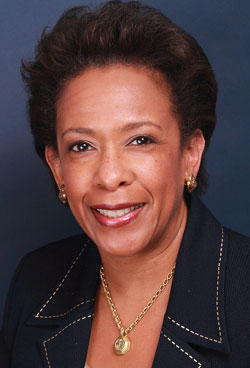
Loretta Elizabeth Lynch
By Uche Onyebadi
FOR over five months, dyed-in-the-wool conservatives in the U.S. Senate lay in an ambush for Loretta Elizabeth Lynch, waiting and looking for the best opportunity to legislatively lynch her. Practically all of them had no qualms about scuttling her desire to be the next attorney general of the United States. The issue was politics affecting her confirmation of the nation’s chief law officer.
Ms. Lynch had twice served as the United States attorney for the Eastern District of New York. But the senators, most of whom really had nothing against her as a person, and had nothing damaging to say about her qualification for the job, just did not want to approve her for the position in an effort to do some horse trading with other issues they needed to deal it, mainly immigration and anti-abortion.

Loretta Elizabeth Lynch
In the end, however, Lynch escaped Senate lynching and was last week confirmed by a 56-43 vote in the Senate to replace Eric Holder in the powerful position of attorney general of the United States. Incidentally, Lynch’s most vocal anti-nomination senator was not present to vote against her. That man, Texas Senator Ted Cruz, preferred to let go his fight against Lynch and focus more on his ambition to become the Republican Party flag-bearer in the 2016 presidential election.
Senator Cruz did not couch his opposition to Lynch in diplomatic language. He said on the floor of the Senate that “for several months, I have been leading the fight to stop the confirmation of Loretta Lynch – and the reason is simple: Ms. Lynch came before the Senate Judiciary Committee and refused to articulate any constitutional limits whatsoever on the authority of the president…Some say, confirming Loretta Lynch means Eric Holder is no longer Attorney General. But there is a difference.
Eric Holder began disregarding the law and abusing his office after he was confirmed. Ms. Lynch looked senators in the eye and told us she intends to disregard the law. For senators to vote to confirm an attorney general in that circumstance means they are complicit in the lawlessness.”
Cruz is not alone in his “lawlessness” argument. His colleague, Senator Jeff Sessions from Alabama, said this before voting against Lynch: “We do not have to confirm someone to the highest law enforcement position in America if that someone has committed to denigrating Congress” and the law.
But, New Hampshire Republican Senator Kelly Ayotte, perhaps spoke for most of his conservative colleagues in the Senate when he put politics aside and acknowledged that “Ms. Lynch is a well-respected U.S. attorney with a proven record and significant experience handling difficult cases. After meeting with her and reviewing her qualifications, I believe she is clearly qualified and has the necessary experience to serve as Attorney General.”
Ms. Lynch is the second woman to serve as a U.S. attorney general. The first was Janet Reno. Both were appointed by Democrat presidents, Bill Clinton and Barack Obama, respectively. Lynch, however, makes history as the first African-American woman to occupy that exalted judicial position. She also made history in another way: the third longest delay in confirming someone for the office of attorney general in the U.S. This history-making position is the result of the partisanship that has become characteristic of Congress in Obama’s tenure.
From the ontset of his administration in 2008, Republicans in Congress vowed to plant cogs in Obama’s wheel of governance. They became so fixated about stopping whatever the president did that Obama himself joked that if he somehow found the medicine that would cure cancer, Republicans would rather die than try the medication. So, it was not a surprise that the senators sat on Ms. Lynch’s nomination for as long as they wanted.
Another important factor that delayed her confirmation had to do with his predecessor, Eric Holder, the first African-American male to hold that position. For some reason, Republican Congressmen believed that Eric was only focused on giving legitimacy to anything Obama did.
Nomination process
The Republican senators who eventually voted to confirm Lynch must have found themselves in a dilemma: in as much as they wanted to scuttle Lynch’s nomination process, they knew that the more they delayed her confirmation and assumption of office, the more they had Eric Holder to deal with. In the end, they must have concluded that voting for Lynch was more pragmatic than having Holder remain in office.
The other possible reason for Lynch’s confirmation is that the campaign for the 2016 presidential election has kicked off. Republicans don’t want to be accused of making it impossible for the country to have an effective attorney general. Yet, they needed to use Lynch to showcase as another example of how tough they are on Obama’s regime. It was no fluke that all three potential Republican presidential candidates very visibly voted against Lynch’s confirmation as attorney general.
Lynch’s confirmation is another notch up the ladder for women in America. It may have been a coincidence, but it is a fact that two days after Lynch’s senate confirmation, Cecily Strong of Saturday Night Live became only the fourth woman to host the annual (94th) White House Correspondents’ Dinner, held at the Hilton Hotel in Washington D.C.
Who knows, 2016 might be another year for the uplifting of women in the U.S. That might be when Hillary Clinton will emerge as the winner of an election that would etch her name in history as the first woman to become the President of the United States of America, a “luxury” that is currently being enjoyed by female presidents in Liberia, Argentina, Brazil, and so on.
Disclaimer
Comments expressed here do not reflect the opinions of Vanguard newspapers or any employee thereof.