
By Uche Nwabueze
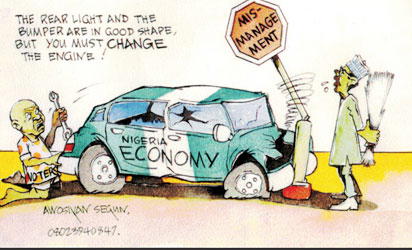
The tenure of Dr. Ngozi Okonjo-Iweala may have brought a rigorous, intellectual and analytical approach to government economic policy, and an end to decades of voodoo economics. It also resulted in the death of Keynesian economics and heralded the dawn of a new era of neo-classicism. Neo-classicism is the economic doctrine favored by international agencies like the World Bank and the International Monetary Fund (IMF).
According to Peter Drucker, neo-classic economists tend to preach the superiority of the free market over any other economic system or ideology, and they also claim that the free market by itself will create a functioning society and, indeed, even a stable democratic political system. The laundry list of prescriptions attempted by Dr. Okonjo-Iweala was not Nigerian specific, but standard neo-classic economic interventions for turning around any failing or failed economy.
It is often anticipated that a neo-classic approach to reinventing an economic system should work like a wonder drug once government spending is cut, a return to the way budgets were initially made by beginning with available revenues, that is, with how much money can be spent and as a result forcing the government to decide what can and should be financed within the limits set by the availability of money. It also encourages the privatization of government-owned businesses, and the elimination of any form of government subsidy.
Furthermore, many who subscribe to this doctrine believe that the transitional period would not be more than two years, although unemployment in the short-term would skyrocket.
However, the reality is that this so called wonder drug has only resulted in marginal economic improvements in Bolivia, Chile, and Argentina, but has failed miserably in Russia, and in coastal China. Be it as it may, Neo-classic economics ideology has led to wild inflation rather than a stable economy.
What international agencies like the World Bank and the IMF has so far failed to demonstrate through this interventionist economic doctrine is that neo-classicism generates a functioning society and a stable polity. As a matter of economic fact, the evidence is to the contrary, and Douglass C. North, who received the 1993 Nobel Prize for Economics suggest and I agree is that the free market does not create a functioning civil society – it presupposes it. Without such a functioning civil society, a few more business speculators and the politically corrupt would get richer, but the economy will remain poor.
Nigerians are very excited about the timely arrival of President-elect Buhari and rightly so, but unless he concentrates first on structural and social development programmes before economic development, the hoped for economic miracle would be a pipe dream.
I would contend like Peter Drucker that the free market works only where there are effective institutional guarantees of property rights, protection of property rights, independent, effective and functional legal system, stable financial and educational institutions, and incorruptible human resources that the society produces. But where no such tradition of a civil society exists as is the case in Nigeria, neo-classicism by itself is unlikely to create a functioning and sustainable economy, let alone a functioning society. It is my humble opinion that it never works when economic development precedes social, legal and political development.
As a consequence, in Nigeria, we must first build a lasting social foundation to support economic growth, but focusing first on economic reform is more akin to building a house without foundation.
Ideals of Economic Intervention
I agree in principle with Dr.Okonjo-Iweala that we need to curtail government spending and borrowing because there has not been one single case of government spending stimulating the economy, let alone one of government spending turning around a recession or depression. Government deficits destroy capital formation, but the Nigerian case is unique and would require increased government spending in the short-term on technological innovation rather than on capital intensive projects in order to create new 21st century jobs.
Fiscal responsibility does not only connote cutting government spending like most Republicans in the United States believe, but also encompasses the generation of internal revenue, and I cannot remember the Jonathan administration articulating a clear policy on the much needed tax reform, the flawed taxation system and might I add, our non-existent taxation system. How many Nigerians, Nigerian businesses, and foreign companies doing business in Nigeria pay taxes directly into government coffers? Nevertheless, Dr. Iweala was right when she suggested early in her tenure the need for a dedicated coordination of monetary policy by the Central Bank of Nigeria (CBN), but I was disappointed that she failed in instituting a truly independent central bank of Nigeria.
The Achilles-heel of our economy is the rate of inflation and sky-high interest rates, and anybody who claims to know the exact rate of inflation in Nigeria is been economical with the truth. In countries with currency woes, it’s typical for official inflation numbers to bear little resemblance to real inflation or implied inflation using black-market exchange rates.
The new administration coming in on May 29th, 2015 must come forward sooner rather than later to share with Nigerians who have lost faith in the Naira and unless some drastic measures are taken, inflationary pressures would result in severe economic dislocation.
Nigeria is one of the most expensive nations in the world, thus the suggestion that the new administration would focus on jobs creation does not make any economic sense if people cannot survive or attain subsistence level living on salaries or wages earned without having to resort to kidnapping, stealing, armed robbery, and corruption. There are two telltale signs that the naira is in crisis: the booming black market and high volatility.
It is common knowledge that we need power and infrastructural development, but a more productive debate is: What will the government do in the short-to-the-medium term? In the short term, it is my hope that the emphasis would be on energy, security, law and order, social discipline, and social development. It is difficult to disagree with other issues raised by President-elect Buhari, but my concern is not about the “what-to do’’ as we say in strategy, but more about the “how to do”, which means execution. Poor execution has cost Nigeria dearly because of the use of public office as compensation for party members. Party affiliation should not serve as qualification for ministerial appointments.
In a society like ours that need to employ the economic doctrine of capitalism with a human face, it is fallacy to conceptualise that it is the role of government to provide jobs. The role of government in job creation, I will contend; is to institute and sustain an enabling, secure and safe business environment for private entities to create jobs. I am very excited about what Nigeria may represent, particularly her macroeconomic ideas, and my strong belief in the mixed economy ideology, small and prudent government, and I look forward to the new administration organising on the assumption of office an economic, education, energy, and healthcare summit, which would avail the opportunity to so many likeminded economists to contribute their two cents to Nigeria’s forward ever and backwards never agenda of social and economic change.
Finally, as we move forward as a nation, we need a legal system that interprets laws, a legislative system that actually legislates by making laws, security agencies that effectively police, and an executive arm of government that governs in behalf of the people. President-elect Buhari must make a prudent choice for the finance ministerial position, and should not listen to the naysayers who argue that democratic governance is different from military rule, it is not. Nigeria is a unique democracy where the executive branch has absolute power and the new president must use his position as a “big whip” to make the country a nation of laws. We pray as a nation for the success of his administration; and that the good Lord and Allah would give him the strength of character and fortitude to be steadfast against nefarious elements in our society.
Professor Nwabueze wrote from Texas Southern Universtity, United States.
Disclaimer
Comments expressed here do not reflect the opinions of Vanguard newspapers or any employee thereof.