
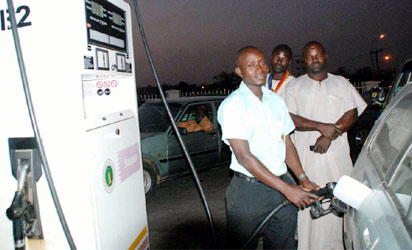
File: NNPC Mega Filling Station
By Henry Boyo
Curiously, in an attempt to align with public sentiment, in an election year, government was stampeded by popular demand to concede and accommodate a N10/litre subsidy on a reduced pump price of N87/litre. Clearly, this decision was not thoroughly thought through, as it ignored the role of Naira exchange rate on the domestic pump price of petrol, as consistently explained in several articles in this column.

Clearly, with continuously bloated Naira surplus in the market, the reduced dollar income from prevailing lower crude prices has exposed the fragility of the Naira/dollar exchange rate mechanism, and rapidly precipitated a run on the Naira.
Not surprisingly, the Naira has since plummeted to about N200/$ from the earlier pegged rate of about N155/$. Historically, the CBN has consistently used the reason of a widening gap between official and black market rates as the prime driver of Naira devaluation.
The following excerpt from an earlier article titled “Why Fuel Prices Will Always Rise And Make Subsidy Inevitable” will explain the relationship between the Naira exchange rate and the price of fuel; …”thus, for example, if for the sake of argument the international commodity price of a litre of petrol is $1, then our domestic pump price would be about N160/litre, (also at the rate of $1=N160), plus clearing costs and other local charges.
Conversely, if government finds it expedient to devalue the Naira, as a result of fall in revenue, to say, N200=$1 to boost monthly allocations, then, of course, the deregulated domestic fuel price will also become N200/litre!, plus margin and other local charges; thus, subsidy values will be over N100/litre if pump price remained at N97/litre.
However if international petrol price increases to $1.20/litre, while Naira remains at an exchange rate of N200=$1, then Nigerians will have to pay over N240/litre, plus margins and local charges, with over N140/litre as subsidy if the domestic pump price remains fixed at N97/litre. Thus, irrespective of crude oil market prices, weaker Naira exchange rates will spiral fuel prices to instigate the need for subsidy, while increasingly stronger Naira exchange rates will instigate lower petrol prices and eliminate subsidy.” See www.lesleba.com.
That this simple reality has finally dawned on the managers of our economy, became evident when Ngozi Okonjo-Iweala, the Finance and Coordinating Minister of the economy noted at a recent media briefing that “the present fuel scarcity was caused by a number of factors, including the depreciation of the Naira’.
The Executive Secretary, Petroleum Products Pricing and Regulatory Agency, Mr. Farouk Ahmed, was more categorical when he told the Senate Committee on Petroleum that “the scarcity currently being experienced across the nation was caused by two rounds of devaluation of the Naira carried out by CBN in November last year and this month (Feb 2015).”
Regrettably, despite over 20% Naira devaluation in recent months, the persistent imbalance between humongous surplus Naira and rationed dollar auctions has further fuelled speculation to drive Bureau De Change dollar rates above N220/$. Nonetheless, if the underlying causative factor of Naira surplus is not addressed, the gap between the current, official interbank rate of N198/$1 and the BDC rate of N220/$1 would further widen and it would not be unexpected if the Naira exchanges for N300/$ by the close of 2015.
Consequently, even if crude oil prices once again rebound above $100/barrel, so long as the huge disequilibrium between “eternally” surplus Naira and rationed dollar supplies persist, the Naira exchange rate would remain loyal to a southbound destination. This should not really be strange as Nigerians recognize that even when crude prices rose well above $150/barrel about six years ago, and exceedingly buoyant reserves provided more extended imports demand cover, than we ever thought possible, no one questioned the stagnation of the Naira exchange rate at about N150=$1.
Clearly, if government had recognized the relationship between fuel price and exchange rate, they would have also anticipated that lower crude prices and reduced export revenue could spark speculation and trigger a weaker Naira exchange rate, which would push fuel price well beyond the earlier subsidized price of N97/litre. Ironically, the price reduction expected from a 50% drop in crude oil price has since been negated by over 25% drop in the Naira exchange rate.
This reality, sadly, escaped the consideration of the Finance Minister, the CBN and the PPRA with disastrous consequences for stability in fuel supplies nationwide, as marketers suspended further importation until government agreed to reimburse a loss of about N100bn already incurred from the exchange rate differentials consequent upon Naira devaluation and the bank interest charges on delayed payments of subsidies on sold stocks.
The scare of the imminent elections probably stampeded the finance minister and her team to hurriedly issue sovereign I.O.Us to Marketers to serve as confirmation to creditor banks that government will ‘eventually’ settle this debt. Consequently, in addition to an earlier projected deficit of about N1tn in the 2015 budget, it is now clear that with government’s penchant for recklessly selling its risk free sovereign debts at between 10-17%, this payment for managerial negligence will ultimately swell government projected borrowing by at least 10% this year!
Sadly, if the Naira exchange rate slide is not halted, so long as the CBN continues to deliberately manipulate market equilibrium against the Naira, such extra budgetary payments may not be the last this year. Payment of subsidies to oil marketers for future supplies will, predictably, still be administratively, negligently delayed by the usual bureaucracy, while the Naira exchange rate will continue to depreciate if CBN continues its misguided traditional defence of the dollar.
Ultimately, marketers would again suspend importation, fuel scarcity will again surface and create economic distortions, while the public will gnash their teeth in anguish at petrol stations for a while, before a hurried accord will once again be concluded with marketers, despite the attendant cost of hundreds of billions of Naira that government would once again have to borrow to settle accumulated debts owed the banks by fuel importers. Thus, an endless cycle of business folly that compounds the evidently deepening poverty nationwide will be sustained.
Certainly, the Naira will continue its free fall unless the market supply equilibrium between Naira supply and the dollar is redressed in favor of the Naira. If however, excess Naira supply continues to be driven by CBN’s substitution of Naira allocations for dollar derived revenue, then a Naira rate of N300/$ would soon evolve to drive fuel prices well above N200/litre with disastrous consequences for inflation and consumer demand, and ultimately on manufacturing capacity and employment opportunities.
Disclaimer
Comments expressed here do not reflect the opinions of Vanguard newspapers or any employee thereof.