
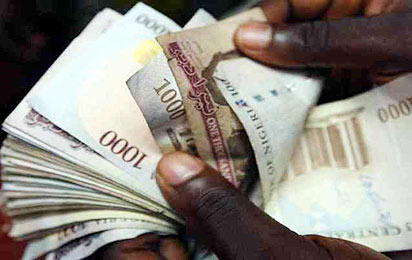
Naira
By Victor Ogiemwonyi
The recent decision of the Monetary Policy Committee (MPC) to retain rates as they are, is seen as making a safe bet so close to the elections, and to avoid being dragged into partisan politics of the current election period. It was however not a decision reflecting current economic conditions in the country.

The Monetary Policy Interest Rate (MPR) retention at 13 percent , ignored the widening gap between the Naira /Dollar exchange rate. This was far from what some analysts expected, especially seeing the rapid and negative reaction to the movement in the exchange rates, after expanding the corridors of the exchange rate management band from N155 to N168 per dollar. This was effectively 8 percent devaluation.
The reaction of the markets and the stretch of the Naira/Dollar exchange rate to N190 at the interbank, speaks to the fundamental issues around the Naira, which we must address if we want to strengthen the Naira.
Youth unemployment
Currency value comes from the productive capacity of the underlying economy. The Nigerian Economy is neither productive nor efficient and the underlying economy of the Naira is weak right now.
The massive unemployment, particularly youth unemployment, weak infrastructure, especially our inability to generate sufficient electric power to support the economy, poor educational support, weak capital markets and the overall non competitive economic environment is what is translating to low productivity and hence low currency value.
The value of the Naira in the last few years was artificially propped up by the high oil prices. Low Oil prices have now also adjusted Naira quickly downwards to find its value. The fixation of the CBN in defending the Naira is for me like fighting gravity.
We cannot afford to continue to defend the Naira with the little Foreign Reserves currently about $34 billion which is hardly enough to cover six months of our import bill.
Those who insist that we cannot afford to allow the Naira to find its value because we are import dependent, should be told that unless we wean ourselves of frivolous imports we will never have the chance to diversify the economy.
My take is for the CBN to quickly draw up a list of importable items the official foreign Exchange can be used for, like Machinery for local production for instance. Items that should not be on this list include all luxury goods and anything that can be manufactured here or have alternatives.
Those who must buy luxury goods must be allowed to do so, but they should get their foreign Exchange outside of the official market and pay our tariffs when they bring them in. India had a rigorous import regime for several decades, they did not allow foreign car imports for instance, look at what has happened to their motor manufacturing industry.
Even Coca cola was out of India for many Years. If we are serious about diversifying from Oil and growing our Economy, we must let the Naira find its true value, first by widening the management band to N185-N200 and intervene only when it breaches the upper limit of this band.
The question is; who is afraid of high exchange rates? And who are we defending the Naira value for? A higher exchange rate for the Naira will provide a more level playing ground for local industries and make it uncompetitive for those who import toothpicks from China. Yes, higher value for the Naira is desirable but not at all cost, especially when on the long run, it will damage the economy. There is no need to fret about the temporary devaluation. The Naira will improve gradually as current fundamental challenges are gradually addressed.
The Japanese currency, the ‘ YEN ‘ started the year 1980 with a value of 237.8 to 1 US Dollar. By the end of the 80s decade, the currency was valued at 209.4. It opened the year 1990 at 144.9 to the Dollar and ended the 90s valued at 133.8 to the Dollar. Today as I write this, the Japanese Yen is trading at 118 to the Dollar.
Anybody watching the Japanese Economy can easily see the relationship with the growth of the Japanese Economy and its currency. Many forget that the massive Japanese export drive started in this period. The Toyotas and many Japanese Companies we all know today, all became important in the last 20 to 25 years.
We should focus on growth. If we are able to grow the economy rapidly, it will address the value of the currency. The Naira devaluation must be seen as an opportunity to make quick progress in accelerating our growth, by encouraging local production for domestic consumption and exports.
Domestic consumption
Current MPR rate at 13 percent is hurting the economy. We cannot see sufficient growth at this interest rate level, particularly when inflation is trending down with the current rate, at 8.5 percent. Investors are interested in real returns.
Inflation at 8.5 percent allows real returns at 9 to10 percent. The lower inflation is an opportunity to lower interest rates. But for lower interest rates to work, foreign exchange rates must be sufficiently high to discourage speculators who might see the lower interest rates as an opportunity to round trip.
We have also seen growth rates revised downwards to about 5.5 percent in Nigeria while the World Bank and the IMF also see slower growth around the world except the US.
This is even more reason to pursue a growth strategy that will eventually see us growing at double digits. Anything less, will not be good enough. We have a huge population that is an advantage if we can grow fast enough, but a burden if we continue on the slow growth path that has seen poverty double in just 20 years.
A key ingredient for growth is lower interest rates. Lower interest rate environment tends to support growth. We have seen this recently during the last financial crisis. Many countries cut interest rates to stimulate growth.
Our concern should be how to accelerate our economic growth in the double digits so we can continue to outgrow inflation and reduce unemployment speedily. This can only happen with low interest rates. We have seen this in other climes. The low interest rate environment in the U.S and UK is the reason why their economies are growing.
Interest rate environment
A Country like Singapore has had low interest rate environment for over a decade allowing all other rates to settle within a range. The slower inflation rate at 8.5 percent should be the impetus we needed to crash the MPR rate, and let its forward guidance be based on the inflation rate for now.
The days of using tight Monetary and Fiscal policies to slow growth to fight inflation and enhance the value of the national currency is long gone. The opportunity of slowing inflation should be used as a tool for efficient management of the Naira.
The insistence on supporting the Naira at all cost with the dwindling external reserves is not in the long term interest of the economy.
- Mr. Ogiemwonyi is the Managing Director/CEO of Partnership Investment Company Plc.
Disclaimer
Comments expressed here do not reflect the opinions of Vanguard newspapers or any employee thereof.