
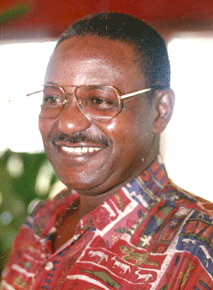
By Ben Asante, veteran political editor who worked with Peter Enahoro in London for many years
There is never a dull moment with Peter Enahoro. I started working with Peter in 1978, some thirty-seven years ago, when he asked me to join him in London to serve as political editor on a magazinehe was about to rebrand and edit.
I was not a stranger to the Enahoro family name. We had an expression in the student community in Ghana: to ‘Enahoro’ someone arose from a story involving Tony Enahoro and S. G. Ikoku, his fellow refugee in Accra but that is another story. Also, in those days the Nigerian Sunday and Daily Times newspapers in which Peter’s name cropped up and which we were encouraged to read under Kwame Nkrumah’s fervent pan-Africanism were circulated in Accra.

Coming from Ghana at that time and belonging to a youth movement associated with Nkrumah’s quest for leadershiptraining I was privileged to work with students and youth organizations in different parts of Africa with organizing workshops, seminars, attending OAU conferences and working with the OAU African Refugees Bureau as well as liberation activities among my assignments.
In the search for an outlet to tell the story of my exciting exposure to African issues I found no better platform than the pan-African newsmagazine Africa owned by a visionary Nigerian RaphUweche and edited by a truly gifted editor Peter Enahoro. I wrote for the magazine from Nairobi and when Peter visited Kenya in 1974 he asked to see me. Inspired by my meeting with Peter I enrolled for a full-time journalism course at the University of Nairobi while stillwriting for the magazine.
Since I started working full time with Peter there has been no haltin ourworking relationship and friendship. On a visit to Nairobi Peter and his wife Susannecame to see my new born daughter Janet. Peter surprised me with an offer of a job that required my relocating to London. But first I should pack my bags and join him to cover the OAU Summitabout to begin in Khartoum.
My previous attendance of OAU Summitshad been in observer status butPeter changed all of that. Interviewing and talking with African leaders was a new experience for me but to Peter this was something he was used to. Meeting the leaders and officials of Liberation Movementswith Peter as facilitator was a thrill.
I have always been struck by Peter’s humour which can be endless. On an earlier visit to Nairobi he asked me to arrange for a small private aircraft to take him to the common border with Uganda. Displaced persons from Idi Amin’s brutal rule were massed there in large numbers and Peter wished to see them at first hand.
I arranged the aircraft but excused myself from going with him as I was writing a paper. En-route the aircraft developed a problem. The pilot had to bring it down in the bush but not before he twice flew low over a gathering of antelopes to create landing space, which meant that there may have been predators nearby. The pilot managed to bring the stricken aircraft back to Nairobi. I was at the airport to meet them thinking mission accomplished. Peter who is never without a sense of humour asked what I knew about the aircraft and what my intentions were in making him go alone on the flight!
On another occasion, we were shocked by the ugly sight of man’s inhumanity to man evidenced by the deplorable plight of thousands of displaced peoplein a war-torn Saharan area in Central Africa. Our hearts bled that there was nothing we could do to help; and so it was weep or leave. Peter took refuge in his humour. ‘Things are beginning to look better,’ he said, meaning that we hadalready stayed so longthere that our eyes were becoming accustomed to the misery.
Back in London Peter had assembled a crop of young editorsfrom various parts of Africa, all in our twenties. We tookover Afif Ben Yedder’s New African Developmentmagazine with itsdwindling circulation, re-branded it New African magazine and shot up its circulation by several thousands.Peter’s witty commentaries and thought-provoking editorials made a difference.
This period was the heady days of military coups and counter coups including palace coups within Africa, my own home country Ghana was not spared. Peter asked us to be on standby and to jump into any country where events erupted unexpectedly. I had my bags packed ready for any timehe called upon me to get on the first flight after an airport re-opened following a coup. Our mission was to dig, find and to bring out the story of ‘why the coup and the future’.
Many times Peter and I travelled together. At some airports immigration officialsroutinely held back our passports to interrogate us in a room afterwards. On one occasionI became worried and asked Peterwhat he thought was going on? He told me to relax. Eventually the immigration officer returned our passports when we were the only ones left with him. He whispered to us, ‘I like what you wrote about that country in your magazine. Please don’t forget us. Write the same about us, too.” What better reward and appreciation can you possibly ask for?
My greatest challenge was covering Nigeria for Peter. From the start Peter said to me that it is more difficult to cover one’s own country and that as an outsider I had no axe to grind with Nigeria. My instructions were to ensure that the right balance was maintained in our coverage. If you think that was a challenge consider attempting to analyze the complex chessboard that is Nigeriawith your best asset Peter Enahoro insisting on remaining in exile. His presence would have made life easier covering Nigeria. On the other hand, although he remained in exile I soon found that Peter’s nameopened doors.
I began my coverageof Nigerian politics from the years of Obasanjo’s military government through to Shagari’s administration.With the mere mention Peter’s name even at the time of military governments Igained entry in politicaland leading business circles.Even in my own country Ghana, when our collaborator was taken into prison detention because of a report on a particularly ghastly killing of judges, Peter rang the National Security Adviser from Nairobi, late one night. This was a man who had said to us earlier that Petersaved his life with the editorial comment he wrote when he was accused of plotting against the Acheampong regime. Our friend was safely spirited out of Ghana.
Peter’s conversations with certain African Presidents and their close associates remain behind closed doors when the tape recorder is switched off. Peter and I warned AB Tolbert, the son of late President Tolbert,not to take things for granted as he sprayed the streets with money for people to chase afterhis car, as we drove with him through the streets at night in Monrovia.
In Sierra Leone President Siaka Steven and after him President Momoh sat us up telling us their problems and sought our opinion. In the tiny Republic of Gambia Peter freely gave his opinion to President Jawaranot to convert his para-military police into an army.
I have taken many things from Peter. He is hard working, humble and humorous. He is both polite and stubborn in his beliefs. Even as an acknowledged master in his trade, Peter would regularly ask the people who worked with himto read over his commentarybefore going to press, to hear their opinion.
The entire editorial staff, the circulation and advertising directors and the administrative secretaries followed him en-masse from New African to found Africa Now. The influence that Peter had on some of us is why we shall always remain journalists with no option of retirement.
Happy Birthday Peter Pan.Among those readers outside Nigeria it’s Happy80thBirthday Peter Enahoro
Disclaimer
Comments expressed here do not reflect the opinions of Vanguard newspapers or any employee thereof.