
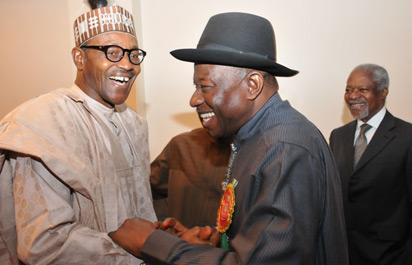
Jonathan and Buhari
By Rotimi Fasan
ONE can say that the general feeling among Nigerians, even without the benefit of a survey or an opinion poll, is that the February elections will be violent. Those who say this or think this way are not without their reasons. History tells us so. Our recent political experience confirms it. Even now, the fault lines are already manifesting. There have been violent skirmishes among supporters of the leading political parties in different parts of the country. Campaign posters have been torn. Party offices have been invaded, houses have been burnt and lives have been lost.
All of these have been on a relatively low scale. We are still some way off the scale of violence that followed the 2011 elections and we do hope that we won’t get there. But there are indications that things would definitely boil over as the elections draw nearer. All of which have given vent to calls for ‘issue-based’ campaign. The question now is when will this be and where? Where can the contestants meet without them or their supporters trading blows? What issues have engaged the contestants until now? What issues should Nigerians insist they engage?
Goodluck Jonathan and Mohammadu Buhari, both presidential candidates of the two leading parties in the land, endorsed an accord last Wednesday that they and their supporters would ensure that the coming elections are conducted in a violence-free climate. Emeka Anyaoku, former Secretary General of the Commonwealth and Kofi Anan, former Secretary General of the UN, were on hand to lend their authority and support for the accord. Let us hope that the coming together of these highly-respected diplomats and their good work on behalf of Nigeria would be more auspicious for the country than in the past.
The last time they came together in this manner on behalf of Nigeria, the outcome was not all too pleasant. This definitely couldn’t have been for any fault of theirs. It was in the immediate aftermath of the June 12, 1993 struggle and these international diplomats had come to persuade MKO Abiola, winner of the annulled election, to let peace reign by giving up his mandate. Abiola didn’t share their view. What follwed next was his obituary. The names of Anyaoku and Anan, two great sons of Africa, were thereafter almost anathema in certain parts and among certain people of this country. They emerged in very unfavourable light for their role at this time. Very critical voices rose against them for what was seen as their complicity in a military-engineered international conspiracy against the wishes of Nigerians.

President Goodluck Jonathan has taken a starring role in all of this while Buhari has been far more dignified, only responding to Jonathan’s tantrum-like comments without being disagreeable. In what looks like a clear failure of anger management for a public figure, the President has been hurling invectives in all directions. This newly-acquired facility for mudslinging, spewing curses and personal insults at his perceived enemies and competitors is Goodluck Jonathan’s own way, it seems, of showing his strength of character. This has been under serious questioning by Nigerians for long. While such petty muck racking may be forgivable in an attention-seeking politician, it sits ill on an incumbent president. Whoever advised the president to take this path has not done him any good. He has no doubt been the butt of jokes and harsh criticisms. Many of these have been for very good reasons if not entirely justified. The way to convince Nigerians that he is not what they take him for is by his action and performance. Not growing a fondness for intemperance which shows him up as desperate and lacking the right arguments to counter his opponents.
Right from when he flagged off his campaign at the TBS in Lagos, Jonathan came out firing. He suddenly appeared conscious of the fact that, far from being a mere contestant as on three previous occasions, Buhari could actually defeat him at the polls. For this reason, Jonathan appears to have developed a fondness to throw what sounds like personal insults at him. This is taking the campaign further away from being ‘issue-based’.
After calling Buhari an old man and charging him and other past rulers with responsibility for our poorly equipped military, Jonathan would in the following days bait him for not knowing his phone number (he’s yet to tell Nigerians how he knew this). Well, let us congratulate Goodluck Jonathan for obviously knowing his own phone number. He probably also knows the make of his phone, when and where it was manufactured.
But is this the kind of information he stores in his mind, turning it practically into a warehouse of trivia? I should think Nigerians want a more informed president than one who uses his mind as a portacabin of phone numbers.
Not done yet with that, Jonathan would follow up the barb at Buhari with another at Obasanjo (not a neophyte, himself, at baiting his opponents), calling him a motor park tout. The president seems to have been listening too much to Ayo Fayose. He would be better off keeping his cool, which in this instance means his dignity, especially now that his hold on the presidency beyond February looks ever more tenuous. What Nigerians need now is a forum for all the contestants, especially Buhari and Jonathan, to square up to each other face to face, telling Nigerians the whys, how and wherefores of their manifestoes. At least two of such encounters should happen before the elections for all categories of contestants. The generalised, free wheeling talk and vituperations that have characterised these campaigns are more like Fela-style yabis sessions. It’s time now to get down to the practical question of how to implement the advertised party manifestoes. It’s time now for the first of the presidential debates.
Disclaimer
Comments expressed here do not reflect the opinions of Vanguard newspapers or any employee thereof.