
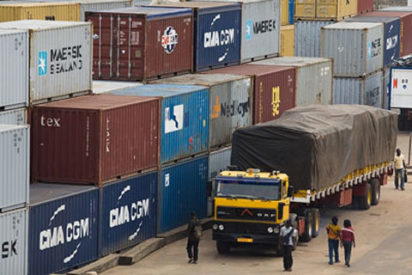
A fully loaded truck in one of the inland dry ports in the sub-region, will be delayed, harassed for bribes by the numerous security agents along the region’s transport corridor before it gets to its destination.
By FRANKLIN ALLI
Operators in the rice and palm oil sectors of the economy have cried out that their investments and the Transformation Agenda of the Federal Government on palm revitalisation in the Agricultural sector are being threatened by imports allocation and duty waivers granted to some companies in the sectors.

A fully loaded truck in one of the inland dry ports in the sub-region, will be delayed, harassed for bribes by the numerous security agents along the region’s transport corridor before it gets to its destination.
Financial Vanguard learnt that millers in the rice sector are lamenting allocation of higher import duty quotas to new investors whom they alleged have neither paddy farms nor factories for milling.
In the same vein, companies under the umbrella of National Palm Produce Association of Nigeria (NPPAN); Vegetable and Edible Oil Producers Association of Nigeria (VEOPAN), Vegetable & Edible Oil Sector of Manufacturers Association of Nigeria (MAN) and Plantation Owners Forum of Nigeria (POFON) are also unhappy over the grant of 75 per cent duty waiver to importers of crude palm oil especially operators at the Lekki Free Trade Zone in Lagos.
Investigation revealed that the likes of PZ Wilmar, makers of Devon and Mamador brands of vegetable oil, Presco Oil Palm Plc; Okomu Oil Palm Plc, etc., have invested billions of naira in the palm oil sector and are now jittery over the fate of their investments in the face of unfair competition from imported brands.
*Rice
Facts obtained from stakeholders in the rice sector showed that in a bid to promote self-sufficiency in local rice production and milling, the Federal Government initiated a new rice policy. President Goodluck Jonathan approved the backward integration policy on rice in May last year and the implementation started in December 2014.
The policy specifies preferential levy of 20 per cent and duty of 10 per cent for existing millers and new investors in rice milling and a higher levy of 60 per cent and a duty of 10 per cent for other rice importers.
Consequently, an inter-ministerial committee was appointed to determine the national supply gap and the appropriate volume of import quotas of the two categories needed to close the gap.
Also, a methodology of allocating quotas, which assigned weight to key criteria of self-sufficiency in rice production and milling in Nigeria, was developed by the Ministry of Agriculture in collaboration with the rice stakeholders and rice experts as supply gap of import grade was determined to be 1.5 million metric tonnes for 2014.
Subsequently, a letter was sent by the Ministry of Agriculture and Rural Development (the project coordinator) to existing rice millers and new investors, to submit their Domestic Rice Production Plan (DRPP) and based on their submissions, a total of 1.3 million metric tonnes of rice import quotas was issued to 28 qualifying companies at the preferential levy of 20 per cent and a duty of 10 per cent. The remainder of 0.2 million metric tonnes of rice imports will be at the higher levy of 60 per cent and duty of 10 per cent for other rice importers.
FV further gathered that to the disappointment of the existing rice millers, new investors were the ones who got the highest quota allocations to import, while millers did not receive allocations and in some instances, received very low allocation.
Similarly, the list of beneficiaries of the preferential import quotas showed that of the 28 beneficiaries, only 16 companies have mills, while the remaining 12 have no mills and account for higher imports than millers.
Mr. Tunji Owoeye, President, Rice Investors Group and also President of Rice Millers and Distributors Association of Nigeria, RiMIDAN, implored stakeholders who feel displeased not to mar the policy with internal squabbles since the policy is still in its early stage.
He said: “Considered on the surface, the government could be faulted but on close review, it is certain government wants to recruit and expand the investors’ base and was not whimsical.
“To a large extent, government gave allocations to encourage big investors who are putting down substantial amounts of money. There is nowhere on earth that major investors are not wooed and that is what the government has done but I can tell anyone who cares to listen that government also took adequate precautions in case of anyone defaulting.
“The critical thing is protecting local investors to the point they can reasonably stand on their feet.”
According to him, “the government developed the new rice policy based on what is produced presently against the shortfalls which were factored to further encourage local investors against those whose core interest is importing and selling locally without the mind of contributing to the national dream of self-sufficiency. I believe the market is big enough for all genuine investors in the rice market so that there is no point dissipating energy on frivolities and wild allegations.”
*Palm oil
In the sphere of palm oil, the Governor of the Central Bank of Nigeria (CBN), Mr. Godwin Emefiele, had during a tour of PZ Wilmer oil palm plantation, disclosed: “This country is losing N20 billion by the 75 per cent waiver given to people who import palm oil into Nigeria. We will work very hard to stop that because we need our revenue in our coffers.”
President of the NPPAN, Engr. Henry Olatujoye, alleged that since the Lekki FTZ has been established, no meaningful exports have taken place there. “What they do mainly is to import thousands of tonnes of Crude Palm Oil (CPO) into the Zone en route to Nigeria Customs Area which is against the policy establishing the Zone,” he said.
Olatujoye said that the industrial users of CPO in Nigeria have come to realise that it was very important to develop their own plantation to sustain their demand for CPO. “That is why PZ Willmar is developing about 30,000Ha, Presco – 16,000Ha, Okomu – 12500Ha, Slabmark – 4000Ha. Ten thousand hectares represent 10 km by 10 km in area. You can see that operators in the industry in Nigeria are spending huge fund to develop plantations. Therefore, any policy that will negate this investment should be seen as anti-Nigeria and should be crushed immediately. All sponsors of this act should be exposed and dealt with,” he said.
Also, the Managing Director, Okomu Oil Palm Plc, Dr. Graham Hefer, said that the 75 per cent waiver should be withdrawn immediately as it is inimical to the future development of the oil palm sector and open to abuse.
“As we see happening now, the 75 per cent waiver is detrimental to the development of Nigeria as a whole since the government will be losing revenue estimated at N20 billion.
For the Managing Director of Araromi Ayesan Oil Palm Plc, Mr. Babatunde Kuku, the granting of 75 per cent waiver on duty payment to some companies in the vegetable oil sector creates undulating playing ground for manufacturers in the industry while industries enjoying the waiver pay only 8.75 per cent while others pay 35 per cent.
“This is unfair and capable of destroying the investments of the companies that are not favoured. Government should reverse the waivers or in the alternative, bring duty down to 8.75 per cent,” Kuku said.
According to Santosh Pillei, Managing Director, PZ-Wilmar, the company’s $650 million Joint Venture project under a robust backward integration programme, alone, would be saving Nigeria up to $300 million yearly in foreign exchange, and drastically reduce the current huge crude palm oil (CPO) importation.
NACCIMA, LCCI react
Based on the foregoing, the Nigerian Association of Chambers of Commerce, Industry, Mines and Agriculture (NACCIMA), called on the government to check the ECOWAS Common External Tariff, CET, document and revise the tariff on finished palm oil products to be in line with other products whose tariff are clearly stated.
Alhaji Mohammed Badaru Abubakar, National President of NACCIMA, said: “The implication of not indicating the duty payable for this product implies zero duty, consequently if this omission is allowed to stand, it would lead to flooding of the market with these products through our neighbouring countries of Ivory Coast, Ghana, Cotonou and Togo where we are all aware they are mostly dumped, thereby killing the market for locally produced palm oil products.”
Import duty waivers create unfair competition – LCCI
Earlier, Muda Yusuf, Director-General of Lagos Chamber of Commerce and Industry, noted that one of the major challenges faced in the Nigerian economy is the arbitrariness and impunity that characterizes the management of economic policies. Import duty waiver is one of such abuses. He said that LCCI is of the view that waivers are detrimental to the economy in a number of ways: It creates a condition of unfair competition, giving one economic player an edge over others; it leads to huge revenue loss to government. Even the Customs high command has severally lamented the adverse impact of waivers on revenue. It results in the perpetuation of a rent economy and it weakens the moral authority of the political leadership to curb corruption since waivers is a variant of corruption.
Disclaimer
Comments expressed here do not reflect the opinions of Vanguard newspapers or any employee thereof.