
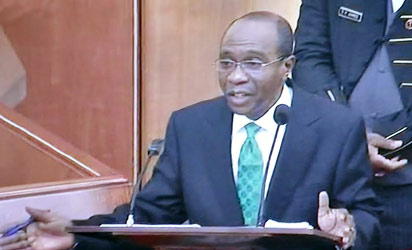
Mr Godwin Emefiele answering questions during his screening by the Senate for Central Bank Governorship in Abuja on Wednesday
By Babajide Komolafe
LAGOS — The Central Bank of Nigeria, CBN, yesterday lifted the ban on banks’ holding of dollar reserves for interbank trading, saying that banks can now keep dollar reserves for interbank trading.

Mr Godwin Emefiele answering questions during his screening by the Senate for Central Bank Governorship in Abuja on Wednesday
The apex bank also extended the deadline for utilisation of dollars purchased in the interbank market to 72 hours from 48 hours.
In response, the naira appreciated by N1 at the interbank market, as the interbank exchange rate dropped to N182.1 from N183.1 last Friday.
The apex bank, last month, had banned banks from holding dollar reserves known as foreign currency trading position, for interbank trading.
The suspension of the ban was communicated to banks yesterday via a circular, entitled: “Daily Foreign Currency Trading Position of Banks and Period for Utilization of Funds.”
The circular, which was signed by Mrs. O. L. Ahuchogu, on behalf of Director, Trade and Exchange Department, stated: “Further to the circular TED/FEM/FPC/GEN01/029 of December 18, 2014, authorised dealers are hereby notified that the daily foreign currency trading positions of banks have been reviewed with immediate effect
“Accordingly, authorised dealers are required to maintain 0.1 per cent as maximum open limit of their Shareholders’ Funds unimpaired by losses as Foreign Currency Trading Position at close of each business day.
“In addition, banks are required to utilise funds purchased from the autonomous/interbank Foreign Exchange Market within 72 hours from the value date, failing which such funds must be returned to the CBN for re-purchase at the bank’s buying rate.”
The CBN had imposed the ban to curb speculation in the foreign exchange market and stabilise the interbank exchange rate of the naira.
The ban was, however, criticised by bank treasurers, saying the ban amounts to killing the interbank foreign exchange market. They called for a reversal of the ban, saying that it is not sustainable.
Consequently, the CBN Governor last week said the ban would soon be reviewed.
“There will be a review in due course,” he told Bloomberg, adding: “But I can tell you categorically it will no longer be one per cent. It will be less than one per cent. The reason we put a stop to one per cent is because we felt that it was too large to be held by banks as a trading position.”
Disclaimer
Comments expressed here do not reflect the opinions of Vanguard newspapers or any employee thereof.