
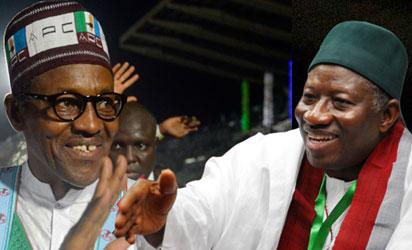
Buhari and Jonathan
By Is’haq Modibbo Kawu
POLITICAL life interests me a great deal. That is one of the reasons I studied Political Science. As we begin the New Year 2015, it is clear that we will soon hurtle into what must be one of the most defining elections ever held in our country, especially since the 1999 transition. There is a tremendous amount of expectations in the air. It is something akin to a pregnancy; we can all see a protruding belly, but no one can determine whether we will have a safe delivery or a stillborn baby. More than ever before, I think Nigerians are united in one direction, that of expecting that the elections should be free and fair, with an outcome which reflects the true feelings of the Nigerian people. But are we going to get a process that all will accept as reflective of this collective longing?
It was Dr. Hakeem Baba-Ahmed who pointed out the remarkable paradox of our political situation recently. He said the 2015 elections would pitch a younger person in President Goodluck Jonathan, whose central argument will be more of the same and continuity; against an older opponent, General Muhammadu Buhari, who is running as the candidate of change. These two individuals represent the two main tendencies in search of power today with all the difficulties that Nigeria will have to deal with, whichever way the votes go, in February. Those who say that Nigeria is likely to be in trouble, whichever of the candidates wins the election, are of course saying the troubling obvious. And it is the seriousness of the danger we are faced with, which has also triggered the suggestion that the leading candidates and their political parties must find a way to blunt the edges of vitriolic speeches and adversarial comments.
The situation building towards the February 2015 elections speaks for the most responsible conduct by the nation’s political elite. This is the time when a nation-building tendency must become the dominant ethos, to help achieve an elite consensus for an election that will not tear the country to pieces. The post-election violence that we witnessed in 2011 might be child’s play, if we do not act with greater wisdom and tact than at any other time in our country’s history, with the 2015 vote. It is not often that I agree with former Foreign Minister, Prof. Bolaji Akinyemi, but his recent call in that direction, in my view is spot on! The Nigerian people will be caught up in the middle of the struggle for power; between the advocates of continuity and those seeking change. It is in the best interest of the people that the struggle between these political tendencies does not degenerate to points where human lives will be endangered or the nation itself becomes pushed to the edge of the precipice. We have heard the politicians speak for their parties and we will hear them even more as we approach the coming elections. As we enter the New Year 2015, I do hope that our compatriots will think for Nigeria and its future. This is a very important juncture in our history. Happy New Year, 2015!
Travel in Borno: In the heart of insurgency (2)
IT is amazing to always behold the resilience of the human spirit. And in my Borno sojourn, the human spirit was asserting itself in a most defiant manner in the big and small events of each lived day. A curfew has been in place in Maiduguri for quite a while now. I was not staying inside the government residences, but in a hotel located not too far from the government quarters of the city. My assignment kept me away till very late in the night and it meant that to get to the hotel, I would have to be driven in a security convoy. The drive gave a measure of the seriousness of the situation that people live through in the city. Maiduguri at night is literally dead: no vehicular or human traffic; no nightlife. The few vehicles around are often directly related to the security situation and there are groups of young men who mann checkpoints in the cold of night. It feels very uncomfortable and eerie to be driven through a dead city at night. But this is what residents of the city have lived through in recent years.
When day breaks, life resumes with vengeance! The streets are filled with all manners of vehicular transport: cars; buses; bhajajs; motor cycles. There is traffic jam along many stretches of roads in Maiduguri and that worried me a great deal, knowing just how many bombs had detonated in crowded areas in recent times. But people take their condition in their strides as they hit the streets in search of livelihood. The streets are festooned with the posters of candidates hopeful about the next elections and the political temperature is rising just like in other parts of the country. It seemed clear that the elections in Borno will have a peculiar edge to it given the configuration of the gladiators and against the backdrop of the insurgency; the accusations related thereto and the suffering that people have gone through in Borno state.
What is also noteworthy is how the semblance of normalcy is held on tightly in many scenes of everyday life. Wedding ceremonies are still held; mosques are filled for prayers and the intrepid Borno businessmen, especially those selling embroidered dresses and caps, still have an eye for a good bargain. There is a building mini boom related to the Legacy Houses that the state government is constructing, which allows a lot of artisans to be employed and new houses are also being constructed inside schools for teachers. The insurgency has sapped life and I was thinking about the effect it has had particularly on the young people on both sides of the insurgency: those who joined the insurgency and those who have chosen to resist it. The young people here have seen horrendous acts of violence and must be deeply scarred by their experiences. How would that impact on our societies into the future? What remedial steps can be taken to rehabilitate those who have lived through the violence of the Boko Haram insurgency and the counter-insurgency activities of the state? What levels of help will come to those who have seen their loved ones brutalized, shot or been slaughtered like rams?
The portents for the future will be scary for as long as we haven’t begun to think of the post-insurgency period of rehabilitation and reconstruction of communities as well as of individual lives. It used to be that Nigerians enjoyed our comfort zones so much and assumed certain things could not happen in our country. Not anymore! The Boko Haram insurgency and its various forms of violence have exposed the depth of depravity that humans in the Nigerian setting can go. But if we give ourselves the pause, we must also interrogate why we have created one of the most unjust societies on earth. There are those who list the billionaires in Nigeria today and think they are emblematic of success. But the obverse of their wealth, are the despair, angst and the underdevelopment which have bred the crises phenomena in the land. In Borno, our people have been living through the worst of times; our duty as a country is to turnaround the situation for the better. How we do that and with what speed, will say much about our collective humanity as well as the responsibility of the Nigerian state. So far, the state has not covered itself in glory, especially in Borno state.
The teenage suicide bomber of Kano
LAST week in Kano, security forces paraded a 13-year old female suicide bomber, arrestd in the wake of a recent attack in Kano. Zahara’u Babangida, told the security people that she had been taken to the bush by her father, where she was trained, along with other girls, by heavily armed men. They had threatened to bury these girls alive if they refused to be suicide bombers. The story went on about how she was taken to Kano along with two other girls to take part in the bombing of the Kantin Kwari market.


Zahara’u
The story has touched me very deeply as a father of daughters, including one that is just about the same age as the unfortunate Zahara’u. This was a young girl that ought to be in school studying so she can eventually become useful to herself, community and our country. She was not in school, did not learn a trade and was handed over to become a suicide bomber. What might have pushed the girl’s father to willingly handover a daughter? We do not know anymore than what the young girl said about the father, but it is clear that there are deep-seated ideological and socioeconomic underpinnings for such an act. We also don’t know just how many young girls like Zahara’u have been brainwashed to become carriers of bombs that will target innocent people around our country. But the truth is that there is a lot of work to do, to uproot the basis of this type of indoctrination. This requires the combined efforts of the state and non-state organizations on a very sustained basis in communities and homes of individuals in the most vulnerable areas of Northern Nigeria, especially.
As for Zahara’u, I hope that conscious effort would be put into rehabilitating her. The effort should be to help her come to terms with her horrible experience; assisting her to reclaim her life as a young girl, who would also get the opportunity to be educated. This is the greatest gift that this unfortunate girl can get from her country. Any other approach will only strengthen the tendency towards surrendering to the diktats of terrorist organizations. And that is not what we all desire for our young girls and our country.
Disclaimer
Comments expressed here do not reflect the opinions of Vanguard newspapers or any employee thereof.