
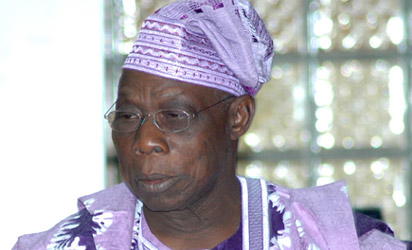
*Olusegun Obasanjo
By Charles Kumolu
BRAYAN Johnson, in his 2012 piece, titled: 10 Most Influential Books That Were Controversial”, observed that books are often written as a result political and economic contigenences as well as religious inclinations.
While other propelling factors of book writing abound, those identified by Johnson are often the drivers of authorship in this age.
Certainly, one of the reasons triggered off the urge to write a 1967 New York Times bestseller, titled: The Report From Iron Mountain.
Reportedly written by a 15-man Special Study Group, the timing of the publication was during the Vietnam War, while the setting was the United States (US).
With a thrust that focuses on the role of the US in the war that turned out as one of America’s greatest military misadventures in the 20th century, it was easy for the book to attract global attention.
This is the story of The Report From The Iron Mountain as told by Wikipedia:”The Report from Iron Mountain is a book published in 1967 during the Lyndon Johnson administration by Dial Press which puts itself forth as the report of a government panel. The book includes the claim it was authored by a Special Study Group of fifteen men whose identities were to remain secret and that it was not intended to be made public. It details the analysis of a government panel which concludes that war, or a credible substitute for war, is necessary if governments are to maintain power.
“The book was a New York Times bestseller and has been translated into fifteen languages. Controversy still swirls over whether the book was a satiric hoax about think-tank logic and writing style or the product of a secret government panel. The document is a favorite among conspiracy theorists, who reject the statement made in 1972 by satirist Leonard Lewin that the book was a spoof and that he was its author.
“U.S. News & World Report claimed in its November 20, 1967 issue to have confirmation of the reality of the report from an unnamed government official, who added that when President Johnson read the report, he ‘hit the roof’ and ordered it to be suppressed for all time.”
“Orders were sent to U.S. embassies, instructing them to emphasize that the book had no relation to U.S. Government policy.”
For an administration that was receiving bullets from home and abroad over its mission in Vietnam, the release of that book is believed to have dealt blows on its image.
In God’s Name, an investigative book on the death of Pope John Paul (1) after 33 days on the throne, also made the list of scholarly works that drew the ire of the state.
The contents of the investigative piece by David Yallop, a Vatican insider, was reportedly dismissed by the church, just as the book was not to be seen inside the city-state.
Peter Wright’ s 1987 memoir, titled: Spycatcher, was another book that pitched a citizen against the state.
As reported by Wikipedia: “Wright wrote Spycatcher in Tasmania, after his retirement from MI5. He first attempted publication in 1985.[3] The British government immediately acted to ban Spycatcher in the UK. Since the ruling was obtained in an English court, however, the book continued to be available legally in Scotland, as well as other jurisdictions. The UK government also attempted to halt the book’s Australian publication, but lost that action in 1987; it appealed but again lost in June 1988.
“English newspapers attempting proper reportage of Spycatcher’s principal allegations were served gag orders; on persisting, they were tried for contempt of court, although the charges were eventually dropped. Throughout all this, the book continued to be sold in Scotland; moreover, Scottish newspapers were not subject to any English gag order, and continued to report on the affair.”
The aforementioned, even though different in settings and characters, share many things in common with the latest account on Nigeria’s democratic experiment.
Titled, My Watch, the book was published by no other person than former President Olusegun Obasanjo-a man whose significance in the nation’s socio-political space is as towering as the controversies around his personality.
Despite not being a baby author of historical accounts, the work, which revealed some backstage actions and inactions of past and present governments, has been a source of controversy.
So much was the beef over the publication, that attempts were reportedly made to foreclose the possibility of it hitting the book stands.
The court order, granted in this respect, gave an inkling that the product of Kachifo Publishers promises to be a thorn in the flesh of antagonists and protagonists.
And that has been the case ever since Obasanjo, who had authored My Command, This Animal Called Man, Nzeogwu, among others, defied the order.
Justice Valentine Ashi of Abuja Federal High Court, after listening to Alex Iziyon’s motion ex-parte brought on behalf of a chieftain of the Peoples Democratic Party, Buruji Kashamu, restrained the former president from going ahead with the publication of the book.
Ashi equally barred the former President from having someone publish same on his behalf.
Since there were reports suggesting that the Presidency had allegedly pleaded to the former leader that the book be released after the 2015 polls, observers were not jolted by the groundswell anger over the matter.
Though the Presidency is not known to have physically identified with the developments, many are not convinced that the spirited efforts to keep the autobiography out of sight are bereft of high-powered influence.
Opinions are hardly divided considering the mind-blowing revelations contained in the compendium.
A look at the various issues and questions raised in the book, published by online news website, Saharareporters, could as well increase the growing curiosity over the issue.
Disclaimer
Comments expressed here do not reflect the opinions of Vanguard newspapers or any employee thereof.