
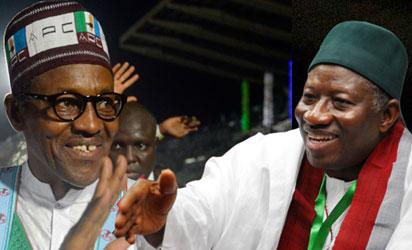
Buhari and Jonathan
By Obi Nwakanma
By noon on Thursday, it became clear that Muhammadu Buhari, retired Major-General of the Nigerian Army, and former Military Head of State of Nigeria (1984-1985), had emerged as the Presidential candidate for the opposition All Progressives Congress (APC) for the 2015 General elections. Buhari is not a stranger to Presidential elections. He has had a go at it consistently since 2003: he ran against Obasanjo; he ran in 2007 against Yar Adua; he also ran in 2011 against Jonathan, the incumbent President. In all of these cases, the Daura born Army General lost. He did not let such humiliating losses deter him. It rather seemed to have fuelled a greater resolve to continue on the marks. In his last outing, Buhari had publicly declared very solemnly to Nigerians that he was on his last elections and would not run for public office again after 2011.
It was a very hard fought election. But his electability had been put to question. His national appeal seemed to have dimmed, because much of the votes he garnered seemed largely derived from a narrow political base – the poor of the North, especially the Muslim urban poor, for whom the General has what seems to be an abiding appeal. The Northern political heavyweights always seemed to regard Buhari as some kind of outsider; a man they could not trust to do business with; and being as pragmatic and self-interested as any other plutocracy, most of them backed the incumbent President Jonathan.
The argument made for the retainership on Jonathan was for peace, stability and continuity. The elite often hate to rock the boat too much without reason. But prior to the 2011 election, Muhammadu Buhari had threatened, or at least was reported to have inferred a threat in his “dogs and Baboon” proverb, which many came to see as his prediction of a national bloodbath if he is stopped by rigging, to win the 2011 Presidential elections. The elections came, and Jonathan had a sweeping victory that first surprised Buhari, and then inflamed him, leading to accusations of electoral manipulations. He did not even offer a concession speech. He continues to claim that a flawed and corrupt national election system robbed him of the peoples’ mandate.
What followed thereafter has remained to haunt the last four years: first, General Buhari’s supporters in the Northern part of Nigeria, formed street gangs that began and attack Southerners and known PDP supporters in the North. The mayhem led to killings including of National Youth Service Corps members sent up to the North to serve the nation.
The bloodbath had hardly been contained when the Boko Haram launched their sustained armed insurgency against the Federal government. The twin factors of political riots and religious insurgency in the wake of a Buhari defeat in 2011, gave ammunition to General Buhari’s detractors, particularly within the Jonathan administration, who circulated the “whisper” that “powerful men from the North” (such unmistakable innuendos were directed at General Buhari and his Northern supporters) were behind Boko Haram. Such men were too powerful for the government to go against them without solid evidence. But as the Jonathan government kept insisting, “we know who they are;” and they led Nigerians to believe that the government would inevitably identify and contain these powerful forces publicly in due course, when the government had presumably gathered and built a watertight evidence against them. It has thus far not happened.
This government has in fact been unable to identify, or bring to court and successfully convict anybody in that front. Even the so-called mastermind of the Abuja bombing, Ogwuche, who was brought back from exile from Sudan after much diplomatic kerfuffle, was allowed to walk. Government lawyers were unable to build a case against him, in what should be an open-and-shut case, very incompetently handled. Now, Ogwuche is demanding compensation for the abridgement of his rights. Sweet irony, when the hunted becomes the hunter.

Buhari and Jonathan
The Jonathan government , faced with the mounting pressure of a growing religious insurgency has been unable to rise, in the eyes of most Nigerians, in the last four years, to contain a most menacing kind of instability. For many, the attempt on General Buhari’s life by Boko Haram which he survived by a hair’s breath, and the widening bombing campaign of the insurgents to places like the city of Kano and Kano’s historic central mosque has raised a problem for President Jonathan’s publicists and Propagandists. Buhari can now no longer be associated with the problem of Boko Haram; he is rather now associated with its solution. That is what has changed in the last four years. A great political momentum is building up against the incumbent President Goodluck Ebelemi Jonathan.
The president can certainly no longer be considered a neophyte, nor can he at the same time be covered by the cloak of innocence and possibility that was sold to Nigerians as his promise in 2011. That innocence is lost, and lost with it, much of the grounds of popular support with which he trounced the General in the last election. Nigerians hurt from the twin forces of domestic terrorism and galloping economic inequity occasioned by wrong-headed economic policies; an incompetent administration weak on national security; the iniquity of corruption perceived in the ranks of the current government, and now compounded by a raging dip in oil prices. Jonathan is faced with the exact situation that confronted Shehu Aliyu Shagari in 1983, and which led to the oil gluts and the austerity measures that rendered that administration indeterminate and prolix. In the last two years, a powerful coalition, a federation of too many strange political bedfellows no doubt, who are currently engaged in the most frenetic forms of incestuous political coupling, came together to create a massive opposition party now called APC. Riding on increasing public discontent, and a sense of serious alienation from the national troughs guarded now by Jonathan’s own Cerberus, these folks are primed to give this president a great run for the money. Jonathan, in formally accepting the PDP nomination said he would not “disappoint” Nigerians.
Well, Nigerians do not buy such catchphrases anymore than they buy Buhari’s own, “Nigerians have spoken” after he was declared winner of APC’s Presidential primaries. Nigerians have not spoken yet: they will by May 2015, just under six months now, when we shall have cause to inaugurate a new government.
The die is certainly cast. General Buhari seems to have opened his moves with a wide gambit, in a move straight out of Sun Tzu, the Chinese military strategist, who wrote in his The Art of War, that to gain advantage the General should take the fight straight to his opponent’s very doorsteps.
Reports reaching me as I write this indicate that Buhari has done exactly that: he has gone right at the President’s very doorstep by picking the president’s nemesis, Governor Rotimi Amechi of Rivers state as his Vice-President. Yes, indeed, the die is cast. For whatever it is worth, Buhari is on a mission, but this is also his last election, and he seems set to make it count, as does the president, who is faced currently with an unfinished and uncertain legacy.
It is going to be a hard war, dear readers, and it is going to be a bruising campaign in this Harmattan of our nationhood.
Disclaimer
Comments expressed here do not reflect the opinions of Vanguard newspapers or any employee thereof.