
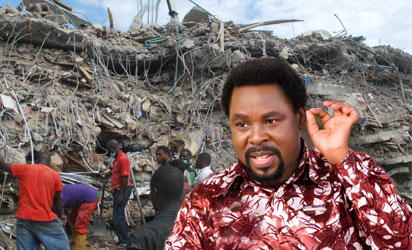
TB Joshua-Synagogue Church
By Rotimi Fasan
SINCE September 12, 2014, when a six-storey building under construction collapsed in the premises of the Synagogue Church of All Nations, there has been a deliberate, even if unspoken, tendency to create the picture that only South Africans died in the unfortunate incident.
The impression has been given that no Nigerian lives were lost in the collapsed building. And when there is some veiled acknowledgment that Nigerian lives were also lost, the whole point has been muted as if this fact is a mere detail that should only be noted in passing. This points to the value that Nigeria places on the life and wellbeing of an average citizen of this country.

TB Joshua-Synagogue Church
Let me enter a quick warning that the purpose of my point here is not to downplay the seriousness of the fact that foreign lives were lost or compare the figure of South African lives lost to that of Nigerian or other foreign nationals’ lives lost, in order to highlight the comparative worth of the lives lost. Far from it that one should be involved in such abominable behavior.
Every man’s death diminishes me and no life is inherently more important than another. Therefore the point I’m making here is not to blame South Africans for insisting on full disclosure of the number of their citizens who went with the collapsed building. That is the very least they could do where we have been conniving, irresponsible and inclined to gloss over these facts.
Rather, what I intend to show is the official levity with which matters that concern Nigerians are treated; indeed the fact that the Nigerian life is from the perspective of Nigerian state officials and so-called leaders worth less than the life of a dog that is run over on a highway.
If what happened at the Synagogue Church had happened outside this country, say in South Africa, and the Nigerian part in the loss of lives had been downplayed, many Nigerians, including state officials in Nigeria would have attributed that to different reasons- xenophobia, racism, racial profiling, stigmatisation, etc.
But what transpired at the Synagogue Church happened right here under our collective nose, on our own soil. Nobody did this to us. It was our own choice to make it look like no value should be placed on Nigerian life. This is a disgraceful act that has become a habit, a national way of life.
Three weeks after scores of lives, foreign and Nigerian, were lost and many more were injured in an avoidable disaster for which people should be answering right now if we were living like civilized beings- three weeks after this shameful occurrence that blights national pride, all we are treated to is the casualty figure of South Africans involved in the incident.
No specific figure has been provided of the number of Nigerian casualty. At each instance, we are left to figure that out after we have been told of the number of South African dead. The Nigerians are mere figures with no names.
There was the initial attempt by the Synagogue Church to cover things up and play the judge in a case in which they stand accused. They sought to make a mole hill of the mountain of questions they needed to give answers to.
They prevented access to the church and made light of the casualty figure. That there is any figure given at all of the number of South Africans dead is simply because the South African government released figures on the number of their nationals believed to have made the religious trip to the church in Lagos. Otherwise, one can be sure that no figure would have been provided at all. Neither by the Synagogue Church that reportedly prevented people, even rescuers, from accessing the church ground or emergency officials that were initially sidelined in a matter over which they should have assumed total and immediate control.
The impunity with which religious organisations carry on in the country is a matter we have to look at very closely. Our tendency to politicise every issue, not to treat matters on their merit, is costing us too much and is making room for Nigerians to perpetrate acts of impunity in different areas of life. It was because some people chose to politicise the despicable outlaw behaviour of fundamentalist islamists that the North East part of Nigeria is today the theatre of insurgency.
When state officials are criticised for abuse of office and corruption, their kinsmen claim it’s because people don’t like their ethnic group. Religious leaders commit all kinds of atrocities in the name of God and those who should ask questions turn a blind eye because it’s these same men of God, so-called, that provide absolution for acts of official corruption that brought these officials into office.
The only time we are able to treat issues of corruption, abuse of office or crime on their merit is only when they involve members of other ethnic or religious groups.
Which then emboldens the criminally-inclined to commit all kinds of atrocities in the name of their ethnic or religious group. Rather than see this kind of behavior as abnormal we expect other people to accept it without question. Many are quick, perhaps very quick, to condemn the Synagogue Church now because of their deep-seated prejudice against the church.
They would not do so if the violations attributed to the Synagogue Church had been committed by organisations acceptable to them. And this is why we don’t seem to place any value on the life of our own people.
Without pre-empting the outcome of investigations into the cause of the collapsed building at the Synagogue Church, there is evidence that the church might have been negligent in protecting the lives of its members. Its alleged failure to adhere to building regulations even when its attention was called to it is a matter that should not be swept under the carpet. This should be without prejudice to its allegation of sabotage in the accident that claimed many lives on its premises, which should be treated on the basis of its own merit.
There is, however, something worrying in the manner state officials have been meeting with the leader of the Church as if to suggest he is already absolved of blame.
Yes, neither Governor Raji Fashola nor President Goodluck Jonathan who had been to the Church had said anything to absolve it but their body language is enough warning to investigators, original Nigerians in their own right, to know what type of questions could and would be permitted. Both the governor and especially President Goodluck Jonathan who left the church for a political rally might have visited the church simply because of the South African lives lost.
Disclaimer
Comments expressed here do not reflect the opinions of Vanguard newspapers or any employee thereof.