
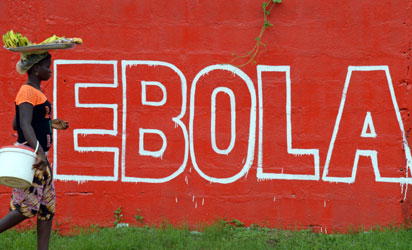
File: A seller of bananas walks past a slogan painted on a wall reading “Ebola” in Monrovia on August 31, 2014. Liberia on August 30, 2014 said it would deny permission for any crew to disembark from ships at the country’s four seaports until the Ebola epidemic ravaging west Africa was under control. AFP PHOTO
By DOUGLAS ANELE
Ever since the Ebola virus disease (or EVD) bumped into public consciousness worldwide in March this year, a lot has been said and written on the subject both by experts in the relevant fields and those who know very little about the disease.

Incidentally, and sadly too, the disease broke out in West Africa, and is gradually but steadily spreading across the world.
The worst hit countries are Liberia, Guinea, and Sierra Leone, although there are a handful of cases in Africa’s most populous country, Nigeria.
Unfortunately, the situation in the first three countries mentioned above is very serious; but thankfully, it appears that the disease has been contained in Nigeria.
Now, the health infrastructure in the affected countries is below global standard mainly because, aside from the devastating effects of civil war in Liberia, over the years, corruption and persistent misappropriation of public funds by leaders of these countries led to chronic underfunding of the health sector, resulting in chronic shortages of well-trained health workers and well-equipped hospitals.
Additionally, the aetiology of the disease makes it very difficult to contain; Ebola virus is transmitted through bodily fluids from an infected person or from objects contaminated with the deadly virus.
EVD is very deadly: its mortality rate is about fifty percent, with the possibility of climbing to seventy percent in the next few months if effective containment measures are not aggressively implemented.
Reports indicate that Ebola patients suffer from fever, diarrhoea, vomiting, bleeding, severe pains and other debilitating conditions – in short, it is not a pleasant way to die. Presently, there is no effective cure or vaccine for EVD; available drugs for managing it are at the experimental stage.
Hence, there is no guarantee that those treated with such medicines will survive. Indeed, the result of administering the experimental drugs is mixed: while some patients recovered, the unlucky ones died.
Globally, there is increasing awareness about the disease, just as scientists are redoubling their efforts to perfect an effective treatment regime for the disease.
The World Health Organisation (WHO) leads the global effort to combat the disease, and different governments are introducing measures to prevent it from spreading to their respective countries.
Overall, the key strategy is containment to reduce potential Ebola patients to a manageable level, and eventually eliminate the disease where it originated.
It must be observed that the initial response of the international community to EVD was sluggish.
The United States and European countries started taking action when their citizens working in Ebola endemic countries, particularly Liberia, tested positive with Ebola.
Gradually it dawned on everyone that no part of the world is immune from Ebola affliction, owing to increasing tempo of international travel.
The Ebola phenomenon is a tragic validation of the cliché that the world has become a global village in which what happens in one place oftentimes rapidly affects another either for good or for evil.
The perennial philosophical problem of God and the existence of evil in the world leaps into bold relief in my consciousness sometimes anytime I watch television news reports and footages of the agonies of Ebola patients and the valiant but futile efforts of doctors and nurses to save them from imminent death.
In other words, the occurrence of evil, especially those horrifying ones beyond human provenance and control, always poses a challenge to belief in the existence of an omnipotent good God for whom nothing is impossible.
In the case of EVD, for example, one wonders what God’s motivation was in creating such a deadly virus. What exactly did God intend to achieve with the virus – to punish people for their sins or demonstrate that he has power to inflict pain and death?
Theodicy, the reasoned attempt to vindicate belief in an all-powerful good God who created a world that contains plenty of evil cannot help us here.
Baruck de Spinoza, one of the most morally cultivated philosophers of all time, argued that if humans can see things sub specie aeternitatis, that is, from the perspective or context of eternity, they would realise that nothing is really evil, since every individual thing is a manifestation of God, the one true reality.
But the problem is that Spinoza’s deterministic metaphysics makes evil seem necessary and useful, since anything that happens no matter how horrific can always be accommodated and explained away as having a role to play in the cosmic arrangement.
Even if it is the case that the presence of evil in a world supposedly created by an all-good, omnipotent God is not logically contradictory, it is quite reasonable to maintain that the reality of evil makes it very unlikely that such a God exists.
Thus, contrary to the dogmatic assertion in the first verse of Psalm 14 in the Holy Bible, which claims that an atheist is a fool, it is rational to deny the existence of God in the presence of so much pointless evils in the world.
The considerations above dovetail to a paradox related to the Ebola problem and belief in miracles.
In Nigeria today, Christians and Muslims believe that God is a miracle-working God. Indeed, the biggest attraction of the new, noisy Pentecostal Christianity – its biggest selling point – is the claim that God uses “anointed pastors” to perform all kinds of miracles.
Most days of the week and on special programmes, believers rush to different worship centres to receive prayers and special anointing for financial breakthrough, freedom from demonic attack, instantaneous healing, and so on.
In well-packaged television programmes and digital recordings, popular pastors such as T.B. Joshua, Chris Oyakhilome, David Oyedepo, Daniel Olukoya etc, purportedly perform miracles by using supernatural powers to heal the sick and the afflicted – that is why large numbers of gullible Nigerians and non-Nigerians flock to their churches.
I think that if these claims were true, these “anointed men of God” should harness such powers to cure patients suffering from EVD.
Specifically, Joshua and others should have quickly gone to the Ebola endemic countries when news of the outbreak became public and healed miraculously those infected, or at the very least healed one or two Nigerians that had contracted the disease. Not surprisingly, up to now, there is no well-corroborated case of miraculous cure of an Ebola patient by any pastor anywhere.
Christians who dogmatically believe in miracles should challenge their pastors to demonstrate the reality of God’s miraculous healing power through the developing Ebola epidemic. Of course, they cannot do so, because of gullibility, fear and intellectual docility.
Aside from spontaneous remissions and the body’s amazing healing powers sometimes triggered by strong faith, virtually all reported cases of miracle cures by pastors are attributable to psychological mechanisms such as hypnosis, auto suggestion and the mind’s powerful ability to simulate both the real and the unreal.
In my view, the idea that laws of nature that took millions and billions of years to crystallise can be suspended to effect a miracle just because a pastor or prophet prayed to a certain deity is preposterous. It is an invitation to intellectual cul-de-sac and theological legerdemain.
As usual, scientists would eventually create a vaccine or medicine that would cure EVD. Resort to prayers and other religious rituals will worsen the situation, just as taking refuge in churches and supplications towards God to fight the bubonic plague actually led to countless number of unnecessary deaths in the Middle Ages.
Disclaimer
Comments expressed here do not reflect the opinions of Vanguard newspapers or any employee thereof.