
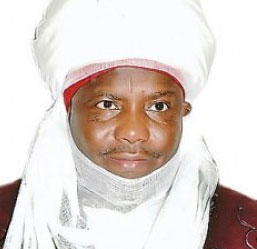
Aminu Waziri Tambuwal, Mutawallen Sakwato
By Is’haq Modibbo Kawu
LAST weekend Sokoto hosted the cream of Nigerian political society. They were in the ‘Seat of the Caliphate’ for the turbanning of the Speaker, House of Representatives, Aminu Waziri Tambuwal, as the new Mutawallen Sakwato. And in the Nigerian political manner of doing things, most of those who turned out were from the opposition APC party.
It was indicative of the seismic shifts taking place on the subsoil of Nigerian politics today that Tambuwal has become one of the most enigmatic personalities on the scene.

Aminu Waziri Tambuwal, Mutawallen Sakwato
He has built a formidable alliance with people from all over the country and in his years as Speaker of the House, has displayed a dexterity and political wisdom far beyond his years.
There seems to be a remarkable magnetism between the man and his colleagues in the House of Representatives, and compared to other periods since the 1999 transition, the House of Representatives of the Tambuwal years has been far more consistently independent and has also taken far more pro-people stance on many of the issues of governance that face Nigeria today.
Maybe because of the way he emerged as the Speaker of the House of Representatives, Aminu Tambuwal has been obliged to make a determined effort to keep his colleagues on side in the face of the hostility of the PDP apparatchik that carries a very deep wound from the inability to force a leadership on the House of Representatives.
So a most interesting political scenario emerged where Tambuwal has kept a remarkable hold on the loyalty of members from both sides of the divide; while outside of parliament he walks a thin edge of suspicion with his PDP co-partymen, but an expansive and increasingly chummy relationship with the opposition.
If ever there is an individual able to hunt with the political pack and run with the herd of politics, that individual is Aminu Waziri Tambuwal. For all intents and purposes, there is no love lost between the House of Representatives of Aminu Tambuwal on the one hand, and the Jonathan Presidency and the PDP leadership. This cloak-and-dagger relationship has been the hallmark of the past few years in our political system.
And as we get closer to the 2015 elections, the situation becomes increasingly more complex, because while Tambuwal remains, officially a member of the ruling party, it is clear as daylight, that his heart and soul seem to have relocated into the opposition APC. There is a local dimension to Tambuwal’s unique position that must not be underrated, and that is located in the political landscape of Sokoto state.
Tambuwal is a very close confidante of the Sokoto state governor Aliyu Magartakada Wammako. Today, the governor is a leading member of the opposition APC and he is a most beloved grassroots politician in his state. Staying close to the governor offers a powerful and secure home base for Speaker Tambuwal.
Tambuwal is loyal to his political roots in Sokoto and that is one of the central reasons for his peculiar political position today. There are indications that Aminu Tambuwal represents a major force in the permutations for the 2015 elections and these permutations are in the context of the choices available to the opposition APC.
While the frontrunners remain the usual individuals: General Muhammadu Buhari; Atiku Abubakar; Governors Rabiu Musa Kwankwaso of Kano; Adams Oshiomhole of Edo and Rochas Okorocha of Imo; there are those working on the possibility of the emergence of the younger Aminu Tambuwal as an alternative rallying point. His adroit handling of the House of Representatives; the network of relationships he has built nationwide; his very careful ability to shield himself from the scandals of political life and his incredible humility and human warmth are cited as positive attributes that will stand him in good stead.
But if presidency becomes a bridge too far, there seems to be a fallback option of governorship in Sokoto for the new Mutawallen Sakwato, Aminu Waziri Tambuwal.
The fact that he is being mentioned in connection with some of the most important positions in the land, merely underscores the heights he has reached in Nigerian politics today. He has been able to learn the ropes and climb so high in a relatively short time. Nigerians recognized his abilities to the extent that his peers gave him a mandate to be their Speaker, much to the chagrin of the party apparatchik.
People are also mentioning his name in the same breath as other leading political heavyweights, in connection with Nigeria’s presidency. Last weekend, his people in Sokoto recognized his community relevance by turbanning him as Mutawallen Sokoto.
A few weeks can often change dramatically the whole basis of permutations in politics, because it is akin to sinking sand, with a pitiless cloak-and-dagger propensity. But wherever Tambuwal will go and the choices that he will make will certainly become clearer in the next couple of months, as the race for 2015 moves into an extra gear.
He will certainly be as entertaining and surprising as he has continued to be in the past few years on the Nigerian political scene. We can conclude with near certainty, that the last has not been heard of the political life Aminu Waziri Tambuwal. Congratulations, Honourable Speaker, Aminu Waziri Tambuwal. Allah ya ja zamanin ka.
Abubakar Shekau: Was he killed after being arrested alive?
THE Nigerian security forces scored a major victory against the Boko Haram insurgency in the past two weeks, when its self-declared leader, “Abubakar Shekau” was allegedly killed in battle at Konduga, Borno state. To prove the authenticity of the story, especially against the counterclaim from Cameroun, that their forces had killed the man near Gamboru Ngala, the Nigerian Army released a photograph of the “Shekau” killed at Konduga. That picture was placed side-by-side with the picture of the character that usually appeared in Boko Haram videos, who was always called “Abubakar Shekau”. It appeared that it was the same person.
There was no gainsaying the fact that it was an important victory for the Nigerian security forces who have weathered a storm of criticisms in recent months, as the insurgency conquered one community after the other and our troops became a laughing stock. Surely, the battle of Konduga was a major setback for Boko Harm, with the casualties it recorded in its futile effort to capture Konduga, as a stepping stone for a quixotic attempt at taking Maiduguri, the Borno state capital.
The Nigerian security forces confirmed that the original Shekau had been killed since 2013, and the man killed in Konduga had acted as a double to maintain the illusion that the original Shekau was still alive. A few days after the composite picture released by the army went out on the pages of Nigerian newspapers, a new video emerged, which showed a man with the semblance of the man killed at Konduga. It however appeared as if the man had been alive when captured.
And in the video, which is available on SAHARA REPORTERS and many other internet sites, the man was leaning against a tree and was wearing blue guinea brocade. He was surrounded by men in military uniforms with one of them holding a dagger close to the man leaning on the tree.
There was a voice in the background telling his colleagues to: “go and waste that man, go and waste him”. A few frames later, it appeared as if the same man was the man on the ground dead, besides another dead individual.
The pertinent question is whether the man had been caught alive as the video suggested. If so what was the circumstance that led to his death? Was there an effort made to ensure the man lived, by provision of medical service to save him?
The reason is simply that it would have served Nigeria and the cause of the war against the insurgency better, if the character called “Abubakar Shekau”, was caught alive, so that he can be debriefed about so many issues arising from the insurgency: where the Chibok Girls are kept; the sources of their arms and finances; their sponsors; the strength of Boko Haram’s membership and its plans to carry out other attacks; and so on.
It would also have served democratic justice to bring him to court and then sentence him. But from the evidence of the video making the rounds on the internet, it seemed the man was “wasted”, to borrow the words of the man on that short video clip.
After the Second World War, the victorious powers set up the Nuremburg Trials which brought leading operatives of the Nazi regime to the dock; they were tried for crimes against humanity and many of them were hanged for their crimes. But before the conclusion of their trials, experts from different fields spent hours and hours debriefing the criminals.
The tomes of evidence collected helped to better understand the psychology of the leading Nazis; the economic, political, military and ideological bases for the war, which killed millions of human beings. Such efforts help society to come to terms with such monumental crimes with the hope of ensuring that it was never going to be allowed to happen again.
It seemed our security forces are not equipped for the intellectual work that goes into the detailed debriefing of criminals, delinquents and other anti-social elements, like those who choose to carry arms against the state.
It is imperative to put such abilities in place, because while it is very important to defeat an insurgency like Boko Haram on the battlefield, it is equally important to draw lessons for the future of Nigeria.
I am very much aware of a discourse that reduces the insurgency only to the emergence of religious radicalism.
That fundamentalism is central to the doctrine espoused by a body like Boko Haram is a fact; but what is equally true, is that there are deep seated socio-economic, demographic and even psychological factors that condition the emergence of anti-state activities which culminate in a military insurgency.
One of the main ways of getting a rounded understanding of these crimes is to get the opportunity to enter the minds of these individuals. But we won’t get such opportunities if the most important leaders of an insurgency are caught alive on the warfront but are extra-judicially executed.
Society loses a unique opportunity to learn very vital lessons into the future. So as we feel happy about victories recently scored by our forces against the Boko Haram insurgency, we should also give ourselves the pause to ask questions about extra-judicial killings, because it is unacceptable in the context of the laws of war. A national army cannot afford to behave like the insurgency it is attempting to suppress!
Disclaimer
Comments expressed here do not reflect the opinions of Vanguard newspapers or any employee thereof.