
By Muyiwa Adetiba
I received a very good news a couple of weeks ago.A childhood friend’s child had just been given a new life; literally.
This person had a birth defect that was seriously incapacitating and had been a source of concern for the parents and some of us who regard ourselves as uncles and aunties.
Now, thanks to a new technology, the miracle of God had been made manifest in all our lives. That this person had been selected as a guinea pig for this new procedure was in itself a miracle.
I shall not talk more about this until I receive a go ahead from the parents who are very close and dear to me. Then — and only then— should I chronicle a life time of struggle, faith and patience.
To watch them, especially their attitude to other people’s children even during those difficult times, was to be inspired by them. But that, like I said, is a story for another day.
Suffice for now, is the fact we were all very elated and excited by this new gift of life from God.
Surprisingly, the specialists— doctors and care givers— were as elated and as excited as we were. When things were not going too well, they tried to mask their disappointment while encouraging the parents.
And when things turned around for good, they could not hide their joy under a professional mien. Never mind that it wasn’t their first procedure. But then every farmer knows that it is not every seed that is planted that takes root. And like a seed, this person had to literally die before being given a new life. We thank the Lord for this His
The passion exhibited by these professionals immediately the case was brought to them went beyond the call of duty. They gave courage and hope to the concerned parents. But then, that is essentially what you expect from professionals.
Any professional without passion for his vocation is just


*Surgeons
marking time and destined for mediocrity.
And any human being without compassion is worse than an animal.
It is my passion for journalism that has kept me in the profession these past forty years, despite the common knowledge that it is not the most lucrative of professions. For me, I was being paid for what I would have done for free.
This passion has gotten me interested in almost every aspect of journalism— from basic reporting to publishing. It is this passion that has allowed me to make the sacrifices— of detention, of police and security harassment, of court cases, of life and death in foreign countries, of precious family time—that I have had to make.
It is this passion that has seen me within a walking distance to the top of my chosen profession. Even today, after forty years, I am still in awe when I read some write-ups and marvel at the display of talent in the way words have been woven together.
While it is true that most of us picked our professions without any serious mentoring—many are doctors and engineers simply because they were good in the sciences— many, it must be said, have developed the compassion and passion that made the inevitable odds around their jobs surmountable.
I know doctors who treat patients on compassionate grounds and lawyers who treat cases on ‘pro bono’. I also have the story of a policeman who made a financial sacrifice to help me when I needed help that will forever live within me.
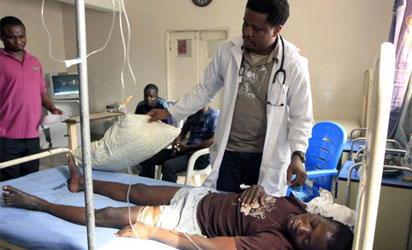
This is why the recent news that the leadership of the Nigerian Medical Association refused to call off the strike of medical doctors even in the wake of the Ebola outbreak was very distressing.
The fact that not one dissenting voice reportedly came up among the Executive was most upsetting. Their decision to continue with the strike was unanimous although prior to this, their President, Kayode Obembe, had resigned following disagreement with his colleagues over the strike.
Where is their passion? Their compassion? What makes them get up in the morning to go to work? Is it only the pay cheque? I couldn’t imagine doing a job that I had no passion for.
It is true that a lot is wrong with the Nigerian structure. A structure that allows a Local Government official to earn more than a University professor is dysfunctional. A structure that allocates so much of the commonwealth to the political class is doomed to fail.
But I am resolved on my part to do my bit to make humanity better. The fact that the Jonathans, the Marks, the Tinubus and the like will not take their money to heaven gives me comfort.
This is why it is confounding that professional doctors will ignore a clarion call to serve humanity on the grounds that the government is not serious. Members of ‘Doctors without borders’ are risking their lives because of the passion for the jobs not minding the working conditions or the pay cheque. Foreign care givers who come from more equitable societies are here risking their lives because of compassion.
It would make more sense if the doctors suspended their strike in order to contain the epidemic —which by the way, can strike closer home than they realize— and resumed their agitations thereafter. They all swore to an oath; the Hippocratic Oath to save lives.
This strike in the face of an epidemic is a direct violation of the oath, of everything that is decent. Only mercenaries show no compassion to any humanitarian cause. And if they continue this strike rather than help contain the looming epidemic in the country, then they are not better than mercenaries.
In fact, I think they are subhuman.
Dr Ukpabi Asika was the Administrator for the East Central State, not the South Eastern State as this column stated last week. I thank the numerous writers who pointed it out.
Disclaimer
Comments expressed here do not reflect the opinions of Vanguard newspapers or any employee thereof.