
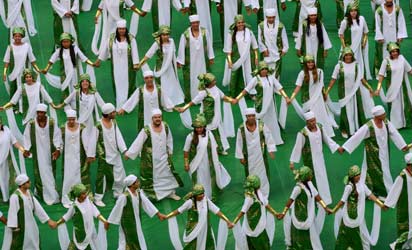
Artists representing Nigeria perform during the opening ceremony of the FIFA Confederations Cup Brazil 2013, held before the Group A football match between Brazil and Japan, at the National Stadium in Brasilia on June 15, 2013. AFP PHOTO /
By Douglas Anele
Ordinarily and in our daily transactions, truth is not a difficult concept to understand, because most people operate implicitly and explicitly with the correspondence theory of truth, according to which truth is the correspondence of beliefs and propositions with reality.
However, in the arcane world of philosophy, things are not so simple, given that there are other theories of truth with differing degrees of plausibility and the fact that the correspondence theory itself is not easy to define precisely. For example, Aristotle’s classical definition, which defines truth as the saying “of what is that it is not, or of what is not that it is, is false, while to say of what is that it is, and of what is not that it is not, is true,” is perfectly correct from the layman’s point of view.
The main problem now is that, outside the domain of empirical matters of fact, it is difficult to articulate satisfactorily how logical and mathematical truths can be conceived as correspondence with facts. Alfred Tarski, a mathematical logician, posited a technical version of the correspondence theory called the semantic theory of truth.
But there is consensus among logicians that the semantic theory is suitable for the formal languages of logic and mathematics, because unlike them each natural language has its own metalanguage for making assertions about the truth values of propositions formulated in it. Inspite of the issues raised by philosophers with respect to the idea of truth as correspondence with facts or reality, we shall assume its correctness in this discourse, because it seems to be the most plausible notion of truth available at the moment.
Reason involves the ability to draw conclusion from given premises, the capacity to weigh evidence dispassionately and arrive at a satisfactory judgement concerning any issue. Therefore, to be reasonable is to act in a fair and sensible manner, to take into account available evidence before reaching appropriate conclusion. A person who is ignorant, excessively emotional and myopic in outlook would hardly be reasonable, since reasonableness requires knowledge, objectivity and an expansive philosophy of life or worldview.
Nation building is a complex activity which requires that a group of people united by geopolitical, socio-cultural, linguistic and historical ties work together to construct an independent nation-state alongside other countries. The factors that lead to the rise and decline of nations are incredibly complex. At any rate, nations evolve or are created to provide security, well-being and conducive environment for the citizens to actualise their potentialities. Sometimes nations are created by powerful countries for the purpose of economic exploitation.
Yet, notwithstanding the manner in which particular nations came into being, in every nation the leaders have a responsibility to harness the human and natural resources there for the benefit of all. On the other hand, the followers are duty-bound to complement the efforts of leaders through hard work, loyalty and patriotism. The prospects of progressive nation building are enhanced considerably if the leaders and rest of the citizenry work harmoniously.
Conversely, if the leadership is corrupt, incompetent, nepotic, unpatriotic and insensitive to the yearnings and aspirations of the people, the country declines. Nation building which entails construction of a strong, viable, united and egalitarian society is a work-in-progress that has no natural end, because the possibilities are virtually infinite and each generation must decide, on the basis of present circumstance and future aspirations, the kind of society they want to be build.
Nigeria as a geopolitical entity is a British creation for the interest of her imperial designs in Africa. Before her emergence in 1914, the various ethnic nationalities and culture-areas that make up the country has existed as independent states with different political structures for thousands of years.
The colonial masters forged a modern geopolitical entity out of the numerous indigenous peoples on the foundation of existing geographical, cultural, historical and commercial unities among them. Thus, in a sense, the creation of Nigeria could be interpreted as the exploitation by British imperialists of existing connections between local communities to bolster the economic interests of Britain and simultaneously reduce administrative costs. It is in this context that one should understand the colonial policies of Britain in Nigeria after amalgamation.
Like every colonial power obsessed with exploitation of the colonised, British colonial administrators formulated and implemented policies that favoured its exploitative agenda without any concern for the exploited. Hence, in Nigeria, for example, Lord Lugard and his successors bent over backwards to appease Northern Nigeria and turned a blind eye to actions which sowed the seeds of ethnic discord and imbalance that have continued to jeopardise national unity in Nigeria up to now.
A few examples would suffice to substantiate our claim. When the British administration made its intention about amalgamation of the North and South public, prominent Northern leaders were unequivocal in their opposition to it. To placate them, Lugard implemented the famous (or, more accurately, infamous) Indirect Rule programme so that, in his own words, “to cause the minimum of administrative disturbance.” Lugard and his cohorts allowed local rulers in the North to implement what in reality amounted to an apartheid system
. All Southerners were herded into sabon garis, or “strangers quarters,” a sort of ghetto outside the walled towns. As Frederick Forsyth remarked, “schooling was segregated, and two radically different societies coexisted without any attempt by the British to urge gradual integration.” In 1944-45, when the Richards Constitution was about to be introduced, the North accepted to go along with amalgamation on condition that (1) the principle of separate regional development should be enshrined in the new constitution, and (2) the North should have about fifty percent of the seats in the legislature.
Indeed, before independence, Northern leaders were overwhelmingly opposed to the unification of Northern and Southern Protectorates. During the various regional conferences put together by Sir John Macpherson in 1949, delegates from the region demanded about fifty per cent of the representation in the central government. In addition, at the General Conference in Ibadan, January 1950, the Emirs of Zaria and Katsina insisted that unless Northern region is allotted half of the seat in the federal legislature, it will seek secession from Nigeria, based on the structure that existed before 1914.
The North demanded the loosest possible form of federation for Nigeria in line with its political philosophy of separateness from other parts of the country, and did not hide its conviction that the amalgamation was an error. It must observed that the region got all its demands mentioned above; its leaders had learned that Northern Nigeria could get its way politically by threatening to pull out of Nigeria.
TO BE CONTINUED.
Disclaimer
Comments expressed here do not reflect the opinions of Vanguard newspapers or any employee thereof.