
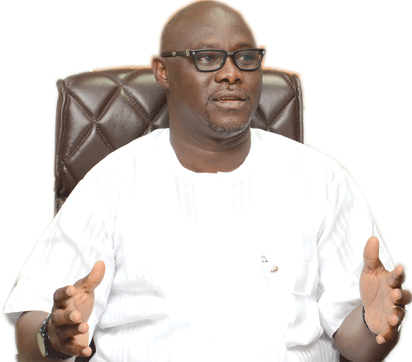
Lai Labode, CEO, Salt & Einstein
By Adekunle Adekoya
Lai Labode is CEO of Salt & Einstein MTS, a mobile transaction switch and business aggregator representing a single mobile financial platform that facilitates businesses of all sorts. Educated in various parts of the country, Labode, an accounting graduate of the University of Abuja with higher degrees from the University of Liverpool and Harvard Business School, had worked with Banking Limited, MoneyBox Africa, before going into private consulting. Salt & Einstein parades giants on its board, including Engr. Ernest Ndukwe, former EVC of NCC who is the company’s chairman. In the interview below, Labode defines what an aggregator is, and enunciates what his company is about in the Nigerian business firmament. Excerpts:
In your own words, what is the firm called Salt & Einstein all about?
I would say we are aggregators. An aggregator is a firm that is able to bring two different parties together to achieve the same purpose, and we are Africa’s first mobile financial service aggregator. It means that we have established a single platform that all mobile financial service providers can fit on and provide service to all of Nigeria and we have done this based on the experience garnered over the years.

Lai Labode, CEO, Salt & Einstein
When GSM came to Nigeria, we had initiated what we call airtime exchange and we projected into the future that for an economy where seventy per cent of the economy is in the informal sector, what are the things we can do with this mobile telephone? So I wrote a business model called airtime exchange, because there was a concept growing — people were already sending airtime from Abuja to Lagos, the receiver will take it and sell and it becomes cash. We didn’t create that, people started to do it on their own. It means there were some needs and people started to do that to satisfy that need. So we thought of creating something in the culture that was already growing.
In an economy like Nigeria, where over 70 per cent of cash flow is in the informal sector, there is need to develop a business model that will address the issue. We have been in the mobile money space for some time now and have discovered that there is so much concentration of people at the bottom of the pyramid, which of course shows the elitist nature of our mobile money sector.
If we truly want to be successful as a nation, and integrate the informal sector with the formal sector, then we need to create models that will touch their lives positively. We have also discovered that there is a lot of emphasis on technology, whereas it is not technology that is the issue, but the business model that is driving the entire process. Today, MPESA in Kenya is successful because of the business model it has deployed that is actually driving the technology.
You recently facilitated a deal between MTN, a telco, and the National Health Insurance Scheme (NHIS), to promote healthcare service delivery to millions of Nigerians via the mobile phones. Can you elucidate?
The mobile healthcare service initiative is of immense benefit to telecoms subscribers in Nigeria and to telecoms service providers as well. Health is wealth and most times people die with their ill-health either as a result of ignorance or poverty. The initiative therefore brings service providers in the health sector, especially the Health Management Organizations (HMOs) and the telecoms service providers, on a single online platform that is accessible to all Nigerians. Healthcare services will be provided on that platform, and all telecoms subscribers that register on the platform, will receive medical advice and attention, via their mobile phones.
With their mobile phones, they could communicate with any HMO of their choice and get best medical service at affordable cost. This initiative is new and not limited to telecoms operators and NHIS. It is open to all service providers from different sectors of the economy, using a single platform to provide services to Nigerians. As an aggregator, we facilitated the initiative between MTN and NHIS, which was launched in Lagos few weeks ago, and our platform is open to all sectors of the economy.
You have been talking about NHIS and health insurance. Are you working with other insurance firms?
Yes, we are doing that, we already have about eight insurance companies already lined up for general mobile insurance that will be launched shortly, we are also in talks with NAICOM (National Insurance Commission). By the time we bring in more insurance companies on board, the bouquet of services will increase and customers will have varieties of choice to make as to which company they want to deal with, and again, the cost of delivering the services will be reduced.
That means your platform is available to other sectors of the economy as well, not just health insurance?
Having realised the need for a single platform that will accommodate several service providers, we decided to come up with a business model that can accommodate industry multiple solutions that should connect the common man. What we did was to look at the entire value chain and came up with business solutions that will address every sector, comprising the regulator, the players and the various ecosystem that will make it happen and that is why our multipurpose single platform can accommodate all manners of businesses, like health insurance, tax collection and revenue generation for their organizations. This is exactly what led to the partnership deal between MTN and NHIS.
There are issues of cybersecurity since the bulk of your operations will be in cyberspace. What measures have you put in place?
Technology has gone beyond regulation and the technology we have in place has addressed all envisaged cybersecurity issues, but there is room for flexibility and change when the need arises. One, we know the service providers, because it is a platform, however, for the data security for each of the parties, that is protected by the technology put in place which is good enough, though it has been a very rigorous one and in terms of the legal framework, work is going on
How would the payment system be managed?
This is going to be pretty easy since people can pay through their mobile phones or through airtime transfer, where the customer buys a recharge card, loads it and transfers the money via his or her personal identification number. We are going to issue Nigerians digital identity cards that will have unique NHIS numbers from birth to death. With this system in place, the NHIS will be able to develop a database for all customers who deal with any HMO that is registered on the platform, such that every transaction carried out between customers and their HMOs, automatically gets to NHIS, through the database. The advantage of this is that customers will be able to make complaints of shabby treatment meted by any HMO or from any hospital, directly to NHIS, via the mobile phone and the issue will be addressed promptly.
You started with MTN on the mobile healthcare scheme, what is the possibility of other telecoms operators becoming part of the system, if they so desire it?
The platform is a general platform that is open to all and can accommodate as many operators from different sectors of the economy that so desire to belong. We started first with MTN because we see it as the biggest GSM operator in the country by subscriber number and we felt that should we begin with MTN, more customers will have the opportunity to benefit from the plan. The platform is therefore open to all operators and we are currently discussing with them and will soon sign some of them onto the platform because it is going to be a massive project, connecting people and touching the lives of millions of people from different sectors of the economy.
Do you have specific software application that customers can download to have access to the service?
Absolutely, we do have. The beauty of it all is that it is an initiative that is the biggest and first of its kind in Nigeria. Our software application enables operators to reach out to more that 120 million people with ease, and people can download the application on their mobile phones and use it to do all kinds of transactions.
Disclaimer
Comments expressed here do not reflect the opinions of Vanguard newspapers or any employee thereof.