
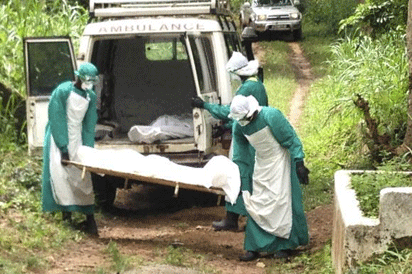
Health workers evacuating the remains of an Ebola Virus Disease victim.
By Obi Nwakanma
I was on my way to Kigali in 1994, to report the brewing troubles in Rwanda, when the Ebola fever epidemic broke out in Zaire. Travelers were quarantined in the Kinshasha International Airport. All connecting flights to Kigali were cancelled. I contemplated the possibility of an Air Afrique flight to Arusha, in Tanzania, and from thence by car to Kigali.
It all became a logistical nightmare and my editor at the Sunday Vanguard, the affable Fola Arogundade, had no choice but to recall me from the assignment, and in his words, “when Ebola blows over, then we’ll think about it again.” The genocides had not started, but there was a clear trouble in the air. I had smelled its thunder from very far away, and I wanted to be one of the few African journalists to report on the ground from Rwanda. In fact, I had been given a very kind letter of introduction by the late Ambassador Segun Olusola, to a colleague of his, a former Rwandan Ambassador to the OAU, with whom he recommended I should to stay.
“He has a beautiful house up in the hills in Kigali” Ambassador Olusola had told me. As it transpired, fate conspired against that trip: the Ebola outbreak stopped me, and as it also happened, the genocide broke out within the week. In a rather cruel twist of fate, Ambassador Olusola’s friend, with whom I was to stay, with his entire family was massacred in their beautiful house up the hills. Who knows, but for that Ebola outbreak, and the logistical difficulties it caused, I may have been a victim of the genocide too. I do not mean to thank Ebola, nonetheless. I mean to note that the prospect of Ebola coming to Nigeria seemed far too distant and impossible.
Ebola was something that happened in far-removed places. But we now just have to brace up to our brave new world that has become more intimate and linked by quicker modes of travel and faster communication that makes communicable diseases and epidemics easier to spread. Which is how the Liberian-American, Sawyer, became the conscious human dirty-bomb that exploded on Nigerian shores bringing with him the frightful Ebola disease to Nigeria and the prospects of a germ apocalypse. The first point is that Sawyer caught Nigeria’s national security and surveillance capacity napping. Public health is a national security issue, as is Agriculture and environmental security. The health of a nation is at the core of its productive capacity and sovereignty. Food security is the ability to determine and control a nation’s food cycle, and to be certain that no foreignorganism is introduced by extraordinary methods into the food culture as a means of controlling its production and nutritional benefits.
But I’m not quite certain that these facts have registered in the minds of the Nigerian intelligence and security elite, who still think of national security in the narrow terms of providing armed guards on streets, and sentries around men of power to create the illusion of safety. But God himself will not save them from germs that break through molecular perimeters or the nano gates of biologically engineered systems. Thus far, the Federaland the Lagos state government have taken good, but limited containment initiatives to the deal with the spread of Ebola following the deaths from the initial contacts. But we must think in broad and longer terms. Luckily, the president is a trained research scientist, and his Foreign Minister, Dr. Onwuliri, is a first class Parasitologist. They should understand the imperative I outline here.
If I were President Jonathan, I would assemble a high-powered Presidential Scientific Commission on the Pandemic, at the head of which would be two of Nigeria’s leading scientists, Dr. Tam David-West and Oye Tomori. Tam David-West? Well, before anything else, he is a highly experience, Yale-trained virologist.
This commission should be charged with dealing with the current Ebola situation, including the search for remedies. Nigeria should rebuild, re-equip, update, re-staff, and re-orient its key National Research Laboratories at Vom, Yaba, etc, and establish three new National Laboratories in Kano, Benin and Owerri, and link them to joint collaborative efforts with the universities to study extant and new germs and diseases that threaten human survival, particularly in the tropics. Indeed, President Jonathan should as a matter of urgency, and as part of his legacy, lead the effort to establish a West African Center for Disease Control and Analysis (WACDCA) modelled after the Atlanta based CDC, but as a joint West African regional collaboration. The Nigerian government has the resources, but it needs to think quickly outside the box… .
AND FINALLY, EUGENE AKALEFU ONU (1940-2014):
A POSTCRIPT…
My uncle, Eugene, was an Engineer and a businessman. In neither did he make astonishing gains. He was not a famous Nigerian. But he was a solid pillar of his community both in Lagos and his ancestral home. They elected him Eze of his community. He was a reluctant monarch; and it was no surprise to me and those who knew him that when the politics of it all led to violence and even loss of life; it turned his stomach, and he quietly turned his back at it all. He was not a man seduced by power. He did not thrive in the limelight. He sought meaning in the spiritual and philosophical things. He was a firm Christian, and like his father before him, a knight of the CatholicChurch. When I came to Lagos after National service in 1989/90, he gave me a room upstairs in his home in Festac Town, and buffered me from the harsher realities of life in Lagos.
Yesterday, we handed back his mortal remains to the earth our goddess. It is a deep and personal loss to me. He died from complications resulting from a stroke. He had driven himself to hospital, I understand, for a routine check-up and suffered a stroke in a hospital! Where does that happen? I feel that his death in an Abuja hospital was the result of very poor medical practices in Nigeria, even though he must have received what may be the relative best, his sons being doctors and his daughter a Pharmacist and all. But that is another story. I think that we must, as a society, begin to pay new serious attention to the practice of medicine in Nigeria. We need to reconsider the general concept of public health delivery, and the ethical requirements in the training and practices of Medical services personnel, in the public and private health systems. There has to be a bill in the National Assembly to give victims the rights to sue a doctor and a medical institution in the event of possible malpractices, and make them accountable for the quality of care Nigerians receive in their hospitals.
This is the twenty-first century. But Nigerian medicine is still trapped in the past. Nonetheless, I ask you kind reader, to keep us all, who are bereaved in the light. It is not death that haunts, but the pointlessness of it; even then I subscribe to these words by Epicurus in his “Letter to Menoeceus”: “Death therefore, the most awful of evils, is nothing to us, seeing that, when we are death is not come, when death is come, we are not.”
Disclaimer
Comments expressed here do not reflect the opinions of Vanguard newspapers or any employee thereof.