
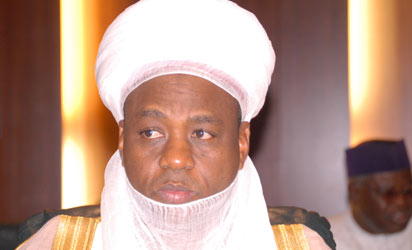
Sultan of Sokoto, Alhaji Muhammad Sa’ad Abubakar III
By Bashir Adefaka
Every community has its eventful time. There is the time for the new yam festival and another to celebrate love. The time for the Nigerian Muslim community, headed by the Sultan of Sokoto, Alhaji Muhammadu Sa ad Abubakar III, is mainly that which sets the eyes of Muslims in the country on a particular side of the sky in search of the new moon heralding the beginning of Ramadan fast. That did take place at the tail end of June.

Sultan, others praying
Every month of Islamic calendar is 29. It is counted up to 30 when the new moon of an incoming month is not sighted on the night ending the 29th of the outgoing month. There are some of the months particularly four in the Lunar Calendar which are attached with certain worships some of which are obligatory while others sunnah, for example: Ramadan and Dhul Hijjah, obligatory.
The significance of Ramadan based on the strong command of Allah as stated in Qur an Suraat Baqarah chapter two from verse 183 has continued to require that leadership of Muslims in any given country takes the sighting of the moon heralding it as a serious responsibility. Realizing the moral, spiritual and political implications of the handling of this task, the Sultan becomes restless until it is properly done; not only to satisfy the requirements of Allah as laid down in the rules of Islam but also to do it in such a way that fosters unity and love among the over 70 million members of the Nigerian Muslim community.
It therefore cannot be surprising why the Sariki Mumunin of Nigeria could not take his dinner that Friday, June 27, due to the tasking activities of the moonsighting.
Arriving palace at Jumat time
I had arrived Sokoto via the Sultan Siddique Abubakar III International Airport at the time of Jumat Service. I was taken into the Sultan s entourage as we walked out of the palatial but moderately constructed palace to the Central Mosque, which is just a stone throw away on the very long Sultan Abubakar Road. Clad in white regalia with a pair of white half-shoes to match, the retired general, who held on to his usual tesbiyy (rosary), walked majestically under the royal umbrella escorted and flanked on all sides by palace chiefs and staff amidst traditional encomiums laden with royal fluting, prayed and returned to the palace at about 2pm.
Shortly after the return to the palace, he sent for me to join him for lunch. There were about 44 others including ‘the high and the low’ ostensibly from his immediate environment, who partook in the lunch of assorted meals. Out of the people sitting with him in that meal time, I was programmed to sit six to him on the right side. I had never been so honoured as, unlike years back, His Eminence the Sultan caused them to serve me and only four others sitting to his right from the two-coloured juice drink he was having, where was contained in two jugs.
But one of the officials, noticing my disbelief at such exceptional royal treatment, fitted me into it, saying, Do not be surprised. His Eminence is not what you think. He is more down to earth than you think; so humble and hardly does he eat alone and I doubt that it ever happened. You just sit down but do not fold you legs the way he does (and he described how to sit before the Sultan to which I complied).
After eating there was a humorous elderly Mallam, who gave a participatory talk, a little of sermon, a little of entertainment. This talk, which made the moment of lunch with the Sultan so lively, appeared to be traditional because after each meal, it seems there is a system in place which keeps reminding the person of the Sultan that world itself is but for a short time and that the outcome in the sight of Allah would depend on how one spends the many opportunities he has while living in it.
This is how His Eminence spends his days especially when he is in town. He performs ablution five times daily and follows that up with the obligatory prayers, Subhi, Zuhr, Asri, Magrib and Ishai. Prophet Muhammad, peace be upon him, said, If somebody has a stream behind his house and he goes there to bath five times a day with the last bath taking place at the time he is about to retire to bed, will he have any stain on him for that day?
The Sultan has been able to live a simple but frank lifestyle because he is guided by the deen (religion) every moment of his day, Hali Maccido, Assistant Private Secretary to the Sultan had said, adding that, that was how the Sariki achieved his humility.
The challenges of moonsighting announcement
The month of Ramadan is a period which places much task on the shoulders of the leader, who concurrently runs the offices of the Sultan of Sokoto and President-General of the Nigerian Supreme Council for Islamic Affairs, NSCIA, Alhaji Muhammad Sa ad Abubakar III.
For four years, the Sultan had brought his wealth of experience as a prince, retired General, Islamic scholar and now a monarch to bear in the alignments and re-alignments process that have taken place, which now put the Nigerian Muslim Community together as truly one brotherhood under one leadership that he epitomizes. That quality-based leadership that he represents came, more, to the fore in his matured way of handling the new moonsighting announcement heralding the last 1435 Ramadan fasting.
Asked about some hitches as few Muslims in the country claimed non-sighting of the new moon by Saudi Arabia, United Arab Emirate and North America, Sultan Abubakar III said Islam had united Muslims in the matter of Ramadan fast but that Saudi Arabia would have been his choice as guide.
If you ask me, I would say we should follow Saudi Arabia in the matter of moon-sighting being that it is the home of Islam in the world and it determines the month and day of Hajj and Arafat. But this is Islam and the religion has laid down rules that guide how Muslims should practise it. Even Saudi Arabia had declared new moonsighting, about three times, and they were wrong. They then said later that people should fast one day to pay back.
I think the issue of yesterday (Friday June 27, 2014) bordered on miscommunication and by the time the information came, which was already later than we had expected, we had to start the process afresh which led the committee that had earlier closed process to re-sitting, screening and, thereafter, I asked the Chairman of the National Moon Sighting Committee, Professor Sambo Wali, to brief the press.
That was how a man considered internationally to be the fourth most influential monarch on the African continent handled and saved Nigeria from what could have punctured the four years achievement of unity and cross-regional peace and love among the Muslims that he leads.
Night time in Sokoto during Ramadan
Sokoto streets remained lively till Sahoor (time of midnight meal) as people especially youths walked round in their respective environments.
Some played football, others secluded in corners doing no more or less than reciting the Qur an in the melodious tones thereby making whoever walked past and was of clean mind feel safe.
They remain awake that way until Sahoor when they now go to eat, go from there to mosque and then go to bed. That is why during this Ramadan period, the streets of Sokoto looks scanty in the early hours of the day, said Alhaji Attahiru Hussein, Secretary to the Sultanate, who took me round in his car at about 1.30am.
Message to the nation
Alhaji Sa’ad Abubakar III had three major messages to pass across and they were, one, to the Muslims, two to the government and three to the generality of the people of Nigeria. In the almost an hour talk, which he gave exclusively to Sunday Vanguard, he wanted the Nigerian Muslims to know that this year moonsighting announcement, which heralded the commencement of Ramadan fast, though was not without hitches as it came at midnight but that, it was a little unusual development that should not cause disaffection among the adherents of Islam in the country.
Abubakar III regretted that the late announcement, which resulted from miscommunication by people that sighted the moon, had dragged the Ummah back to square one because, according to him, Muslims in the North and South of Nigeria had moonsighting announcement not later than NTA network news period in the last four years. However, he said, all that had happened pointed to the fact that Muslim leaders in Nigeria would need to sit down and decide which means to use in determining the beginning of fast.
To the government, His Eminence wants the leadership of the country to continue to take the issue of justice as paramount, noting that justice has a way of easily resolving many problems in any given society. The Sariki, who apparently avoided to speak on political issues, said the insecurity ravaging the lives of Nigerian people would come to an end but that Nigerians should move closer to God restricting acting based on the dictates of their respective books of faith.
Disclaimer
Comments expressed here do not reflect the opinions of Vanguard newspapers or any employee thereof.