
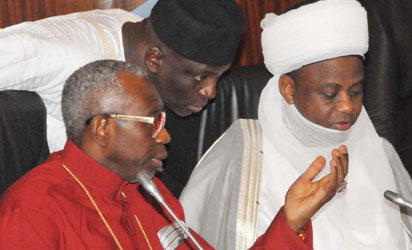
From left: Co-Chairman, Nigeria Inter-religious Council (Nirec), Pastor Ayo Oritsejafor; National Co-ordinator/executive Secretary, Prof. Is-haq Oloyede, and Co-Chairman, Sultan of Sokoto, Alhaji Sa’ad Abubakar III, at a meeting of NIREC with President Goodluck Jonathan in Abuja. NAN Photo
By Douglas Anele
Nigerians are among the most religious people in the world. But most of them hardly spend time to reflect on the origin and nature of religious worship. Moreover, they accept the doctrines of Christianity and Islam uncritically, and hardly deviate from the religions of their parents or of the society to which they belong. Given the recurrent problem of religious intolerance and recrudescence of fundamentalist violence in Nigeria and in different parts of the world presently, it is important that believers should periodically reflect on the essence of their faiths. This is because such reflection can lead to better understanding of the purpose of religion as a means of attaining spiritual enlightenment leading to a better practice of life. To trigger the much-needed reflection is the major objective of this paper.
Now, the ubiquity of religion globally probably indicates a deep-seated need for self-transcendence, for reaching “towards the beyond,” in human beings. Similarly, archaeological discoveries in different parts of the world establish that pre-historic humans engaged in religion. It follows that religion is an important aspect of human existence on earth, because it ministers to some basic human psychological and spiritual needs. At any rate, despite the antiquity of religion, scholars are still debating fundamental issues connected to human proclivity to worship a transcendental creator of the universe believed to exist. For example, questions about the meaning, origin and nature of religion are yet to be settled, just as the ontological status of the beings postulated by different religions and epistemological queries with respect to religious claims continue to generate controversies in academic circles.
Like most words that denote a complex phenomenon or complicated human practice, theologians, philosophers and other scholars interested in the subject have defined ‘religion’ in various ways. Sometimes, religion is defined as whatever anybody believes in strongly, with the implication that everybody has a religion, because each person has entrenched beliefs. Such a reductionist definition of religion is unacceptable. As J.I. Omoregbe correctly points out, it would mean that atheists and agnostics have their own religion, since they strongly believe that God does not exist or that evidence either for the existence or nonexistence God is inconclusive, a conclusion that is at odds with the dogmatic nature of religion.
Another erroneous conception of religion equates it with morality. According to proponents of this view, morality is inseparable from religion; morality cannot exist without religion. However, the fact that religions embody some moral teachings does not entail the inseparability of religion and morality. This follows from the fact that there are atheists and agnostics of high moral quality who profess no religion, and countless believers of low moral worth. Indeed, religion needs morality, and not the other way round. Of course, adherence to a particular religion can induce one to live a morally upright life. Yet, a non-believer can be highly moral based on philosophical, secular and humanistic considerations.
A useful approach to the problem of defining religion is by analysing the etymological roots of the word itself. ‘Religion,’ according to Omoregbe, evolved from three Latin words, namely, ligare (to bind), relegere (to unite or link), and religio, (rendered in English as ‘relationship’). Omoregbe argues, from the foregoing, that religion indicates a relationship between at least two persons, which are the human person and the divine person or God who is believed to exist. Thus, religion links human beings to a divine transcendent spiritual being. In the relationship, God or the Supreme Being is the originator and sustainer of the universe and all its contents, including humans, whereas it is the duty of believers to worship the Supreme Being.
Monotheism, belief in one God, evolved at different times in different communities. There is good evidence that polytheism, the belief in more than one God, antedated monotheism. Now, polytheism is declining steadily globally: more than half of the world’s population are Christians and Muslims, which are monotheistic in nature, although the concept of trinity complicates the picture of God in Christianity. Traditional African religions embody what might be called diffuse or soft monotheism, in the sense that the Supreme Being is considered so remote from human beings that it has to be propitiated through intermediaries or lesser Gods and Goddesses.

From left: Co-Chairman, Nigeria Inter-religious Council (Nirec), Pastor Ayo Oritsejafor; National Co-ordinator/executive Secretary, Prof. Is-haq Oloyede, and Co-Chairman, Sultan of Sokoto, Alhaji Sa’ad Abubakar III, at a meeting of NIREC with President Goodluck Jonathan in Abuja. NAN Photo
It must be remarked that, although majority of the religions practiced by human beings since the dawn of civilisation contain belief in God or lesser deities as an article of faith, the original version of Buddhism founded by Siddhartha Gautama was fundamentally atheistic. This contradicts the theory that belief in God is a basic requirement in religion; it also indicates that such a belief is neither a necessary nor a sufficient condition for categorising systems of beliefs and practices as a religion.
At the barest minimum, any system of beliefs can be called a religion if it postulates a non-empirical transcendental world or state of being generally considered superior in some sense to what obtains in this life. It must also involve belief in afterlife and special modes of behaviour and practices, including prayers and worship, that help believers tap into the supernatural realm and gain access to the transcendental state we alluded to earlier especially after death. Hence, virtually every religion contains an eschatology or doctrine of the final or last events, particularly in the purported afterlife.
Differences in religious beliefs and observances stem from the incredible mix of contingent socio-cultural, historical, geographical, economic, political and biographical factors that determine their form and content. Yet, despite these differences, there are similarities that unite them and justify classifying them as ‘religion.’ That is why scholars have sought to penetrate the surface and probe deep to uncover what might be called the essence of religion.
Of the numerous theories on the origin and purpose of religion, six of them are predominant. The first one we shall consider is the anthropological theory posited by Ludwig Feuerbach in his book, The Essence of Christianity. According to the theory, religion is nothing other than the worship of human nature. God is the projection of everything of value in human nature. Feuerbach argues that In the process of inventing the idea of God, human beings alienate themselves from their very nature. All the divine qualities attributed to the divine being are human qualities projected into an imaginary being called God. Hence, “the yearning of man after something above himself is nothing else than the longing after the perfect type of his nature, the yearning to be free … from the limits and defects of his individuality.” The Christian doctrine of Incarnation, in which God became man (Jesus) so that man might become God, agrees with Feuerbach’s anthropological theory.
To a large extent, Feuerbach is correct in that all the qualities ascribed to God are usually the superlative of positive attributes of humans – wisdom, intelligence, justice, mercy, justice, power, creativity etc. The main problem with Feuerbach’s theory is that it concentrates too much on the idea of God and paid little attention to other important features of religion that cannot be easily explained as projections of human nature.
TO BE CONTINUED.
Disclaimer
Comments expressed here do not reflect the opinions of Vanguard newspapers or any employee thereof.