
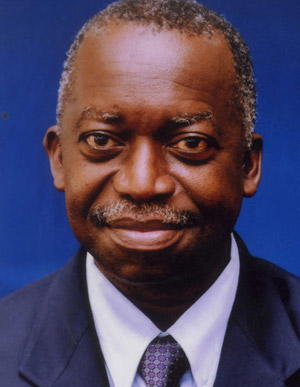
Prof Sofoluwe, VC, UNILAG
By Douglas Anele
On a certain occasion, I went to the Staff Club to have lunch with my bosom friend and confidant, Chief Ralph Obiduba. As we sat down waiting to be served, Prof. Sofoluwe walked in with Prof. Longe and others. After exchanging pleasantries with people around, he came to where I sat and asked the waiter closest to him to give my friend whatever drink he wanted.

Late Prof. Adetokunbo Sofoluwe
When I mildly protested, he smiled and said, “Oyinbo man, you are not working hard enough. I will buy you a drink after doing what I asked you to do.” About twenty minutes later, the waiter placed a chilled bottle of Star lager in front of me and said “from the VC.”
Readers may wonder what Prof. Sofoluwe wanted me to do that I had not done to warrant his friendly rebuke. Now, for quite some time, the late VC had been encouraging me to publish enough papers so that I would be appointed Professor during his tenure, because he felt that although my academic brilliance was beyond dispute, I was not paying adequate attention to research.
Before he died on May 12, 2012, the task was completed. Sadly, however, he was not around to witness the fulfilment of his wish for me. From his untimely demise, I learnt the useful lesson that given the temporal unpredictability of death, we should not procrastinate or postpone what we can do today until tomorrow.
Prof. Sofoluwe was a religious man. Occasionally, we usually argued about Christianity – in fact, he wanted me to be a Christian. As a confirmed unbeliever, I disagreed with his uncritical acceptance of biblical doctrines. I always reminded him that The Holy Bible is riddled with mythologies and contradictions such that literal interpretation of its contents is absurd and misleading.
Whenever I tried to demonstrate the untenability of Christian beliefs, Prof. Sofoluwe would reiterate the biblical story of Saul who later converted to Paul. He would end by saying, “Oyinbo, God will arrest you one day.”
During the fiftieth anniversary celebration of the founding of the University of Lagos, the late VC ensured that religion featured prominently in the event. I remember vividly an encounter in his office, a few days before the night vigil service by the Redeemed Christian Church of God (RCCG) at the university’s Sports Centre.
I had gone to see him for discretionary admission into the diploma programme of the university. He teased me by saying that he would grant my request on condition that I attend the night vigil. I politely rejected the condition. With a smile, he promised to look into my request, but insisted that I should attend the programme.
I was adamant: I just did not see any rationale or benefit in forfeiting several hours of sleep to listen to the noisy insipidities and inanities of well-fed, well-clad and prosperity-intoxicated pastors. Moreover, contemporary Pentecostal Christianity, given its obsession with bulimic materialism, instantaneous miracles and showy religiosity, has deviated from what I consider the true mission of religion, that is, to serve as a tool in the disciplined quest for spiritual enlightenment.
Upon noticing my unwillingness to accept his invitation, Prof. Sofoluwe suggested that my refusal was because I was afraid that the Holy Ghost would convert me back to Christianity. His strategy worked: in order to prove him wrong, I accepted to attend the night vigil.
At the event, I sat in the front row so that the late VC would see me. After about an hour, when one of the officiating pastors started asking for offerings either in cash or by cheque, I left. Of course, I am still an unbeliever: the Holy Ghost could not even make me stay until the end of the programme, let alone convert me!
Like every human being, Prof. Sofoluwe is imperfect.
I am sure that some people exploited his generosity of spirit and approachability to gain unfair advantage within the university system. There are allegations that during his Vice Chancellorship, appointments and promotions in the university were not always based on merit. Again, his informal and somewhat light-hearted approach to issues sometimes creates the erroneous impression of unseriousness.
That said, there is no doubt Prof. Sofoluwe was dedicated to his job. Given severe constraints in the Nigerian university system generally, and in the University of Lagos particularly, a plausible case can be made that he tried his best to transform great UNILAG into the “university of first choice and the nation’s pride.”
To underscore this, shortly after his appointment as VC, Prof. Sofoluwe produced “The Blue Book,” a small pamphlet which contains explicit statement of his mission and programme of action intended to revolutionise teaching, learning, research, infrastructure, and every other aspect of life within the university community.
A committed team player, he worked tirelessly to promote harmonious working relationship between his administration and the major trade unions in the university. Prof. Sofoluwe was cordial to students, and had an uncanny ability to discern when it is necessary to adhere strictly to laid-down procedures and when it is appropriate to cut through the red tape of university bureaucracy and get things done as expeditiously as possible.
Obviously, Prof. Sofoluwe has played his part and gone forever. The proclamation by one of the officiating pastors during the funeral service that the late VC now rests in the bosom of Jesus Christ is based on the fiction invented by the early Christians to make the absolute inexorability of death endurable.
But belief in hell and heaven, in immortality, is a cowardly attempt to compensate for the utter irreversibility of death, an article of faith quite unworthy of mature and sensitive minds fully aware of the uniqueness, preciousness, and perishability of individual human life.
It ought to be replaced with a deep understanding of the fundamental uniqueness and precariousness of our existence, which tends to foster determination to live humanely and productively, since it serves as a constant reminder that this life is all there is and, therefore, it must be lived to the fullest, especially in the service of others.
In that regard, the pertinent question for us who knew Prof. Sofoluwe personally and worked with him is, what are the appropriate lessons from his life? In my view, the most enduring lesson is that humility and graciousness are extremely important qualities irrespective of one’s status and position without which our humanity is diminished.
As I said earlier, the late VC was a very humble and humane person who demystified the elevated position of Vice Chancellorship. His combination of humility, kindness and concern for the welfare of others is one of the characteristics of people with high emotional intelligence. That is why, despite his mistakes, even his critics acknowledge that he was a good man.
The best we can do to honour his memory is to preserve his legacy by cultivating those qualities that made him admirable and ensuring that those after us imbibe them as well. Incidentally, that is the only way Prof. Sofoluwe could live on after death.
CONCLUDED.
Disclaimer
Comments expressed here do not reflect the opinions of Vanguard newspapers or any employee thereof.